analysis
Getty Images, PA
50%
17%
1.5m
women on uk boards
women in senior management
women as business owners
wealthy women
useful sites
self-employed women
women’s pay
women: the stats and facts
Women make up 19%
of board seats in
FTSE 100 companies...
Women earn 82%
of what men earn,
comparing full-time
earnings
... and 15% of
seats in FTSE 250
companies
Diageo is the top FTSE 100 company for
women on the board, with 44% of its
directors being female. Unilever (36%)
comes second.
Source: BoardWatch, Nov 2013
Quintiles, the US biotech and pharma
company, comes out top among the
multinationals ranked in the top 25World’s
Best Multinational Workplaces.Women fill
50% of senior management posts.
Atento, the Spanish and Latin American
sales centres/professional services business
(43%), hotel chain Accor (41%) and
confectioner Mars (38%) are the chasers
behind Quintiles.
Source: Great Places To Work, July 2013
Females represent 17% of business
owners, according to RBS’s
InspiringWomen
in Enterprise
report.
Source:
-
enterprise-different-perspective, Oct 2013
Women’s Business Council
Women on Boards
/
uploads/attachment_data/file/31480/11-
745-women-on-boards.pdf
Opportunity Now
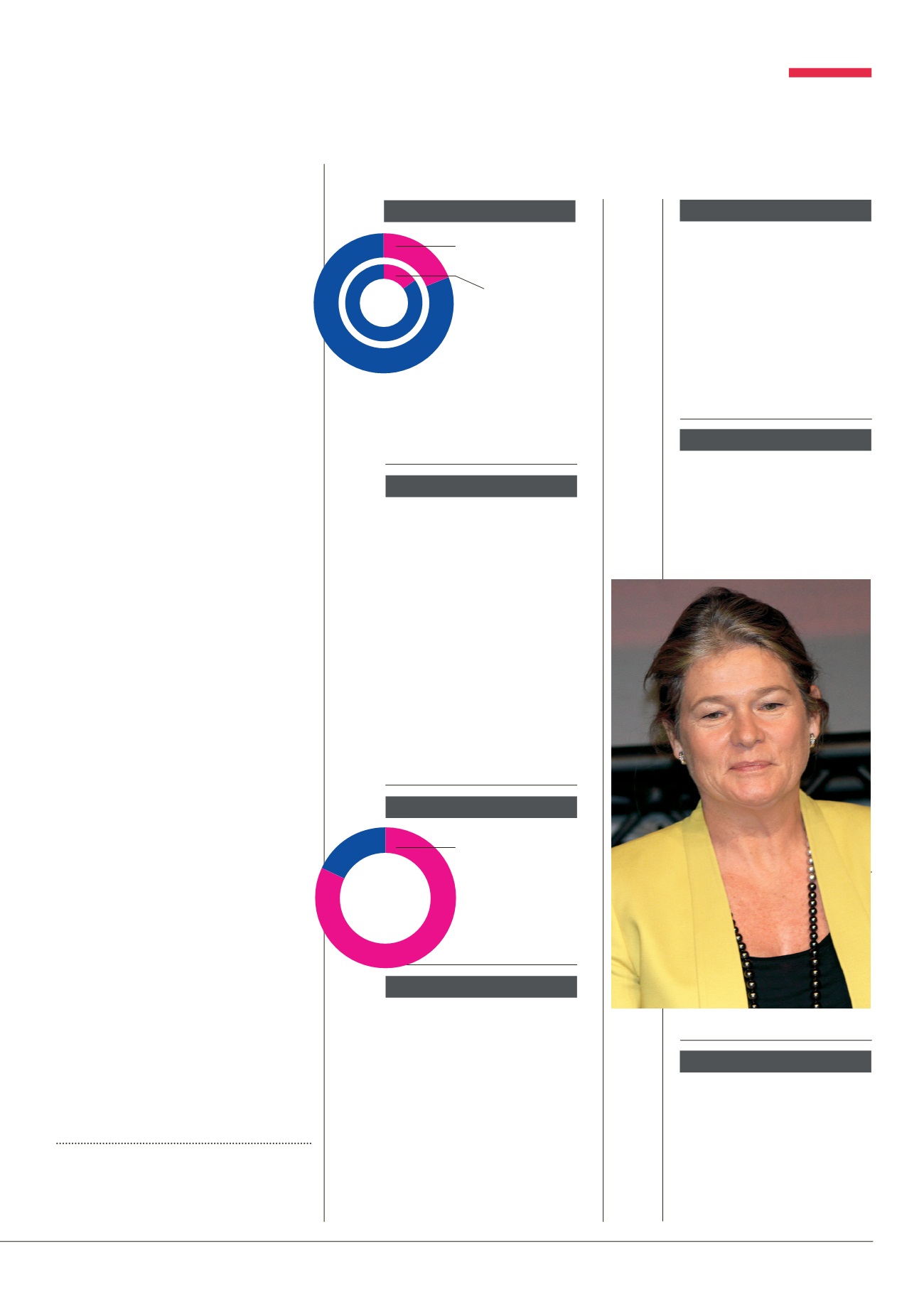
One of the richest British women in business
is Charlene de Carvalho-Heineken (below),
who owns a controlling interest in and sits
on the board of Dutch beer giant Heineken.
She inherited an estimated £3 billion fortune
on the death of her father, Freddy Heineken,
in 2002.
Source:
, Dec 2013
Women make up nearly a third of the
self-employed in the UK; there are now
1.5 million self-employed women.
An unprecedented 80% of the new
self-employed starting out between 2008
and 2011 were female.
Source: Prowess.org.uk; Labour Force Survey 2013
from the Office for National Statistics, Nov 2013
THE INVESTOR
|
21
Balance sheet
After decades of failing to meet equality
targets, statistics show that women in the UK are still
behind men in terms of pay and representation on
company boards. But as more women enter the workplace,
it seems changes are taking place behind the scenes.
would have been the second income, the
one usually brought in by the female,’ says
Catherine Johnson, anAcademy Partner at
St. James’s Place.‘And circumstances have
dictated that some women have returned to
work after having children when they might
not have done otherwise.’
In fact, many of those women have set
up their own businesses.This is clearly an
area where women are breaking through, as
the vast majority of people entering self-
employment in recent years have been female.
Jenny Moloney, another St. James’s Place
Academy Partner, says:‘More and more, a
household needs to have two people to be
working.’ She adds that many women are
now equal partners when it comes to the
financial decision-making, if indeed they are
not already at the helm.This is not because
women are taking over, but because ‘women
handle a lot of logistics in running the house,
and decisions on money come under that’.
Acceptance of women varies from
sector to sector – and the financial advice
sector may be one where more women
will find roles for themselves. For example,
of the individuals training to give wealth
management advice in the St. James’s Place
Academy, 19% are women, reflecting the
kind of changes taking place in households.
This compares to 10% in the financial advice
sector as a whole. St. James’s Place is keen
to attract more women as it believes that
clients want the choice of having female
advisers, and it recently ran a special session
for women who might be interested.
Baroness PatienceWheatcroft, non-
executive director on the St. James’s Place
board, chaired the session and said she
was particularly heartened by the growing
number of female owner-managers.‘There
are many more women who are wealthy in
their own right,’ she says.
It could be that equality will one day
be reached less by male structures slowly
adapting to women by incremental
targets, than by women creating their own
businesses and their own wealth; perhaps
with business cultures that also employ and
highly remunerate women.
Source:Annual Survey of
Hours and Earnings, Office
for National Statistics,
Dec 2013


