38
|
THE INVESTOR
IN YOUR INTEREST
final word
Plain Picture
T
he belief that drives our
investment approach is a simple
one: if we can acquire stakes
in companies that generate an
above-average yield, and if those
dividend payments grow, then the capital value
of our holdings will appreciate. Furthermore,
we are conscious that it is cash flow that
underpins a company’s dividend payments; so
it is on cash flow, rather than on the dividend
itself, that we focus.We primarily look for
companies possessing these characteristics.
The outcome of this approach is that
a significant part of our fund’s long-term
returns are derived from the relative certainty
of income payments rather than from
fluctuating market levels.This is not to say that
the fund is immune to market movement, but
it has historically been less volatile and more
resilient during downturns than the wider
market (although we can offer no guarantee
that this will remain the case).
Over the past three years, the portfolio
has managed to outpace a rising market.
Throughout the recovery we have sought
to capitalise in the best areas for dividends
and dividend growth, and to minimise our
exposure to areas where valuations are
unattractive or vulnerable to correction.
Recently, that has meant building weightings
in miners, banks and other stocks that
benefit from improved economic and market
conditions, such as life assurers, housebuilders
and selected consumer-facing companies.
Where we are far more cautious, however, is
in those areas that are threatened by structural
change. Perhaps the most obvious structural
change taking place today is the move towards
living online. For some companies, the
transition to an online world is a painful one.
They must try to service customers with
increasingly divergent habits, which implies
increased costs without an offsetting increase
in sales. For other companies, however, it is an
opportunity to gain a jump on their rivals and,
by improving service levels, to capture their
customers’ loyalty for longer. Companies that
succeed in adapting to this change will have
stronger growth and better cash flows, and will
be able to increase their dividends. For others,
the price of failure could be that their dividends
disappear altogether.
We believe the stock market can continue
to take encouragement from the increasing
evidence of recovery in the UK, the US and in
the more troubled parts of the eurozone. Some
might see this recovery as a threat, worrying
that interest rates must rise or inflation will
take hold.We don’t worry too much about
inflation, as we see the internet as a deflationary
force. Furthermore, if interest rates do
increase, it would represent a normalising of
economic conditions; and, for a long-term
investor, normality is preferable to a world
sustained by central-bank support and
artificially low rates.And while valuations are
no longer as cheap as they were, we think rising
profits and flows from bonds into equities will,
on balance, send share prices higher.
Of particular importance to the UKmarket
is the outlook for its largest companies. Despite
their attractive yields and generally modest
valuations, their performance relative to their
smaller counterparts over the past five years
has been pedestrian.While the attractions of
the‘mega caps’ are readily acknowledged, the
complaint is always that they lack an exciting
narrative and that they are too big to grow.
Sceptics may be right when they point out that
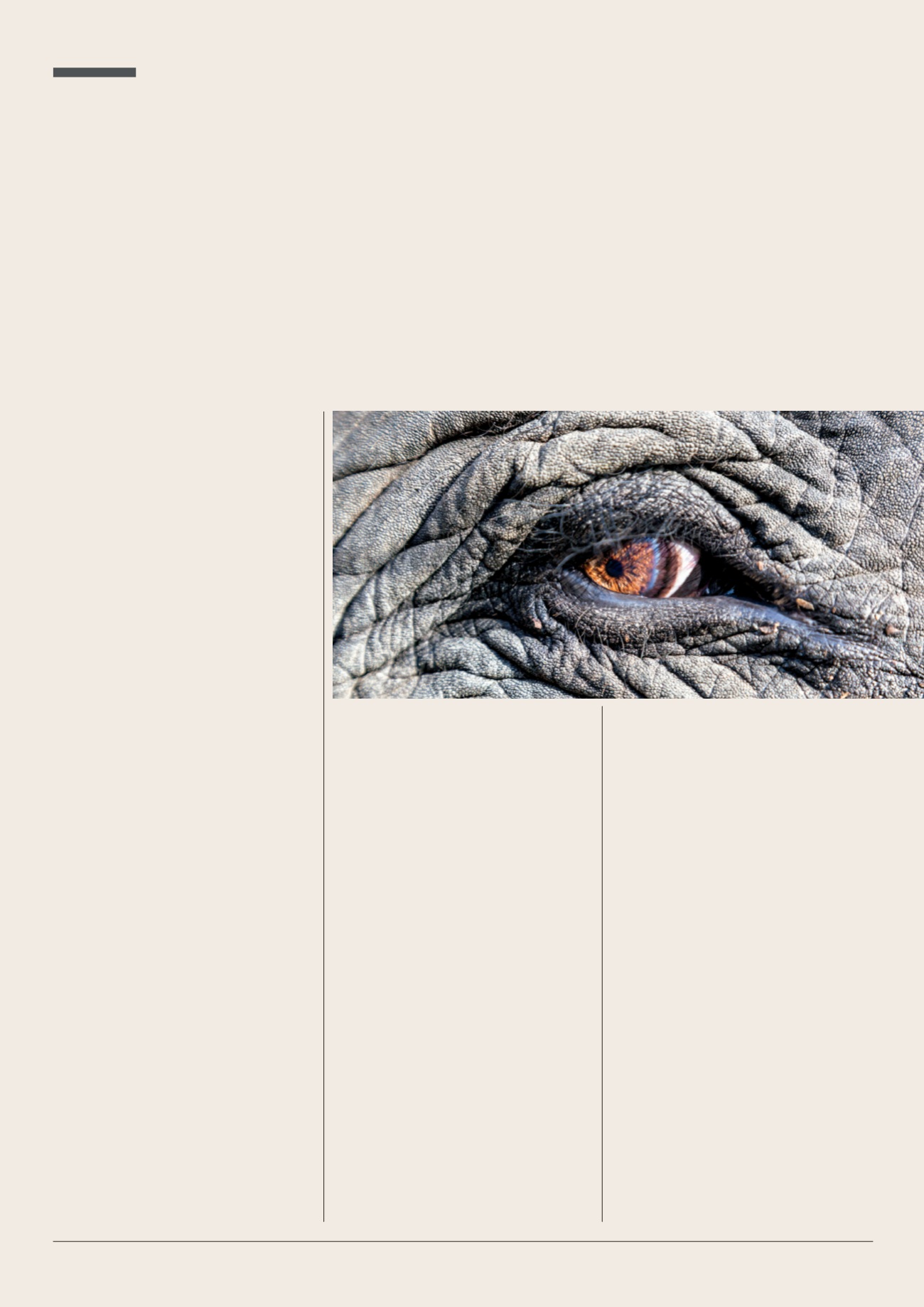
‘elephants can’t dance’.
But in our view these behemoths do not
need to tango or salsa to appreciate in value;
all they need to do is to try to touch their toes.
Some of them are already warming up. BP,
for example, is putting shareholder value over
growth, emphasising cash flows and dividend
payments rather than investing in getting
bigger; RioTinto is striking a better balance
between expansion and shareholder returns;
and Novartis is beginning to focus on costs,
shedding its non-core businesses and buying
back shares.
The balance between risk and reward is
firmly in favour of these types of company.
We look forward to seeing what these
elephants will achieve – in 2014 and beyond.
elephantine
enrichment
Dividend growth is a crucial part of investment returns.Adrian Frost
fromArtemis, co-manager of the St. James’s Place UK & International
Income fund, shares his philosophy and outlook


