32
|
THE INVESTOR
THE INVESTOR CENTRE
All information correct as at 31 March 2015
I
n February, many of the companies we
hold reported annual earnings and released
annual shareholder letters.The management
team at Markel, specialty insurance
underwriter, commented that all commented
that all the concerns about the global
environment it had entering 2014 still existed
in early 2015. Despite this, it increased the
value of the company during 2014 – not
the share price but the asset value of the
company, which management believes is the
best measure of progress. Unilever has been
criticised for its modest sales growth recently.
It is easy to forget that sales growth of 2.9%
equates to well over £1 billion of new sales.A
new sale should be regarded as an important
accomplishment. Sprinters are not expected
to set a new personal best every time they
step on to the track, but that is expected of
companies. Incredibly, many are successful in
growing sales year after year.That is not to say
that they should strive for anything less, but
it is worth remembering the human e ort
behind these improvements.As shareholders
we try to create an environment that allows
these companies to meet their potential.We
discourage activity that may create short-
term bubbles in the share price at the expense
of the long-term potential of the company,
and encourage a patient approach that
maximises value over the long term. In this
way, we hope that our investments help the
individuals who relentlessly push companies
to achieve their potential.
FIRST STATE
Joint manager: Worldwide Managed
and Worldwide Opportunities
Worth remembering the human
effort behind year-on-year growth
Sprinters are not
expected to set a
newPB every time
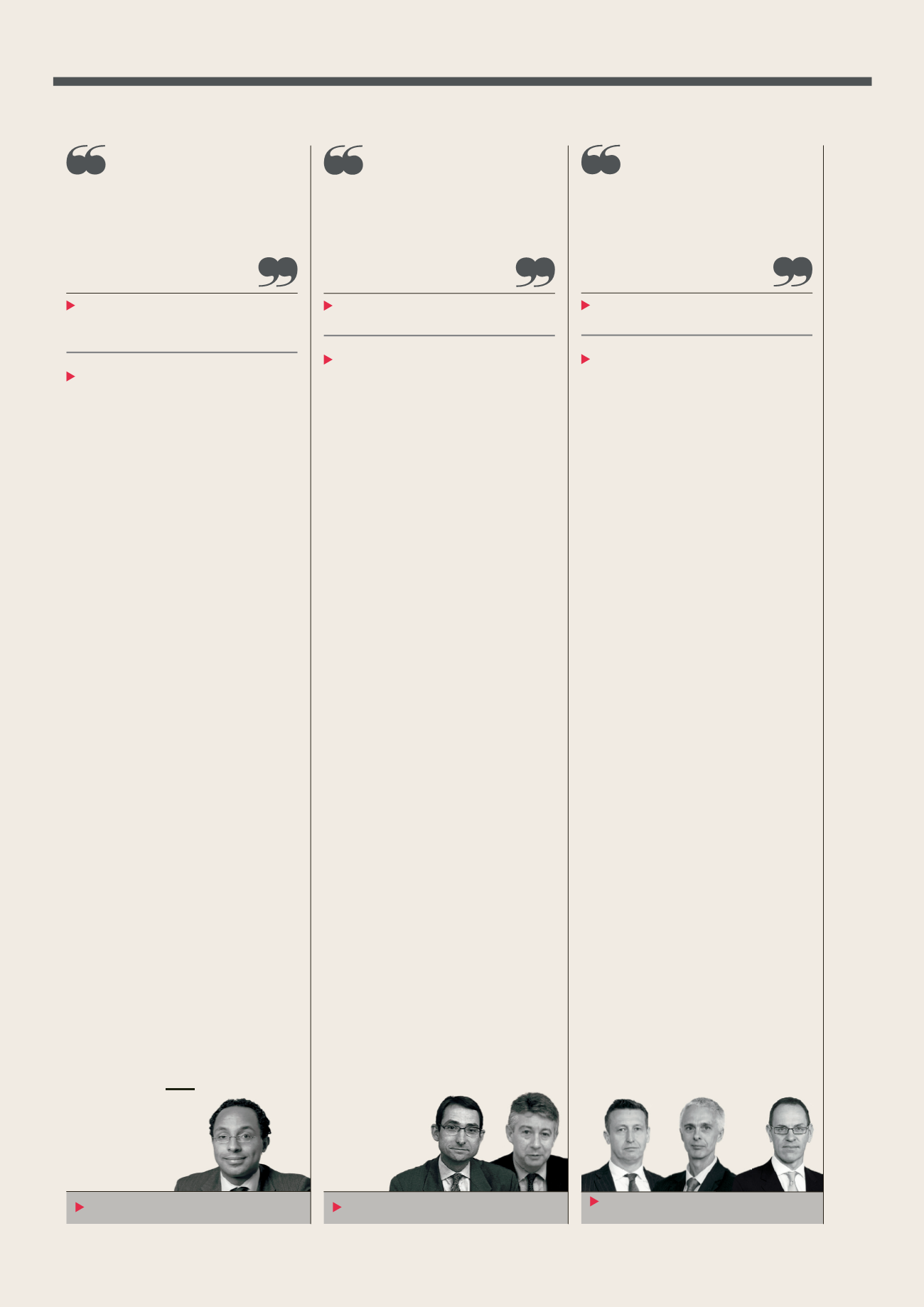
Jonathan Asante
Q
1 has seen some relatively dramatic
action from central banks to contain
the threat of de ation and stimulate
growth.The ECB has launched a massive
QE programme. Monetary easing has
also been a dominant theme in Japan, and
more than 20 of the world’s central banks
have cut interest rates since the beginning
of the year.The US Federal Reserve and
the Bank of England have been managing
the expectations of the nancial markets,
acknowledging the de ationary pressures
exacerbated by the tumbling oil price,
while simultaneously encouraging markets
to look through low in ation and focus on
the timing and nature of interest rate hikes.
This divergence of global monetary policy
presents both challenges and opportunities,
as we keep a very close watch on the
portfolio to ensure we have the correct
blend of ideas to achieve our return and
volatility targets. For example, we have
closed out a number of our interest rates
ideas that have boosted fund returns, but
now do not o er su cient returns going
forward; this includes our short Australian
rates idea, our European Curve Flattener
and our US Duration idea.We also added
ideas to bene t from potentially lower
UK in ation, a possible narrowing of
the di erentials betweenAustralian and
European interest rates and a belief that
the Japanese yen will strengthen versus the
Korean won.
INVESCO PERPETUAL
Multi Asset
Global monetary policy presents both
challenges and opportunities
More than 20of the
world’s central banks
have cut interest rates
I
t has been an eventful three months for the
high-yield bond market, with a number of
signi cant macro events in uencing returns.
Falling crude oil prices depressed in ation,
pushing out the market’s expectations
about the timing of interest rate rises.This
supported government bonds and higher
quality corporate bonds, which tend to
have a higher sensitivity to interest rate
changes. Meanwhile, it became increasingly
clear that the ECB would implement QE.
The size of the programme eventually
announced beat expectations and higher
quality bonds rallied further as a result.The
outperformance of these bonds, however,
reversed through February as the more
economically sensitive high-yield sector
bene ted from stronger than expected
economic data. In the three months to the
end of February, Barclays estimates that
just over €23 billion of European high-yield
debt was issued, with the majority issued in
2015.According to data fromMerrill Lynch,
European high-yield bonds achieved a total
return of 2.9% over the three months to
the end of February.There was considerable
variance within the sector, with BB-rated
bonds returning 3%, and CCC and below
returning 1.5%.Within investment grade,
BBB-rated euro corporate bonds returned
2.1%. (All returns sterling hedged.)
INVESCO PERPETUAL
Corporate Bond
High-yield sector benefited from
stronger than expected economic data
Just over €23 billionof
Europeanhigh-yield
debt was issued
Paul Read and Paul Causer
David Millar, Dave Jubb and
Richard Batty


