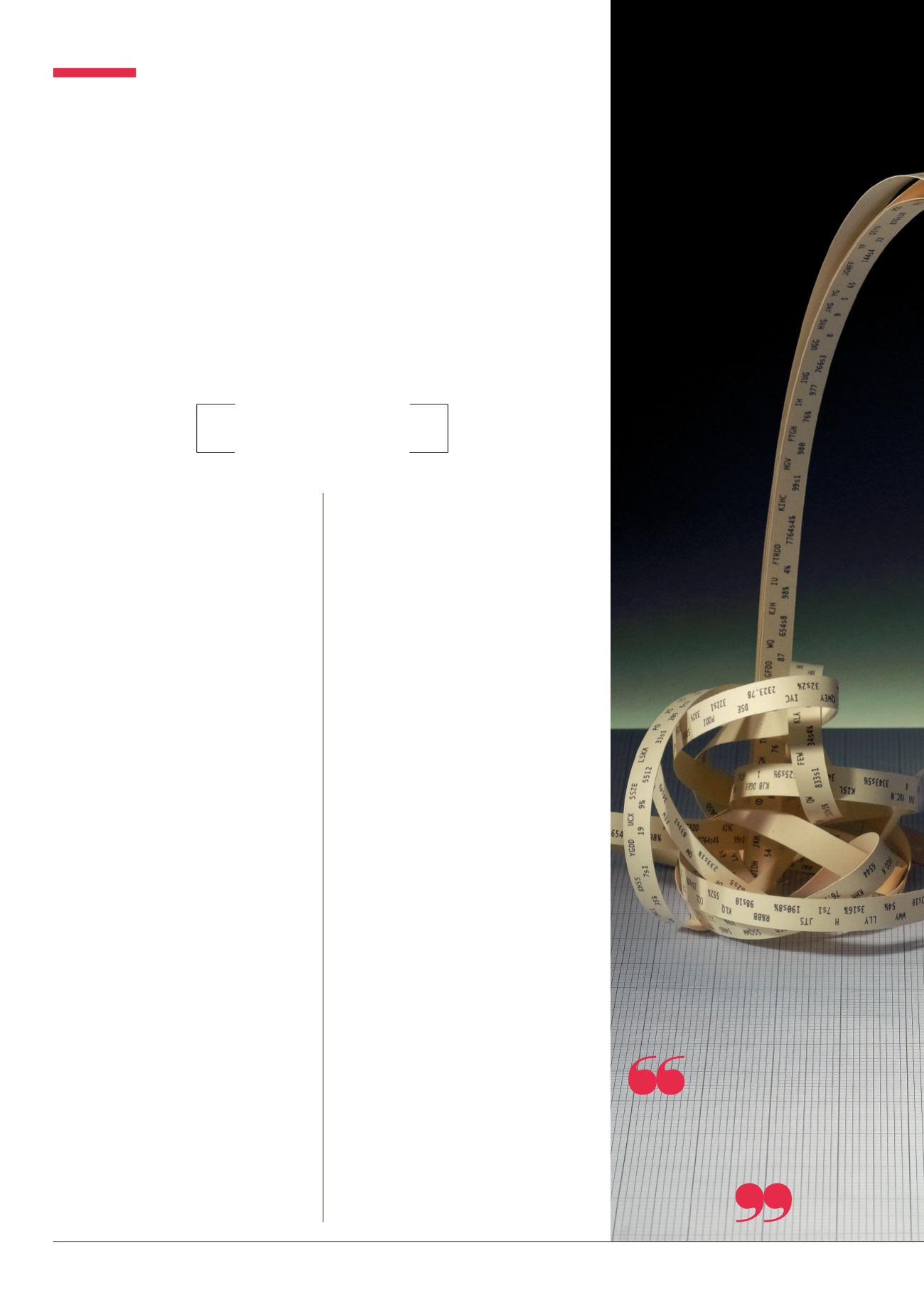
Photo illustration: Kyle Bean and Owen Silverwood
After a lengthy truce in the global currency
markets, the recent effects of government and
central bank policy threaten a currency war
By Jonathan Gregson
16
|
THE INVESTOR
T
ake full advantage of a record
strong pound, advises an
unsolicited email from a
company marketing villa
holidays in Europe.And, yes,
it is cheaper for Britons to purchase European
holidays since sterling has appreciated so
strongly against the euro (though not to a
‘record’ as the exchange rate is still below
pre- nancial crisis levels).And yet, only a
couple of years back, people went skiing in
the Rockies rather than theAlps because the
dollar was weak and the euro expensive.
Sharply oscillating exchange rates do a ect
people’s decisions – and not just over holiday
destinations.They a ect the cost of raw
materials and the price at which companies
can sell their goods or services abroad. If
exporters choose to hedge their currency
risk, exchange rate volatility increases the
cost of such insurance.And this year, foreign
exchange markets have been particularly
volatile, with many traders expecting the
euro’s 20% slide against the dollar to continue
until it reaches parity or even lower.
We have been here before. In the 1980s,
sterling uctuated between dollar parity and
a two-for-one exchange rate.Were those
currency wars? No, insofar as governments,
in a world of oating exchange rates, cannot
suddenly declare a devaluation of their
currency. But there are many means by
which a central bank can either defend its
currency’s value or encourage it to depreciate;
in particular, the‘unconventional measures’ –
namely ultra-low interest rates and quantitative
easing (QE) – adopted by some central
banks since the nancial crisis to combat
weak growth and the threat of de ation, tend
to weaken a currency, and thereby achieve
de ation.As a result, accusations from other
countries of exchange rate manipulation have
multiplied in recent years.
The term‘currency war’ was made
famous by a Brazilian nance minister back
in 2010 when money was pouring into
Brazil because it o ered better returns than
anything available in the United States.These
in ows caused the real to appreciate, making
Brazilian exports more expensive – apart
from commodities such as iron ore, which are
priced in dollars.
But depreciation was not the main aim
of the US Federal Reserve (or indeed of the
Bank of England) in launching QE; it was
to contain the nancial crisis and rekindle
growth. Similar domestic priorities, this time
the threat of Europe going into a de ationary
spiral, nally persuaded the European Central
Bank to follow suit.Yet the most immediate
result has been the euro’s fall by more than
20% against the dollar.
‘Currency depreciation is one of the most
important mechanisms to enable an increased
rate of in ation,’ says Paul De Grauwe,
professor of European Political Economy at the
London School of Economics, adding that‘the
policies that cause a depreciation of the euro
are necessary because there is no other way to
prevent the eurozone drifting into de ation
and negative growth’. He does admit, however,
that this‘shifts the problem to other countries’.
Countries with strong economies can
cope with that pressure.‘The US economy
has recovered quite strongly and for the
present it seems to be accepting the implied
Many traders expect
the euro’s 20% slide
against the dollar to
continue
ANALYSIS
CURRENCY WARS


