32
|
THE INVESTOR
THE INVESTOR CENTRE
All information correct as at 30 June 2015
M
ost people from the developing world
take for granted that large sporting
events present serious opportunities for
corruption, where greedy‘insiders’ can
extract riches from the huge construction
projects needed to get the host country ready.
Corruption should be important to global
investors because the developing world,
where the opportunities for wrongdoing
are greatest, happens to be where many
management teams hope to nd sales growth
for their companies.We met the management
of Unilever in both Ghana and Russia
recently, gaining comfort that the company
brings its values to bear in riskier operating
environments. It would be naive to think we
can know everything about an organisation
which has thousands of employees, but
addressing the subject in our analysis of
companies remains a key part of our
investment process. Perception of corruption
among countries’ public sectors is ranked
byTransparency International.The obvious
correlation between corruption and
development, with less corrupt nations
generally richer, implies that revelations
about bribery can be positive indicators of
a country’s long-term prospects. Exposing
corrupt behaviour makes it less likely that
it will happen in the future. It also implies
that shareholders stand to bene t most
where companies seek to become part of
the solution to corruption and not part
of the problem.
FIRST STATE
Joint manager: Worldwide Managed
and Worldwide Opportunities
Global investors should take an
interest in tackling corruption
Exposing corrupt
behaviourmakes it less
likely it will happen
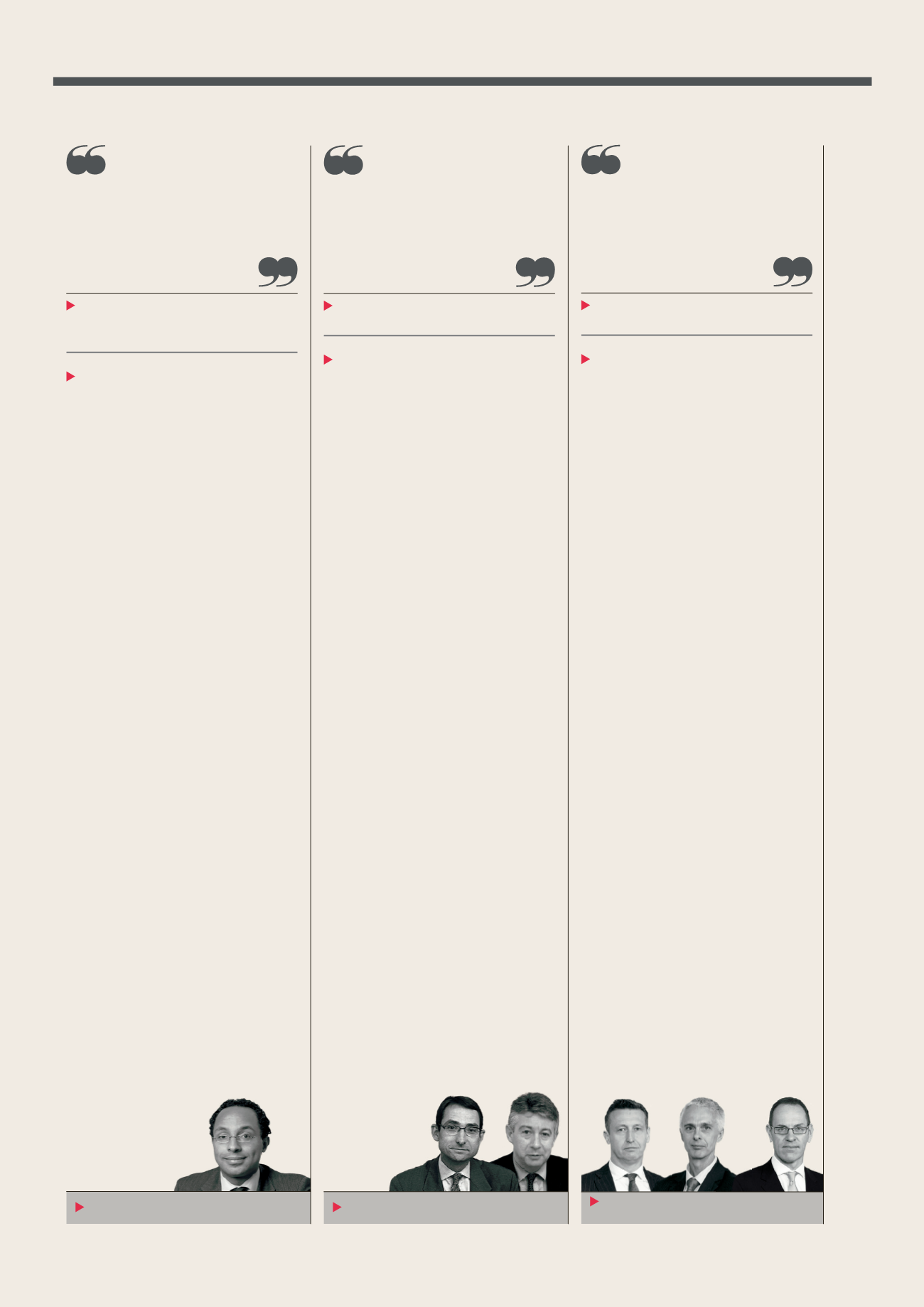
Jonathan Asante
G
lobal markets have seen a sharp change
in correlations between asset classes
over the past three months. In the past, xed
income proved to be a helpful asset type
for inclusion in a multi-asset portfolio, not
only delivering returns but also providing
diversi cation due to its negative correlation
with equities. However, recent data has
shown that correlation between bonds
and equities turned positive.Markets are
currently in a transitional phase, and it
appears that very few factors are driving the
performance of a range of di erent asset
types. Currently, a lot of focus is being put on
the potential for tightening policy in the US,
which is impacting xed-income markets.Yet
concerns over Europe’s political landscape
are also impacting risk assets such as equities.
We are constantly reassessing our portfolio
and are taking an active view on which ideas
we believe can deliver returns over our
two to three-year investment horizon.Most
recently, we re-evaluated the amount of risk
in the portfolio as, according to our risk
model, it had started to drift up in recent
months; consequently we reduced both
credit and equity risk.
INVESCO PERPETUAL
Multi Asset
Markets in transition as fund
re-evaluates portfolio risk
Correlationbetween
bonds and equities
turnedpositive
D
uring what has often been a challenging
period for bond markets, the European
high-yield sector delivered a positive return.
The commencement of the European Central
Bank’s long-awaited quantitative-easing
(QE) programme began in March and in
the months leading up to this, issuance and
demand in the high-yield sector had been
very high. Investors appeared to take the
opportunity to take some pro ts as QE
was initiated, with the sector giving back
some performance in March. Returns
picked up again throughApril, amidst signs
of improving economic data in the region.
The sell-o in German Bunds during late
April and early May meant that high-yield
returns tended to be higher in bonds with
lower credit quality, which are less impacted
by changes in interest rates. In the three
months to the end of May, Barclays estimated
that €30 billion of European high-yield debt
was issued.The majority of this issuance
happened in March andApril, with the
spike in yields toward the end of the period
depressing issuance levels.According to data
fromMerrill Lynch, European high-yield
bonds achieved a total return of 1% over the
three months to the end of May. BB-rated
bonds returned 0.8%, while CCC and below
returned 1.4%.Within investment grade,
BBB-rated euro corporate bonds returned
-0.8%.
INVESCO PERPETUAL
Corporate Bond
QE sparks investors to take profits as
economic outlook improves
Europeanhigh-yield
sector delivered a
positive return
Paul Read and Paul Causer
David Millar, Dave Jubb and
Richard Batty


