may be healthier than their children can
expect to receive, increased longevity
means the funds will have to last far longer:
a man retiring in 2014 can expect to live
for an average of 18.6 years
4
, and a woman
for 21.1 years – and life expectancy continues
to increase.
These factors have combined to transform
the business of financial and estate planning.
A generation ago, the focus would have
been mainly on distributing wealth at death
and the key concerns would have been to save
enough in a pension to fund what was likely to
be a relatively short retirement and to leave a
reasonable nest egg for their children.
Today, distribution of wealth is more likely
to happen before death and the key challenge
for families will be to balance the needs of
the three generations: education (for
grandchildren as well as children), bearing
the costs of helping children with mortgages,
and preserving enough wealth to cover the
needs of parents from retirement to death.
That requires a new approach to financial
planning, an intergenerational approach that
balances the benefits of the tax efficiency of
a pension with the flexibility of ISAs as part of
a portfolio of investments to meet long-term
growth and income requirements. Recent
pension reforms, which introduced greater
freedom over how and when to access
these funds on retirement, provide useful
flexibility for this intergenerational financial
planning; but it is vital to consider the needs
of all the generations in deciding how to use
pensions and other savings, as well as when
and how to access them.
A collaborative, intergenerational
approach, in which all parts of the extended
family are educated, advised and consulted
on ways to make the maximum use of
family wealth, for everyone’s benefit, will
increasingly become the norm. Far from being
selfish, baby boomers are increasingly using
their windfall wealth to make the future
brighter for the older and younger generations.
1
2
/
3
4
Balance sheet
Retiring baby boomers have complex
financial needs, as they seek to take care of their children,
themselves and their parents.Your St. James’s Place
Partner can advise on your wealth distribution.
virtually unheard of. Unemployment among
16- to 24-year-olds now stands at 12.3%: in
1971, it was just 4.2%. In 1967, 12.2 million
people belonged to a workplace pension; by
2012, that had fallen to just 7.8 million
3
.
Much has been written about the iniquities
of this wealth divide, with headlines berating
the selfishness of the baby boomers and
accusing them of stealing their children’s
future. But DavidWilletts, the former MP
who now chairs the Resolution Foundation,
highlights a more pertinent truth:‘I do not
believe that this shift is creating an
intergenerational conflict.What we see
instead is a considerable transfer of wealth
from recent retirees down to their children
and grandchildren, for instance by helping
them to get on the property ladder.’
Indeed, today’s generation of baby
boomers may be wealthier than their children
can aspire to be but they also have far more
calls on that wealth.They are funding their
children’s (increasingly expensive) university
education; opening their houses to them again
while helping them with deposits and
mortgages for their first homes – almost half
of first-time buyers could have had help from
parents or grandparents, according to the
Council of Mortgage Lenders
4
.
Eóin O’Gorman, StrategyAdviser at
St. James’s PlaceWealth Management,
believes that it is not just money that young
people want from their parents:‘They are
increasingly turning to their parents for
financial advice too. Intergenerational
wealth management is now becoming
much more important for all ages within
the family.’
Indeed, baby boomers are also facing calls
on their wealth from older generations, too.
Life expectancy has increased dramatically
over the past three decades and there are
already more than half a million people aged
over 90 in the UK
3
.While medical advances
have helped us survive diseases like cancer,
stroke and heart attacks, increased longevity,
together with a rising incidence of debilitating
diseases likeAlzheimer’s and other forms of
dementia, mean that demand for, and costs of,
social care are rising.
The baby boomer generation may, then,
be squeezed by the costs of helping their
offspring make a start in life and their parents
end theirs in comfort. But they are also facing
expenses of their own.While their pensions
ANALYSIS
WEALTH DIVIDE
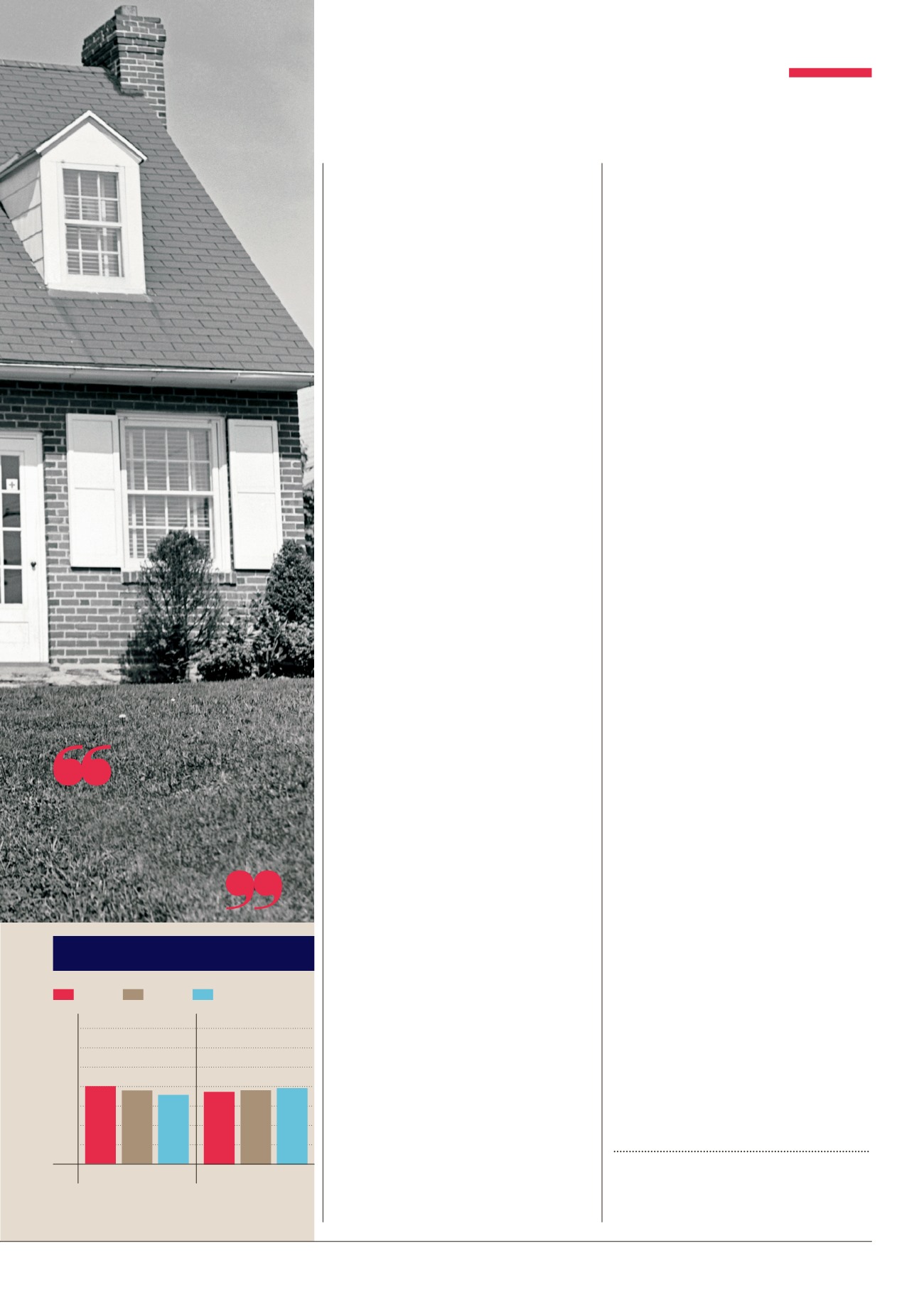
House price rises have
underpinned the wealth of
the post-war generation
Share of household wealth by age, 2006-12
Baby boomers
have the greatest
share of the
nation’swealth
30%
35%
2006-08
16-44
65-74
25%
5%
20%
15%
10%
20% 18% 16% 17% 18% 19%
Source: Resolution Foundation, based on analysis ofWealth and
Assets Survey, Office for National Statistics, 2006-08 and 2010-12
2008-10 2010-12
THE INVESTOR
|
23


