analysis
news
THE INVESTOR
|
05
Getty Images
The list of powerful women – currently headed
by Angela Merkel, the German chancellor, and
Christine Lagarde at the International Monetary
Foundation – has a new member in February as
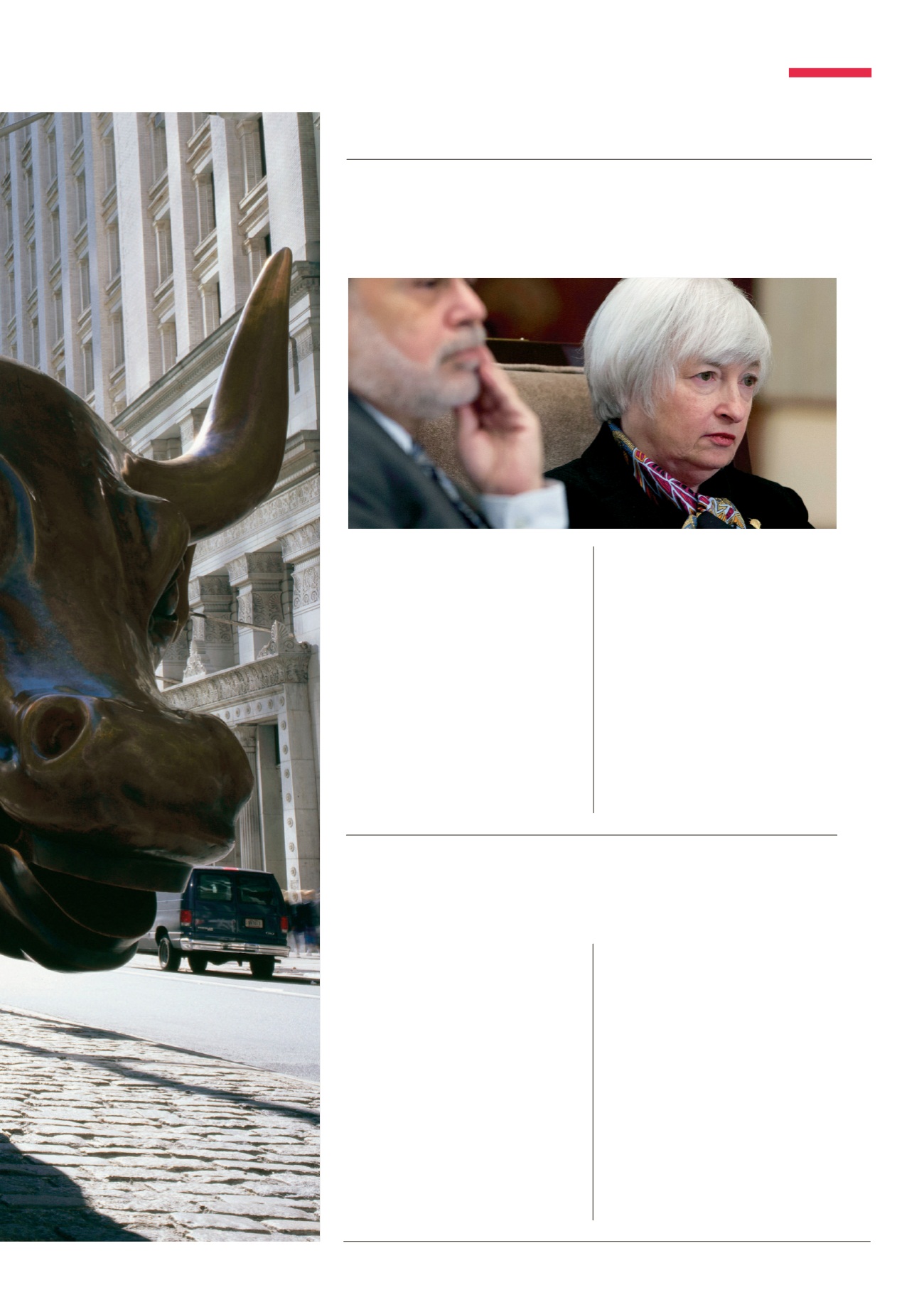
Janet Yellen takes over from Ben Bernanke as
chair of the US Federal Reserve.
As the first woman to hold the post, Yellen
will become one of the most influential people
in the global economy, as the Fed’s decisions
on matters such as interest rates and how to
proceed with the tapering of QE, which was
announced in December, have repercussions
for economies across the globe.
She inherits the post at a time when the
strains on the global economy seem to be
easing. US banks are regaining their financial
strength, albeit still paying for the excesses of
The consumer recovery seems firmly established
with retail sales, house prices and mortgage
approvals all showing sustained increases.
Last year’s Autumn Statement from chancellor
George Osborne underlined the consumer
renaissance when he upgraded his forecasts for
UK economic growth from 0.6% to 1.4% for
2013, and 2.4%, up from 1.8%, for 2014 – the
first upward revisions for some time. But the
independent Office for Budget Responsibility
(OBR) admits that ‘business investment and net
trade have continued to disappoint’.
The government is now turning its attention
to measures to stimulate business investment.
Last month, it announced a £375 billion
programme of investments in infrastructure in
energy, transport, communication and water
over the next two decades. Insurance companies,
us
yellen in the hot seat
New Federal Reserve chair is the first woman to hold the
post as US shows signs of regaining financial strength
uk
consumers driving uk growth
Chancellor upgrades growth forecasts thanks to sustained
increases in retail sales, house prices and mortgage approvals
the boom years in fines and penalties, while
Europe and the UK are progressing down the
recovery path. The US housing market seems to
have turned the corner with prices and permits
for new buildings both rising. Employment rates
are also increasing.
Yellen has been deputy to Bernanke for
the past two years and is generally seen as a
‘dove’ on economic policy, largely in favour of
economic stimulus to help engineer a recovery.
But it will be some time before financial
markets assess how she is steering the US
economy. In the meantime, the fact that the Fed
has a new head will add to the uncertainty over
the impact that the tapering programme will
have, both in the US and in other markets.
n
See ‘Women in the spotlight’, p20
including Prudential and Standard Life, also
announced that they are to invest £25 billion in
infrastructure. Other business-focused measures
included a cap on Business Rates and the
scrapping of employees’ National Insurance
contributions for people aged under 21.
These measures may be small consolation to
those people, however, who were also told they
will have to work even longer before they can
draw their State Pension, with the retirement
age now set to rise to 68 in the mid-2030s,
some 10 years earlier than planned.
That not only reflects the ageing of the
population and the rising cost of providing for
their retirement, but also that the government’s
finances remain poor.The fiscal deficit reduction is
currently behind target but, according to the OBR,
is expected to be in surplus by the end of 2020.


