08
|
THE INVESTOR
ANALYSIS
EUROPE
The move to the far
right is not that great
and nomore than
occurred in other
periods of economic
slowdown
Gallery Stock, Getty Images
Balance sheet
Economic growth in the eurozone is weak
and unevenly distributed, with unemployment in some
southern countries still unacceptably high.Yet despite this,
European equities are outperforming those of the US and
UK, leading the global investor to return.
EXTREME POLITICS
Five years on from the financial crisis, and with unemployment in many European
countries still at high levels, it is hardly surprising that doubts about the European
project and distrust of mainstream political parties are spreading.A recent report by
the Organisation for Economic Co-operation and Development showed trust in
government at its lowest levels since the crisis began, particularly in those countries
that were hit particularly hard, such as Ireland, Portugal and Spain
1
.
Such dissatisfaction manifests itself in protest movements, as in Brittany where
farmers and small businessmen have donned red caps. Former comedian Beppe Grillo’s
populist Five Star Movement enjoyed success in Italy’s last elections as a protest vote
against a discredited political establishment. Distrust of Brussels – and a dislike of its
constantly interfering at every level – has fuelled support for eurosceptic parties such as
UKIP or Alternative for Germany. But, arguably, the greatest challenge to the European
project comes from the far right.
From France’s National Front to the True Finns, the Freedom Party of Austria or
Greece’s banned Golden Dawn, populist and extremist movements have been gaining
ground. How real is the threat these present to the European Union and the single
currency? Stuart Mitchell (below) believes doom-laden forecasts are exaggerated. ‘The
main reason for their success so far is the economy.The move to the far right is not that
great and no more than occurred in other periods of economic slowdown.’
Dr Matthew Goodwin of the University of Nottingham and Chatham House sees the
far right’s appeal going back far before the financial crisis, or even 9/11. ‘It’s about
immigration and its effects on society, about access to public services and healthcare,
coupled with a sense of cultural threat and political dissatisfaction.’
The first real test will be next year’s elections to the European Parliament, when the
far right, eurosceptics and protest parties are all expected to do well. ‘The results will
look ugly,’ says Wolfgang Münchau, ‘and the mainstream democratic parties may find
themselves short of an absolute majority.That could force them into some grand
coalition, including the Greens.’
He also points out that extremist parties will be able to block decisions going through
parliament, and that they will exert an indirect influence on right-of-centre parties such
as the Conservatives or France’s UMP, seeking to defend their electoral base.And, with
the leader of France’s National Front, Marine Le Pen, forging a pan-European alliance
with Geert Wilders’ Dutch Party for Freedom, the far right might go beyond its historic
tendency to splinter along nationalist and ideological fault lines.
Dr Goodwin believes current projections of extreme populists gaining a third of
seats next year are exaggerated, and that they will end up with 20% or less. He notes
that such parties have been unsuccessful in Spain and Portugal, where memories of
fascist dictatorships remain alive.They may pose a challenge to established parties
on the right of centre. But, as Mitchell points out, so long as the vast majority
continue to prefer sticking with the euro to what might happen after a break-up,
the eurozone will survive.
1
that is years ahead of even the latest chemical
plants elsewhere.That enables them to be
competitive while retaining better margins.’
Similarly,Volkswagen leads the way in
sharing components between the 12 brands
it produces in more than 100 plants around
the world. Recent lower sales in Europe
and emerging markets, along with ‘capacity
optimisation’, mean it is postponing
construction of some new factories,
though spending on technology and products
will be una ected.
Of course, there are risks.While the
southern economies are stabilising, their
growth is likely to remain pedestrian
for years to come and the high levels of
unemployment will act as a brake on
consumer growth.While the immediate
threat of a break-up of the euro has receded,
there is no guarantee that it will survive.
Having risen sharply, European stock markets
could well mark time for 2014. But the
long-term picture is, however, improving.
‘Europe is always the last to turn
the corner towards recovery,’ observes
Mitchell,‘and it will follow the Anglo-Saxon
economies’ recovery next year. Compared
to the UK or the US it is a low-in ation
economy and, in my view, the euro is still
undervalued. It has a solid industrial base and
is therefore better balanced than service-led
economies like the UK.
‘From an investor’s perspective, Europe is
all about the risk premium. Shares should be
trading at a small discount to US stocks, but
currently they are still at a 35-40% discount.’
That gap could tighten soon.‘Risk premium
moves,’ he notes,‘can be very sudden.’
1 FTSE Index Services
2, 3 FinancialTimes
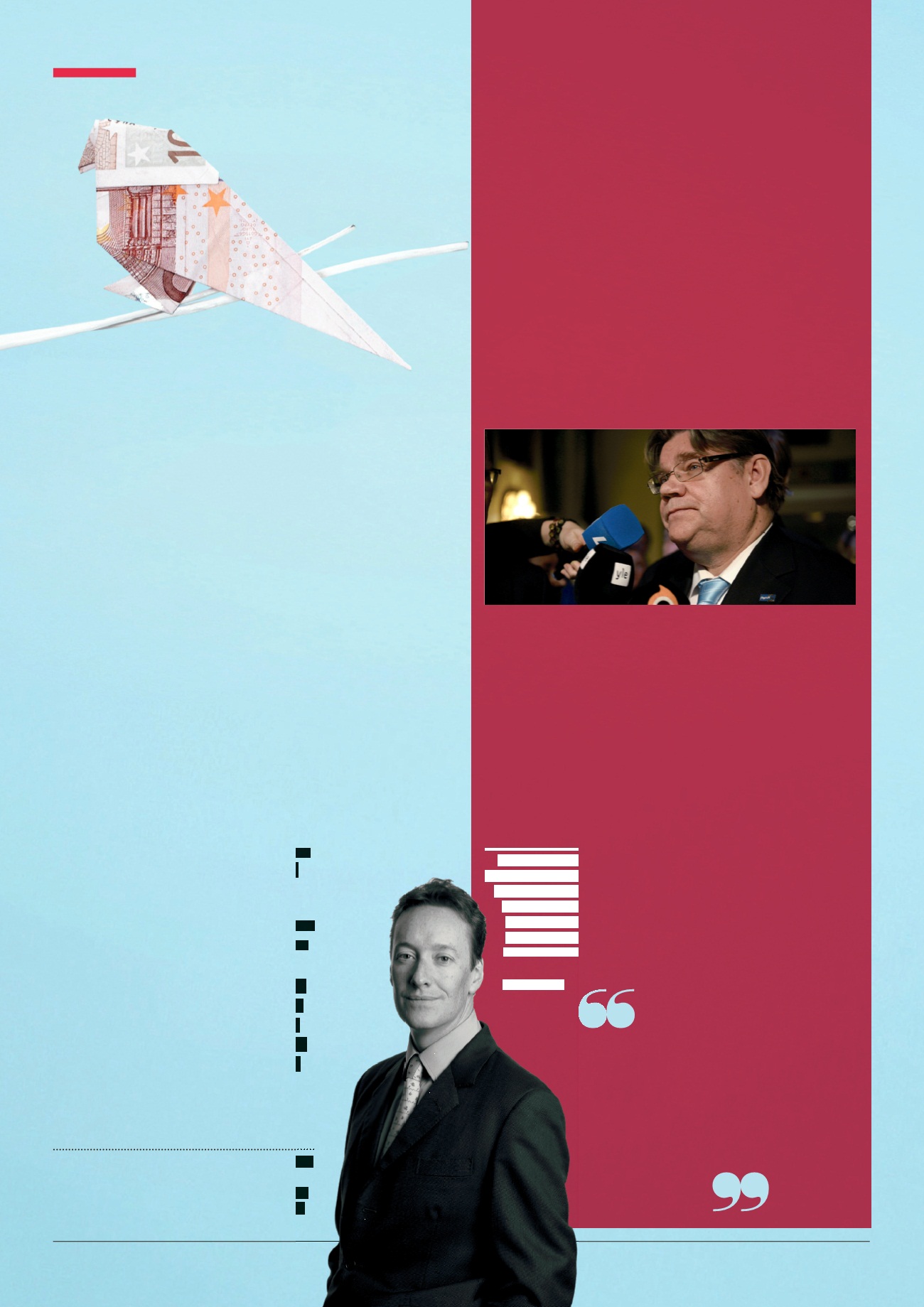
Timo Soini, chairman of theTrue
Finns party, which has been
gaining ground in Finland


