38
|
THE INVESTOR
THE INVESTOR CENTRE
FINAL WORD
So much for a summer lull.Against a backdrop
of geopolitical unrest, raging debate on the
leanings of the US Federal Reserve and the
Scottish referendum, the FTSE 100 crunched
its way to a 14-year high.The days when
investors could‘sell in May and go away’
have long gone amidst a modern market
that sways to the veiled messages of central
bank statements and remains obsessed by any
incremental changes of economic data.
As we pass the sixth anniversary of the collapse
of Lehman Brothers, nancial markets have
an eerie feel to them. Central banks, having
successfully staved o economic ruin in debt-
laden developed
markets, have
since unashamedly
distorted asset values,
forcing investors
into more exotic
higher-yielding assets.
While the euphoria
often associated
with market tops is
noticeably absent,
there are pockets of
exuberance.Our time
is spent understanding
the moves of central
bankers and interpreting the implications
for the portfolios – all in the context of
bottom-up valuations and the expectations
attached to each stock.
While the wider market remains focused
on the moves of the Federal Reserve, which
appears to be preparing the ground for higher
rates, it is important to recognise how the
policies of the Bank of England, the European
Central Bank (ECB) and the Bank of Japan all
weave themselves together, and then to try to
understand what their collective impact will be
on nancial markets.
So far this year, the withdrawal of US
stimulus has been o set somewhat by the
Bank of Japan, whose printing presses remain
at full stretch.At the beginning of September
ECB president Mario Draghi announced
that it would buy securitised loans and
covered bonds from the region’s banks to
help kick-start lending.These initiatives are
detailed and complex, but we believe that the
measures will provide a signi cant tailwind
to depressed European business sentiment,
with a subsequent follow-through to earnings.
Notwithstanding the heavy trading exposure
of London-listed companies to Europe, we still
see good opportunities in the UK.
Despite the ongoing con ict in Iraq and the
uneasy cease re in Ukraine, the oil market
remains well supplied and the price of Brent
crude has slumped below $100.This is partly
supply-led, with the shale revolution and a glut
in theAtlantic Basin; but it
is due to the demand side
where China-led weakness
has exacerbated the issue.
China is running short
of options; and while the
recent weak in ation data
has raised hopes for further
stimulus, even China’s
leaders now recognise this
would be a poor solution.
The economy needs to
rebalance. Sentiment
towards emerging markets
has improved slightly over
recent months but the weakness in iron ore,
steel futures andTokyo-traded steel suggest
to us an economy that is on a path towards
more muted economic growth.
The slide in the oil price is, however, an
e ective tax cut for the developed market
consumer.With expectations that prices
will remain subdued, we have reduced
exposure to integrated oils, at the same
time increasing exposure to companies
that will bene t; speci cally consumer and
economically sensitive stocks.One such
company is Carnival, the world’s largest cruise
ship operator.Operating in a market that is
e ectively a duopoly, the business bene ts on
two fronts: cheaper fuel and a consumer with
a bit more disposable income.The shares have
the added attraction of a cheap valuation, after
a di cult few years of operational mishaps.
Heightof summer
The investment team at Majedie comment on the
state of the markets after a turbulent fewmonths
E
conomic news included a strengthening
UK economy, a strong US jobs market
(with a stock market at all-time highs), and a
commitment from the ECB to loosen credit
conditions in the EU through‘targeted
longer-term re nancing operations’
(TLTROs). For us, two observations are
striking. First, the oil price has remained
subdued during a period of unrest; the
principal reason is excess supply owing to
China’s decreasing demand (as the economy
cools).This could have a positive impact
on the western consumer’s disposable
income. Second, we feel thatTLTROs
could give asset prices a signi cant boost in
Europe: giving the banks the backing they
need to lend to a consumer and business
community that are keen to borrow.What
does this mean for your portfolios? We
are still on a defensive footing, given that
uncertainties abound, eschewing where
possible emerging market exposure.We
have trimmed our exposure to integrated
oils in favour of airlines and one or two
consumer stocks that we feel will bene t
from a lower oil price, and added a little
to banks. Food retail has been a laggard
for us, particularlyTesco; despite the latest
unfortunate accounting revelations, the
new management team has given a clear
indication of its desire to make material
changes, so we expect to see disposals and
a refocusing of the business.
MAJEDIE
UK Growth
Joint manager: UK & General Progressive
Portfolio on a defensive footing due
to continuing uncertainties
Oil price has remained
subduedduring a
periodof unrest
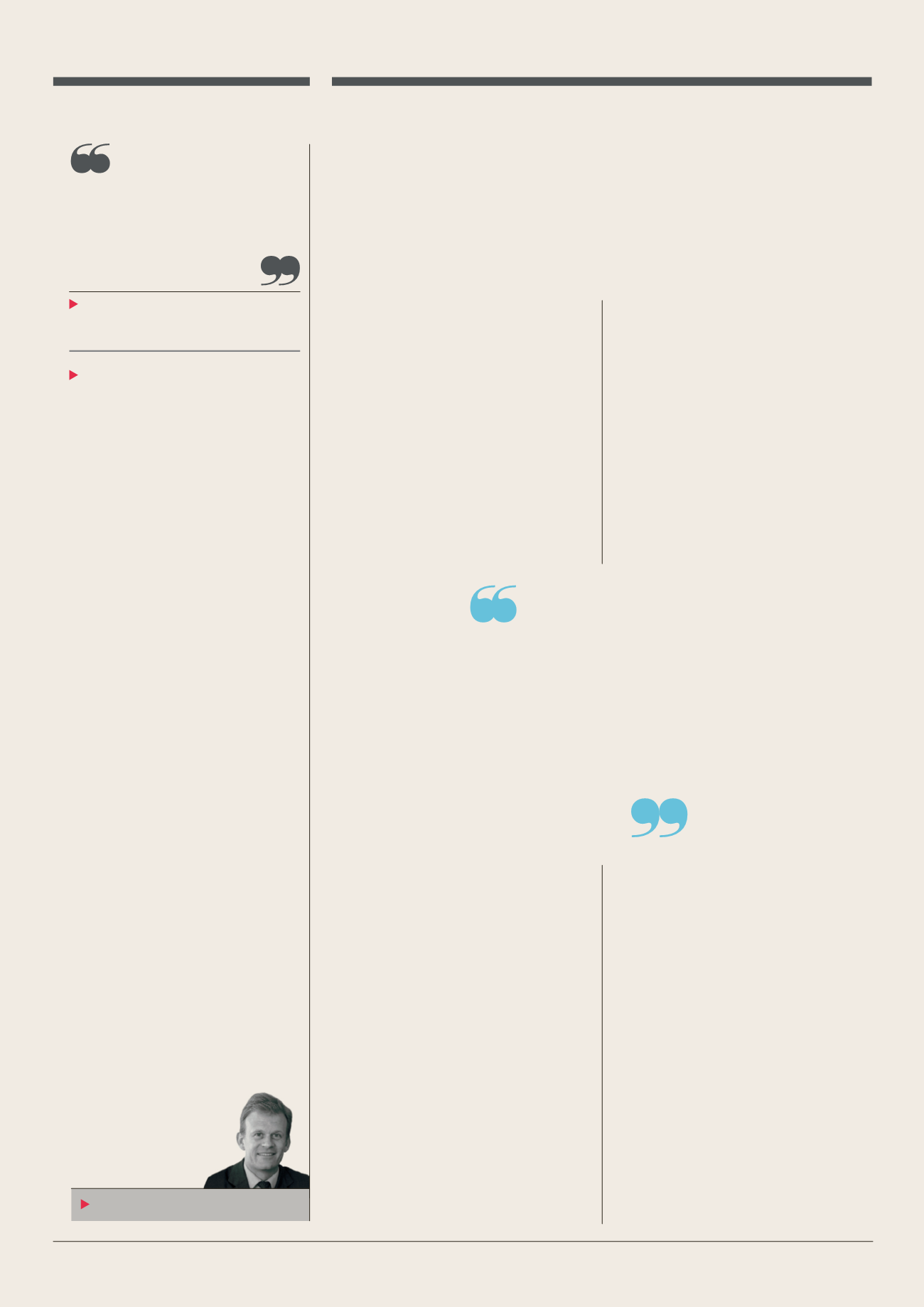
James de Uphaugh
While the euphoria
often associated
with market tops is
noticeably absent,
there are pockets
of exuberance


