08
|
THE INVESTOR
ANALYSIS
US ECONOMY
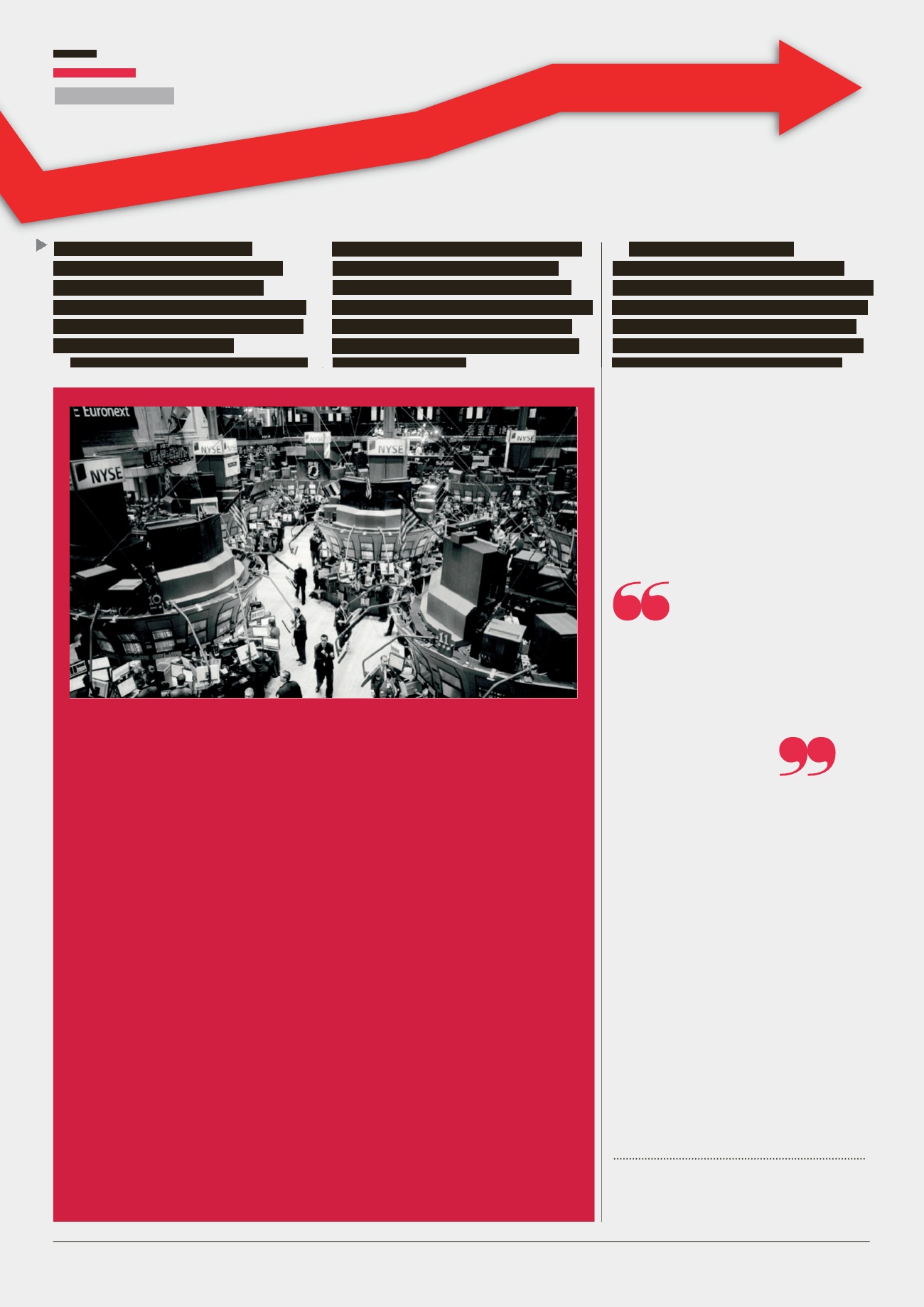
Sundeep Bhui, Gallery Stock/Anthony Suau
We expect the US
economy to grow at
a steady rate, but
belowprevious
recovery rates
Balance sheet
Although there are plenty of positives
behind the US economic recovery, concerns over mixed
housing and labour market data – and continued low
interest rates – could be a long-term danger.
Professor Allen notes that ‘stock markets have been at
all-time highs, but growth prospects are not so good.
This raises a number of questions. Is this boom in asset
prices caused by QE? And by continuing with
ultra-accommodative monetary policy, are we setting
ourselves up for another meltdown?’
Worries that interest rates will be raised sooner rather
than later meant that what should be good news –
namely that the US economy is growing faster than
anticipated – was immediately greeted by a retreat in
both bond and equity markets. For those who believe
current valuations are only sustained by extremely cheap
credit, an early rate rise is a signal to sell.
But that does not necessarily mean a disorderly rout.
‘A lot depends on the sequence and how rate rises occur
around the world,’ says professor Allen. ‘The UK will
probably move first. Europe’s problems are likely to be
exacerbated by the stand-off with Russia, while the
European Central Bank is unlikely to tighten. China
needs to reform its financial system and this is likely to
have an effect on internal rates. Rate rises here will leak
into international markets.’
The LSE’s Gianluca Benigno says: ‘The ending of QE
has already been priced in by the markets, but not early
action by the Fed.’ However, the bullish argument is
that stronger US growth, solid corporate earnings and
effective forward guidance from the Fed – especially
that assurance rates will stay on the low side – will be
sufficient to avoid a sharp sell-off.
‘Forward guidance is a different tool to QE, and is not
without its own risks,’ says professor Krishnamurthy. He
believes that the current search for yield across financial
markets has been encouraged by the Fed’s policy of
keeping interest rates low for a long period. ‘Exiting from
the low-rate regime will likely lead to some dislocations,
similar to last summer’s taper tantrum.’
Benigno warns that careful management by the
Fed will be needed. ‘In averting a sharp bond
sell-off, communication will be very important,’ he
says. ‘Since May 2013 the Fed has been very effective
in communicating with markets. But problems will
arise if markets are surprised, either by how early
rates are raised or, more important, how fast they will
continue to rise.’
Exiting from ultra-low interest rates and
unconventional measures was never going to be easy.
So far the Fed has managed market expectations,
though Janet Yellen’s recent reference to ‘stretched
valuations’ of bio-tech and internet stocks had no more
lasting impact than her predecessor,Alan Greenspan’s
talk of ‘irrational exuberance’ in the Nineties, which was
ignored by investors for more than five years before
markets turned.
Investors should therefore focus more on the
continuing earnings momentum of US corporates as
a measure of whether to hold US stocks, and the fact
that corporate America is in better shape than it was
seven years ago.
[part of the process of QE] has been
important in keeping mortgage rates low
and fostering the slow recovery of the
housing market.’ He also believes that the QE
programme has made the Fed’s commitment
to keep rates lowmore credible.
But with the Fed’s asset purchases nishing
This is unlikely, says professor
Krishnamurthy, because‘the Fed has been
e ective, post-taper tantrum, in separating QE
from forward guidance.This is why continued
tapering is not having the dislocations that it
did back then.My expectation is that the exit
fromQE will continue smoothly without
having signi cant negative consequences.That
said, I expect that [it] will impact mortgage
rates in particular, pushing these rates up.’
The Fed has a delicate balancing act ahead of
it in moving towards‘normalcy’ in monetary
policy, while not spooking the markets and
thereby derailing the broader US recovery.
Benigno says:‘Looking ahead, we expect
the US economy to grow at a steady rate, but
below previous recovery rates.
‘And while the recovery is not that
strong, in ationary pressures are nonetheless
mounting. US wages and salaries rose in the
second quarter at the fastest rate in six years
and unemployment dropped to near 6%.
So in ationary pressure could force the Fed
to raise interest rates earlier than indicated,
possibly by the end of this year.’
That might dampen asset prices, particularly
US Treasuries. But if wage rises are gradual and
sustainable, then a continuation of low in ation
and a strong US dollar could create a virtuous
circle, drawing in new investment seeking
higher returns and allowing economic growth
to continue its upward trajectory.
1 Bureau of Labor Statistics (Sept 2014)
2 Marketwatch.com (July 2014)
in October, how will forward guidance work
on its own? Some foresee a sharp market
sell-o – similar to the‘taper tantrum’ that
followed the Fed’s announcement in May 2013
that it would be gradually reducing its asset
purchases – and fear that this might push the
US recovery o course.
US STOCK MARKET FACES QUESTIONS OVER PROSPECTS


