W
e remain optimistic on the outlook
for European equities. Investors
have been unsettled by the combination
of a weak German services PMI in
September, modest initial take-up of
theTLTRO and continued low in ation
data.At the same time, however, there
is a wealth of data suggesting that the
recovery is proceeding as we might have
expected. Notably, the economies of the
periphery continue to rebound. Spanish
house prices, for example, are rising
for the rst time in six years. Mortgage
approvals also rose by an impressive 28%
in July. In fact, dramatically improving
construction con dence suggests that the
Spanish economy could grow by some 3%
next year. Credit conditions, furthermore,
appear to be improving across the region.
TheTLTRO and purchases of asset-backed
securities and covered bonds should help
lower bank funding costs, most notably
on the periphery of Europe.The recently
published European Central Bank lending
survey was also encouraging.The results
of the Asset Quality Review, furthermore,
suggest that the nancial system is better
capitalised than many had feared.The
recent, almost 10% fall in the value of the
euro relative to the dollar should also help
support the export sector.The sharp fall in
the oil price should likewise help stimulate
growth. More important, both second-
and third-quarter earnings have tended to
surprise on the upside.
S. W. MITCHELL CAPITAL
Continental European
Joint manager: Greater European
and Greater European Progressive
Expected growth in Spain for 2015 as
European equities outlook is bright
Spanishhouse prices
are nowrising for the
rst time in six years
THE INVESTOR CENTRE
THE INVESTOR
|
37
I
n our previous commentary, we
mentioned a study conducted by John
Coates (Cambridge University) examining
the biological responses of a group of
London traders to an increase in equity
market volatility, and the impact of those
responses on risk taking. In contrast to
Coates’ traders are the dispassionate
responses of value investors. Jason Zweig,
the noted
Wall Street Journal
columnist and
author of
Your Money andYour Brain
(2007),
credited much of the investment success
of value investors such asWarren Bu ett
and Benjamin Graham to being‘inversely
emotional’, sharing a quality that goes
beyond calm,‘a certain imperturbability
or implacability’ and used a classical Greek
term,‘ataraxia’, to describe the state of not
being bothered by the things that bother
most people. Perhaps we share the a iction.
While we were somewhat chagrined to see
many of our stocks take it on the chin in late
September and early October, we welcomed
the increase in market volatility.AsWarren
Bu ett has said on numerous occasions, a
long-term consumer of equity securities
should welcome pullbacks in equity
markets, which a ord them the opportunity
to buy interests in businesses at attractive
prices.We absolutely concur.While the
recent volatility has been unsettling to many,
it does carry with it potential opportunities
to put some of our cash reserves to work.
TWEEDY, BROWNE
Satellite manager: Global Equity
Consumers of equity securities look to
invest in businesses at attractive prices
The recent volatility
does carrypotential
opportunities
T
he search for income has been a key
driver of nancial markets in recent
years and we believe that this situation
will remain unchanged in 2015 given that
the environment of relatively subdued
growth and in ation, as well as very low
interest rates, is likely to persist. Indeed,
expectations for higher interest rates in
both the US and the UK have been pushed
back as 2014 has progressed, while the
eurozone is widely expected to embark
on a programme of quantitative easing to
ward o the threat of de ation.Against
this background, income from savings
accounts and government bonds is likely
to remain meagre. Consequently, stocks
that o er a relatively high yield and which
can sustain and even grow their dividends
should remain in strong demand.The
appeal of the yield these stocks provide
is such that they can also o er protection
against further market volatility.This is an
important consideration given that nancial
markets may well encounter turbulence
given the uncertain global economic
outlook. Moreover, although equities have
enjoyed a meaningful valuation re-rating
over the past few years, we continue to
nd attractive opportunities; while our
bottom-up approach means the portfolio
is not dependent on a buoyant market or
economy to generate performance.
THREADNEEDLE
Strategic Managed
Expectations for higher interest rates
in US and UK have been pushed back
Income fromsavings
accounts is likely to
remainmeagre
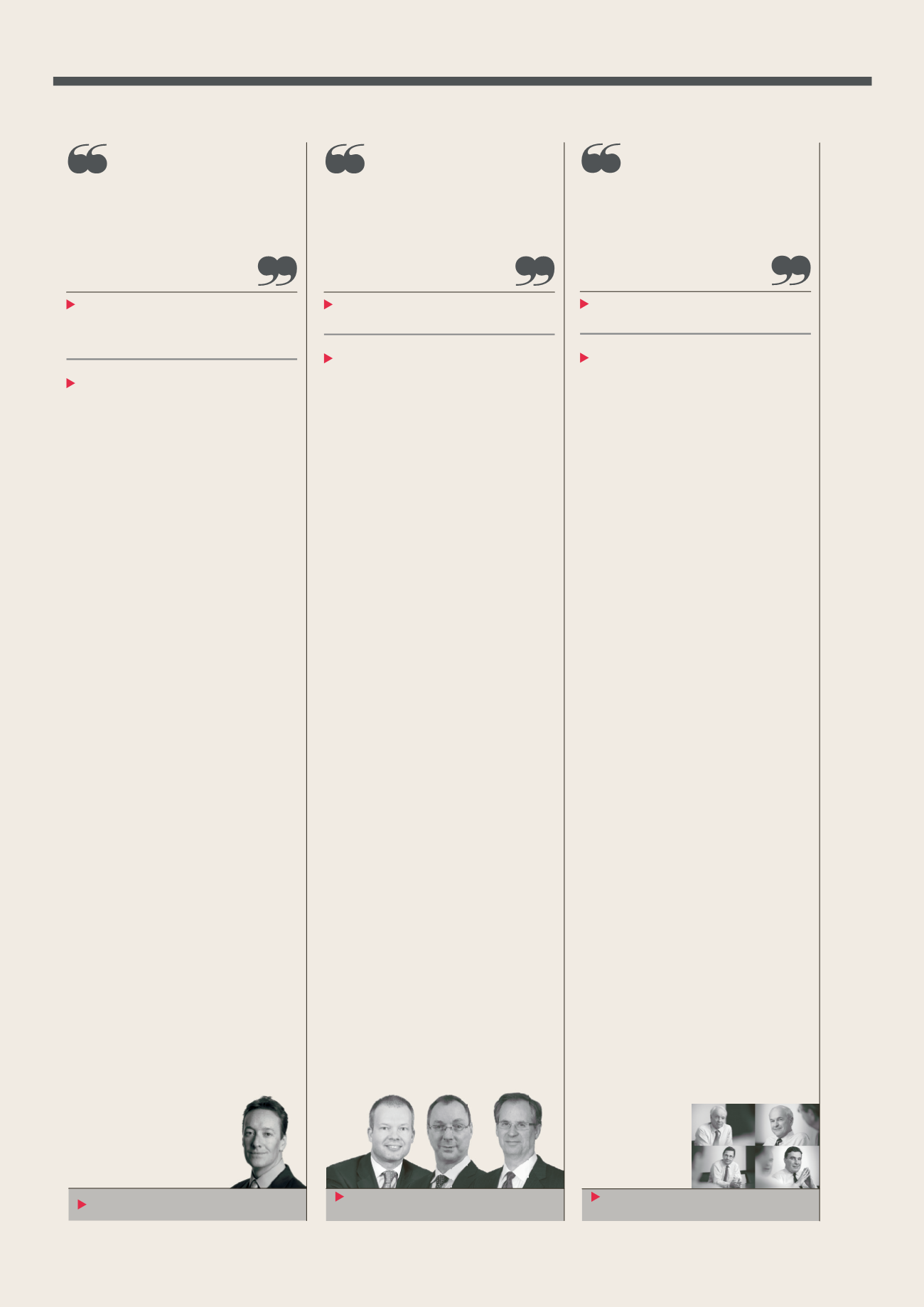
William Browne, Tom Shrager,
John Spears, Robert Wyckoff
Stuart Mitchell
Richard Colwell, Stephen Thornber
and Jim Cielinski


