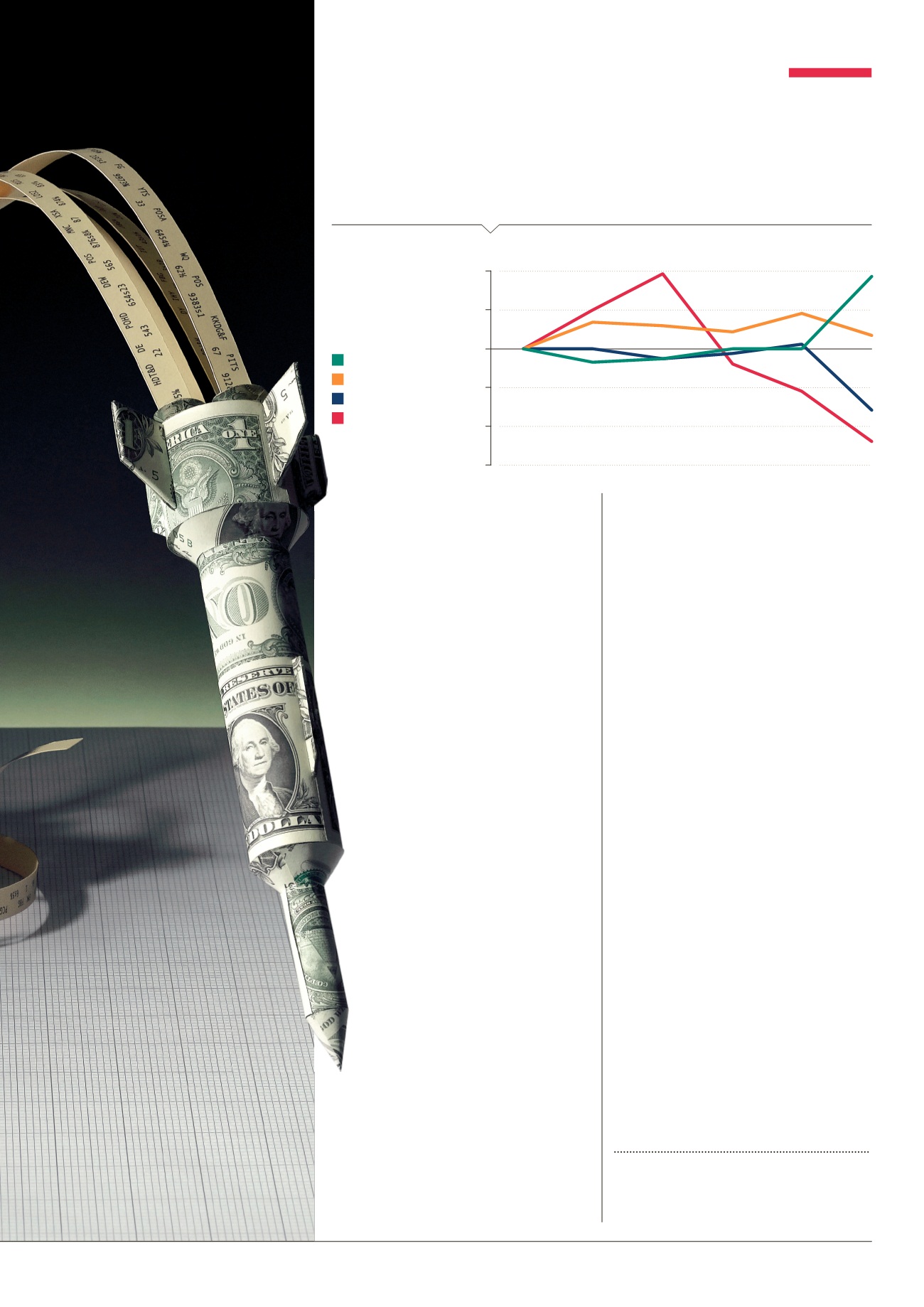
US dollar
British pound
Euro
Japanese yen
HOW CURRENCY
STRENGTH HAS
CHANGED OVER
THE PAST FIVE YEARS
(BASED ON 19 MARCH,
2010 SPOT RATE)
THE INVESTOR
|
17
appreciation of the dollar,’ says former Bank
of England rate-setter professor Charles
Goodhart. But he sees‘sterling’s usual
position midway between the US dollar and
the euro as not entirely comfortable, since
most imported commodities are priced in
dollars and most exports go to Europe’.
That means the UK is at risk of losing
competitiveness, squeezed between an
appreciating dollar and a depreciating euro.
The problem is compounded for smaller
countries trying to maintain a currency
peg – where one country’s exchange rate
with another is xed – with larger trading
partners. Switzerland has long been treated
as a‘safe haven’. Since its main trading
partner is the eurozone, it decided to peg
the Swiss franc to the euro. But the euro’s
sharp depreciation in 2014 triggered
massive in ows into Switzerland, putting
upward pressure on its currency.When its
central bank unexpectedly abandoned the
peg, the Swiss franc’s value jumped by 20%,
leaving the country’s exporters facing some
hard choices.
Since then the pressure has shifted to
Denmark, whose currency is also pegged
to the euro.‘Denmark’s situation is very
dangerous,’ says professor Philip Booth
of City University’s Cass Business School.
‘It is similar to that of the UK when we
were shadowing the Deutschmark in the
early Nineties.’ Its central bank has moved to
negative interest rates – e ectively charging
investors for the privilege of holding krone.
But for speculators seeking large currency
gains when the peg is abandoned, this looks
like a one-way bet.
‘Small economies don’t have to peg,’ says
De Grauwe, adding that countries‘like Sweden
and Norway, which have maintained exible
exchange rates, have been relatively successful’.
But Sweden has had to reverse its policy
of raising interest rates to head o a property
bubble precisely because this had caused its
currency to rise too far.
Booth believes that in the past‘ oating
exchange rates have served very well in dealing
with major nancial shocks’.The greatest
threat of currency wars may be in the Far
East where Japan has embarked on the most
extreme form of stimulus tried so far in order
to jolt its economy out of two decades of
stagnation.‘The short-term e ect has been to
reduce the value of the yen, but there is as yet
not much sign of it boosting economic growth,’
says Booth.
A weaker yen has made Japanese exports
more competitive, but that is putting pressure
on major trading partners. Should China
take retaliatory action and further loosen its
monetary policy, Booth believes this would
most likely raise internal prices in Japan and
o set any bene t of having a weaker currency.
So the end result is that – except for gaining
temporary competitive advantage – nobody
really wins from currency wars. But currency
wars mean interest rates will probably stay
lower for longer, forcing investors further up
the risk spectrum and fuelling asset prices.
Herein lie the real dangers.
ANALYSIS
Balance sheet
‘Unconventional measures’, used by
central bankers to combat weak growth and the threat
of deflation, mean that accusations of exchange rate
manipulation have multiplied.
March
2011
0%
March
2012
March
2013
March
2014
March
2015
10%
20%
-30%
-20%
-10%
Source: Oanda.com
THE UPS AND DOWNS OF CURRENCIES
March
2010


