Against that, however,Young suggests that
the business climate remains fairly robust,
as the new regime is keen to encourage
growth.‘Even though there are rival
political factions, there is no philosophical
disagreement about how to run the economy
and many businesses go on much the same
as usual. People likeThailand and tend to
give it the benefit of the doubt. Foreign
investment is welcomed and there is a
growing manufacturing sector,’ he says.
Countries such as Indonesia and the
Philippines were once infamous for their
corrupt regimes but moves are afoot to
drive change. In Indonesia, President Joko
Widodo rode into power late last year on
a pro-business, anti-corruption agenda.
‘It’s a country of more than 200 million
people, with tremendous potential for
development.The new president is a keen
reformer, but the opposition has quite a
lot of power still and there are still many
vested interests to battle against. It is not
necessarily going to be a smooth transition,
but the country is maturing and people are
generally becoming richer,’ saysYoung.
In the Philippines, President Benigno
Aquino III has also pledged to clean up the
country and there has been encouraging
progress since he came to power in 2010.
In recent times there have been clashes
with Muslim extremists, but most
commentators remain positive about the
economic outlook.‘I believe it will be the
best-performing economy in the region this
year,’ says Gareth Leather,Asia economist
at Capital Economics.
Stock market performance from the
Philippines, Indonesia andThailand has
been impressive. Each delivered gains of
more than 20% in 2014 and they have
made further headway this year
6
.The
tinyVietnam stock market has delivered
double-digit gains, while Malaysia, hit by
the falling oil price, has moved into positive
territory this year. Some of the smaller
ASEAN markets, such as Laos or Cambodia,
can be hard for investors to access. Many
prefer to invest in Singapore instead.
The FTSE StraitsTimes index in Singapore
rose 6% in 2014, and has made further
gains this year
7
.
‘The Singapore market is still relatively
cheap. Many of the companies have a
footprint in places likeVietnam or Indonesia,
and have higher standards in areas such as
corporate governance. So it can be a safer
way of accessing some of the racier countries
in the region,’ saysYoung.
Clearly, the 10 countries that make up
ASEAN are diverse on many levels. But
there are certain characteristics that most
share, such as young populations, growing
wealth and a consequent increase in demand
for consumer goods, financial products and
mobile technology.There is also a growing
desire for closer unity.
The region has made a commitment
to forge closer ties; to allow free trade
and free movement of goods, services and
people by the end of 2015.While there
is considerable scepticism about whether
this goal can be achieved, the target itself is
seen as encouraging.Across ASEAN, most
observers are confident that progress is
being made and that long-term prospects
are promising. However,‘caution’ remains
an essential watchword for investors.
‘It is easy to get carried away, but you have
to use common sense and make sure you do
proper due diligence,’ saysYoung.‘Companies
are being run better, but bureaucracy is
often corrupt – and poor infrastructure
means that even if wages are cheap, overall
operating costs may not be.There are some
great businesses out there and some excellent
investment opportunities; but you have to do
your homework, you have to understand the
region and, ideally, you have to have contacts
on the ground.’
1,3,5Trading Economics
2
ASEAN Community in Figures
4
ASEAN’s Bright Future: Growth Opportunities for Corporates
in theASEAN Region
6 Investopedia
7 wsj.com
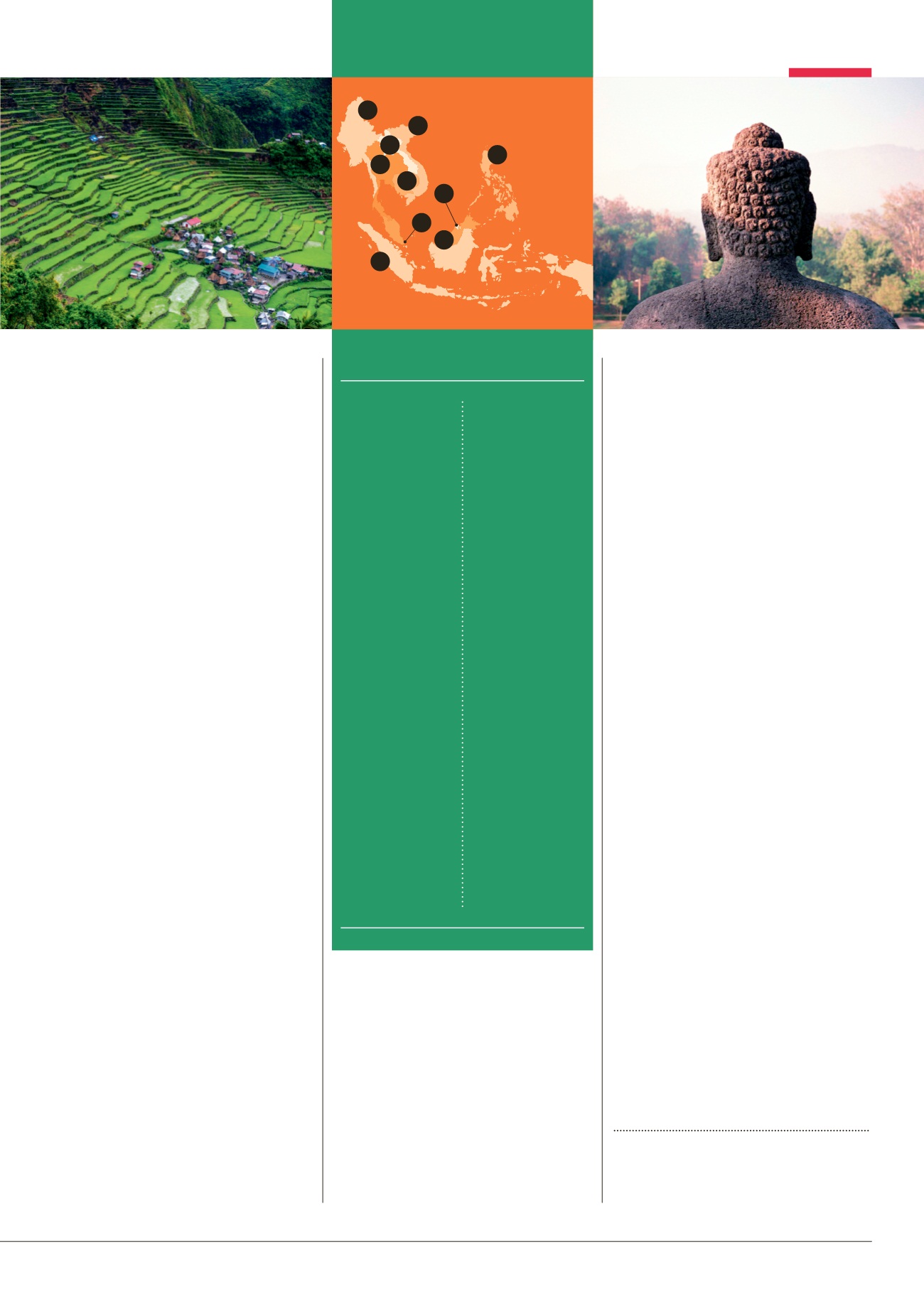
ANALYSIS
1
BRUNEI
Currency: Brunei dollar
GDP: $16bn
GDP year on year:
-0.20%
Pop: 0.42m
2
CAMBODIA
Currency: Riel
GDP: $15bn
GDP year on year:
7.20%
Pop: 15.14m
3
INDONESIA
Currency: Rupiah
GDP: $868bn
GDP year on year:
5.01%
Pop: 250m
4
LAOS
Currency: Kip
GDP: $11bn
GDP year on year:
7.60%
Pop: 6.77m
5
MALAYSIA
Currency: Ringgit
GDP: $312bn
GDP year on year:
5.80%
Pop: 30.4m
6
MYANMAR
Currency: Kyat
GDP: $53bn
GDP year on year:
6.50%
Pop: 53.26m
7
PHILIPPINES
Currency: Peso
GDP: $272bn
GDP year on year:
6.90%
Pop: 100m
8
SINGAPORE
Currency:
Singapore dollar
GDP: $298bn
GDP year on year:
2.10%
Pop: 5.47m
9
THAILAND
Currency: Baht
GDP: $387bn
GDP year on year:
2.30%
Pop: 67.01m
10
VIETNAM
Currency: Dong
GDP: $171bn
GDP year on year:
6.96%
Pop: 90.73m
Getty Images
Source:Trading Economics
1
6
10
4
9
2
8
3
7
5
THE ASEAN ECONOMIES
THE INVESTOR
|
11
Balance sheet
With a collective population of more
than 600 million people and a combined GDP of almost
$2.5 trillion, ASEAN is an economic force to be reckoned
with – with great opportunities for investors.


