ANALYSIS
news
THE INVESTOR
|
05
Getty Images
Britain, so Chancellor George Osborne claimed in his
Budget speech in March, grew faster than any other
developed nation last year.The claim is borne out by
figures from the International Monetary Fund, which
puts the country a whisker ahead of the US and
Canada in GDP growth for 2014.
Alternative figures from the OECD, which cover the
entire period since the start of the financial crisis in
2008, show the UK in the middle of the pack; neck
and neck with Germany, ahead of France and Italy,
but some way behind Canada and the US.
The recovery does, however, appear to be
gathering pace.The Office for Budget Responsibility
has revised up its growth figures for this year and
next, but warns of a ‘roller-coaster profile’ for public
‘Uncertainty’ and ‘volatility’ remain as central
themes in most parts of the world as the global
economy continues to struggle to recover from the
impact of the financial crisis.The US still looks likely
to be the first of the developed economies to raise
interest rates, having pegged them at 0.25% for
more than six years.
While the Federal Reserve dropped its pledge to
be ‘patient’ from its guidance on when rates could
rise, a slight softening of growth figures at the start
of the year, and continued concern over low inflation
rates, mean that the betting on when the rise will
come is shifting from June to September.
In Europe, the launch of a
€
1.1 trillion programme
of quantitative easing (QE) has been overshadowed
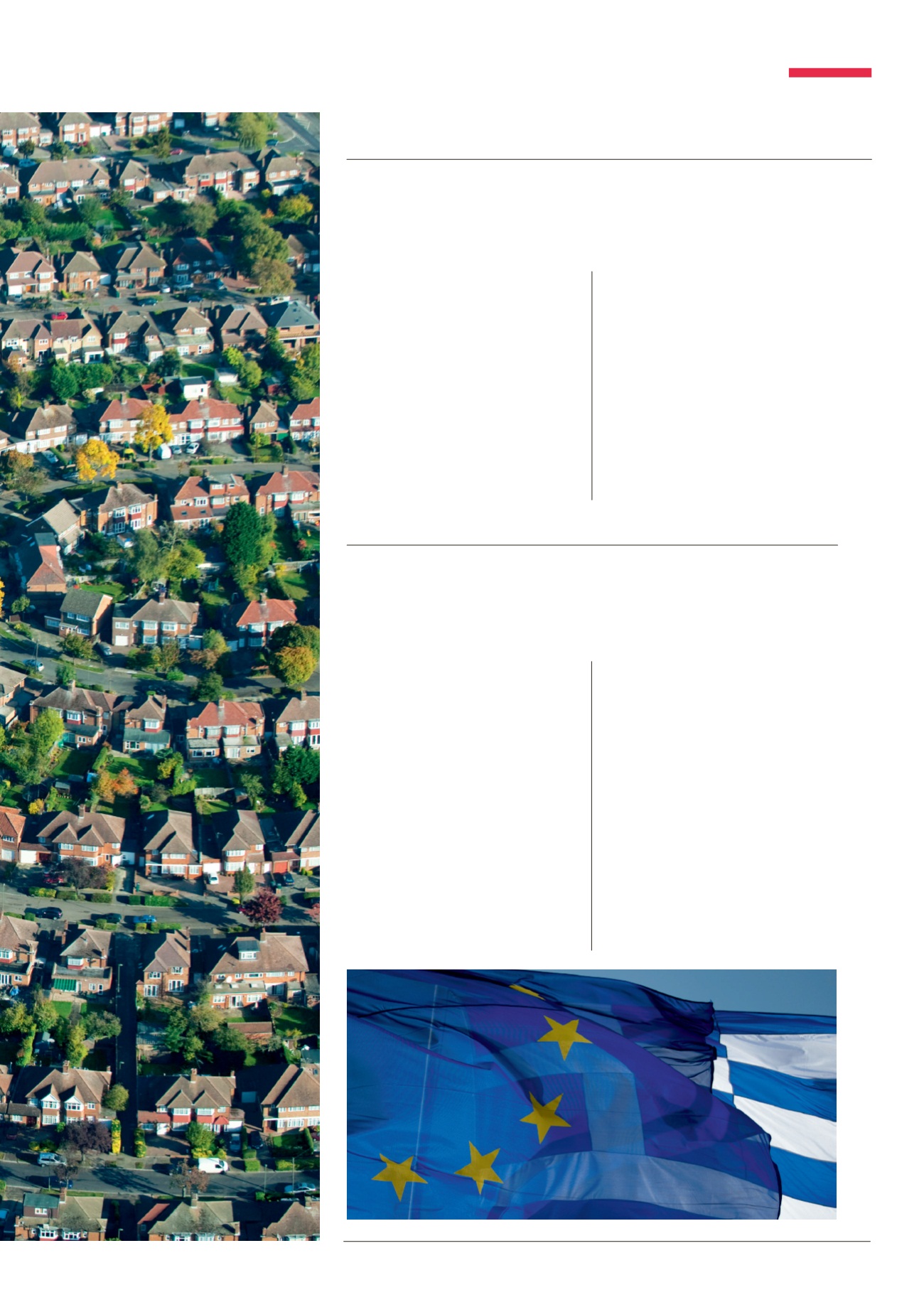
by negotiations over the Greek bailout.
That uncertainty, coupled with the impact of the
stimulus programme, pushed the euro to its lowest
level against the dollar in more than a decade.This
UK
GROWTH FIGURES POSITIVE AS RECOVERY GATHERS PACE
Election pledges show differing economic strategies as UK tops IMF list
GLOBAL ECONOMY
US DROPS PATIENCE PLEDGE ON INTEREST RATE RISE
Major markets look to differing fiscal programmes to stimulate growth
spending under the plans outlined in the Budget,
with a ‘much sharper squeeze on real spending
in 2016-17 and 2017-18 than anything seen
over the past five years, followed by the
biggest increase in real spending for a decade
in 2019-20’.
While the March Budget was a useful snapshot
of where we have come from, we will not have
a clear picture of where we are going until the
new administration produces the first of its own.
One thing that is clear is that the economic
strategies unveiled by the rival parties during
the General Election campaign show just how
different that Budget could look, depending on
who is the new Chancellor.
may help European exports, but strategists are
starting to worry about the impact of the dollar’s
strength on global companies.
In Asia, China has reduced its growth target
from 7.5% to 7%.While that is still impressive in
a world where growth is hard to come by, it will be
the lowest in more than two decades – and there
are questions over whether it can actually be
achieved. Japan’s much-vaunted ‘Abenomics’
programme of QE and market reforms is also having
a slower impact on deflation and growth than had
been hoped.
Despite the uncertainty, most developed stock
markets remain relatively buoyant.While some of
that is undoubtedly due to the lack of alternative
investments, given low interest rates and the impact
of QE on bond prices, it also reflects the fact that
companies are in reasonable shape and that
dividend income is still relatively healthy.


