18
|
THE INVESTOR
IN YOUR INTEREST
BACK TO THE FUTURE
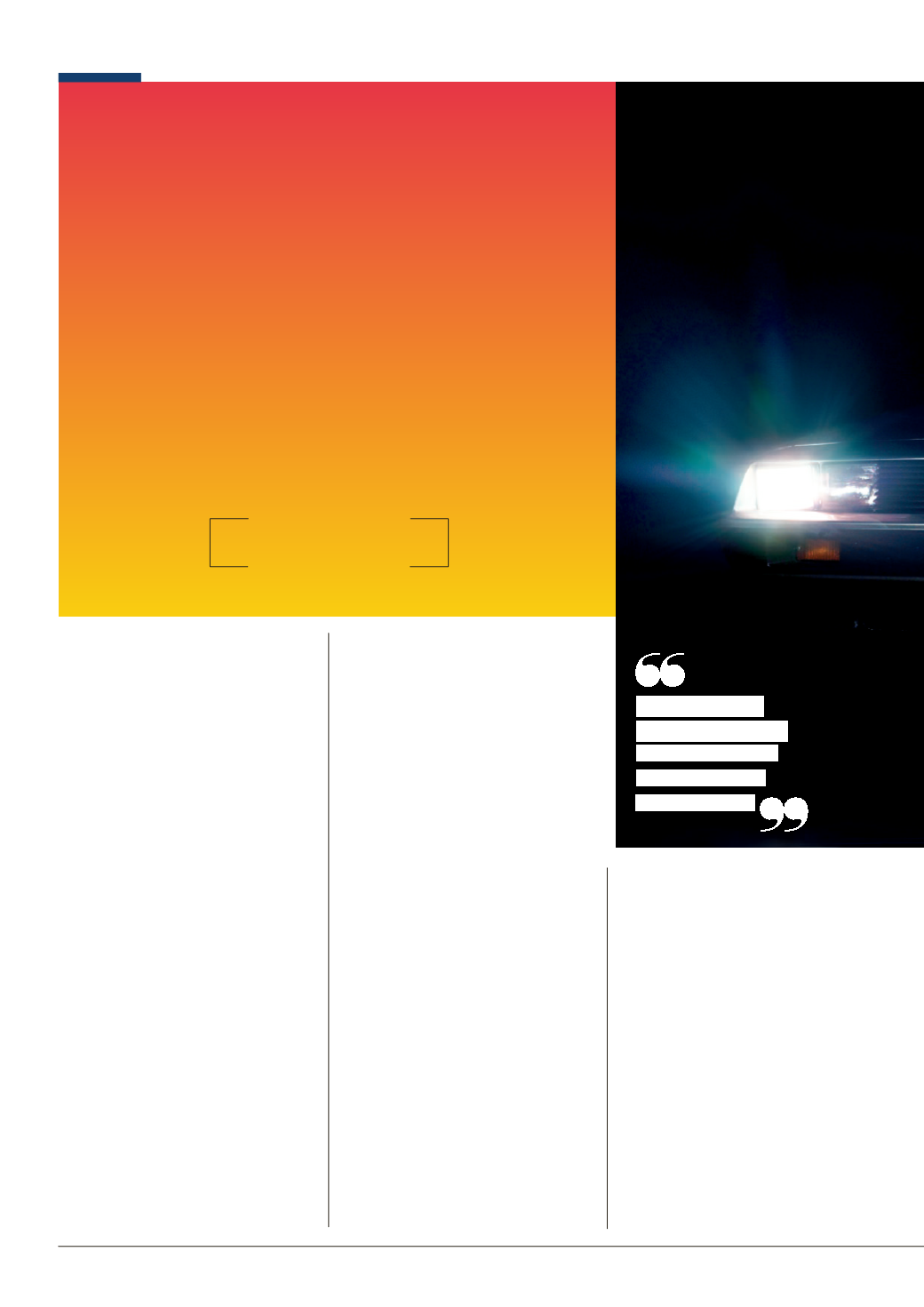
It’s 30 years since the film ‘Back to the Future’
was released. Did the trilogy’s bold predictions
about the future come true?
By Heather Farmbrough
shakier now. Our lives, and the way in
which we interact with each other, will be
transformed.
We may become hypochondriacs,
caused by wearing a range of sophisticated
devices that could allow us to monitor our
health. Devices such as Fitbit are already
encouraging us to monitor our activity
and calorie intake. Common viruses could
be harnessed to help ght diseases like
cancer. Most – if not all – surgery could be
performed by robots.Our domestic lives
could also be made much easier as we use
robots to do everything from vacuuming
the carpet to answering the door, and
our fridges will tell us when they need
replenishing.
Once brain implants have been
developed, coupled with advances in genetic
T
hirty years ago, the rst lm
in the
Back to the Future
trilogy hit the screens.
A youthful Michael J Fox
played Marty McFly, an
American teenager who is transported back
to 1955 in a DeLorean DMC-12, which
has been converted into a time machine by
the eccentric inventor Dr Emmett Brown.
McFly bumps into his parents and their
high school colleagues – a meeting that
will change all their lives. But the issues
that preoccupy Marty and his parents in
1985 and 1955 are timeless: love, family,
relationships and work.
The year 1955 saw the opening of
Disneyland in California, while in the UK
The Archers
was rst aired on radio. In the year
that Rosa Parks refused to give up her seat
on a bus to a white man – sparking the civil
rights movement inAmerica – it would have
seemed as inconceivable that Barack Obama
would be president of the US in 2015 as it
did to the residents of HillValley in 1955 that
a black man (GoldieWilson) would be its
mayor in 1985. It was also the year in which
Steve Jobs was born – at that time there were
only 250 computers worldwide.
By 1985 the McFly family has a Mac
computer, while Doc Brown has embraced
technology with an electric can-opener
in his kitchen. But it is in the sequel,
Back
to the Future Part II
, where the technology
really takes o . Marty travels to 2015 and
the lm features ying cars and hoverboards
rather than the luxurious driverless cars
that Mercedes,Audi andTesla are currently
developing.While technology will clearly
reduce the workload for some, these show
how it will create more work in other areas:
lawyers in California are currently working
on legislation to cover these vehicles – being
computer-controlled, it is unlikely that they
will be involved in as many accidents as
conventional road vehicles.
While critics may enjoy spotting
predictions that have failed to materialise
or developments notable by their absence,
such as the internet, the lm-makers
weren’t completely wide of the mark.The
high-tech specs worn in the lm perform
many of the functions of Google Glass,
while, as in the lm, we have ngerprint and
facial recognition in the form of biometric
identi cation. Petrol pumps are no longer
manned, although they are not yet run by
robots; it seems unlikely that petrol retailers
would invest in such technology now given
that we do the lling up for them.
As technological change takes place at
an exponential rate, our ability to predict
30 years into the future must be even
Our ability to
predict 30 years
into the future
must be even
shakier now


