Gallery Stock, Press Association, Reuters
This small island in the Pacific Ocean has
grown to be a global force to be reckoned
with since it achieved independence
By Heather Farmbrough
16
|
THE INVESTOR
O
n 9August this year
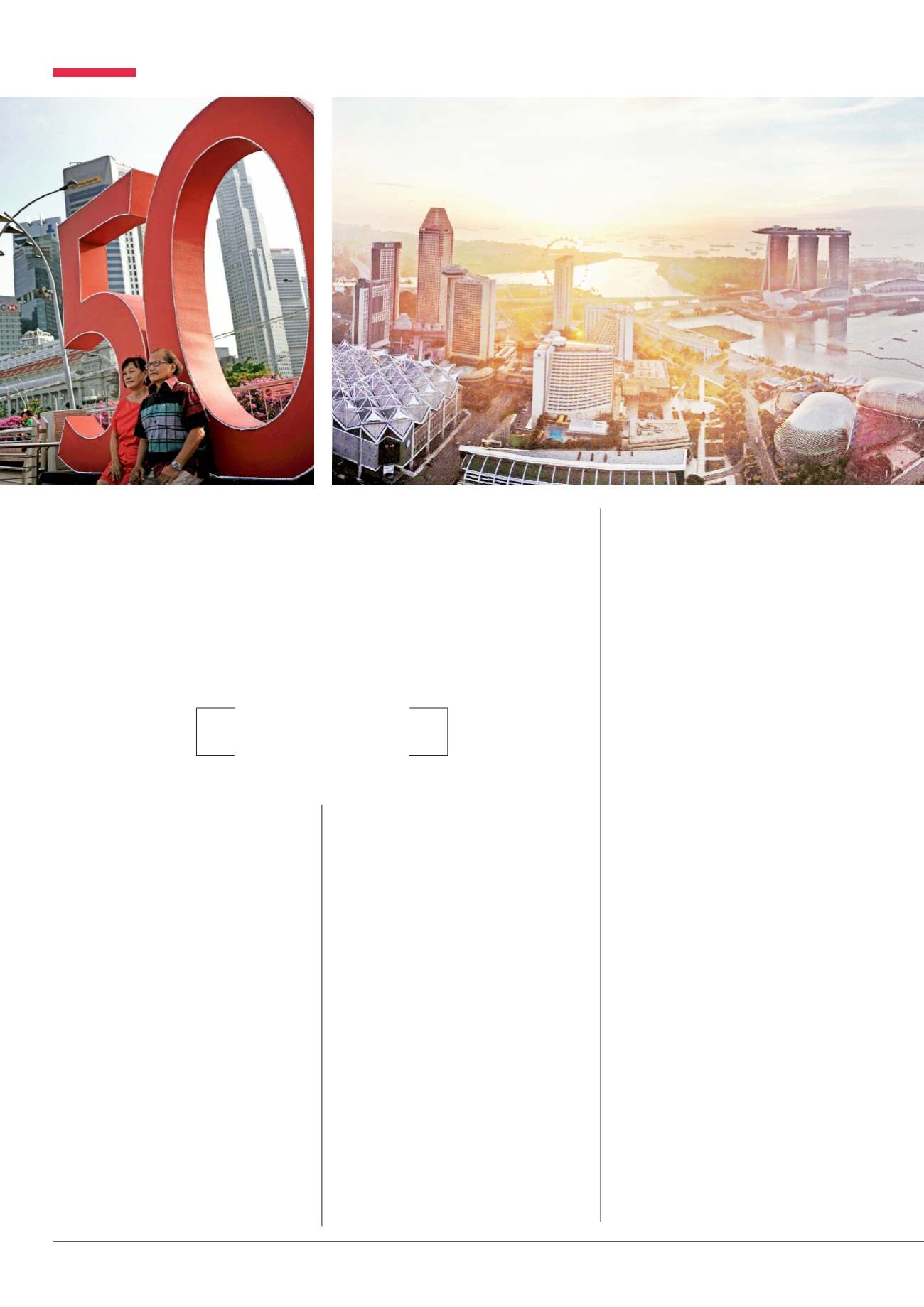
Singapore celebrated 50
years of independence
with fireworks and events
across the island. It has
become independent twice; once from the
British when it was decolonised in 1959, and
then in 1965 when it was expelled from the
Federation of Malaya.
Fifty years ago Singapore was a poor
tropical island with few natural resources,
no compulsory education and a potentially
explosive racially and religiously diverse
population.Today it is a stable country –
a global financial and export centre with
some of the world’s most highly skilled
workers. It has also been successful; over the
past five decades GDP per capita has
increased at a 10% compound annual rate
1
.
That record is a tribute to Lee KuanYew,
the country’s first Prime Minister, who died
earlier this year. He set out to unite the
ANALYSIS
RUSSIA
singaporeat50
different races and create a new, united
nation. Economic success was regarded as
essential, not just for economic development
but to help stabilise the country politically.
Singapore was historically one of the
world’s busiest ports, thanks to natural
resources nearby like palm oil in Malaysia
and oil in Jurong, but Lee’s government
had more ambitious aims and set out to
expand Singapore’s economic base. Initially,
the government focused on attracting
foreign manufacturing companies with
a low-cost workforce, but competition
from other Asian countries towards the
end of the 1970s led to a realisation that
it needed to evolve into a more highly
skilled economy.
The government began to focus on
education and eventually created a system
that enabled the more academically gifted
students to excel.Today, Singapore’s
education system is one of the best in the
world, withTIMSS (Trends in International
Mathematics and Science Study) regularly
rating its students top in both maths and
science.This has helped Singapore to evolve
over the past two decades into a leading
centre for research, science and technology,
with government incentives introduced
to attract major pharmaceuticals and
technology companies.
During the oil boom of the 1970s,
Singapore became regarded as one of the
most desirable locations for expatriates,
enhanced by a combination of fiscal and
regulatory incentives.With zero tolerance
for crimes of any kind – including dropping
chewing gum and litter in the street –
Singapore became, and has remained, one
of the safest places in the world.
Visitors are often struck by the general
obedience of the population: staff smile
at customers in shops (as they have been told
to do) and comply with requests to share
their cars in the rush hour. Lee’s government
was one of 10 referred to as a ‘benevolent
dictatorship’
2
. Freedom of expression in
Singapore is limited, but there is a
communal interest in ensuring the island’s
stability and civil order, essential for the
livelihoods of the island’s working
population of around 3.5 million, as well
as for its 1.3 million expatriates
3
.
Lee’s government also set out to create
a premier financial trading centre with
tax incentives for foreign companies and
zero tolerance of corruption. Last year,
St. James’s Place acquiredThe Henley
Group, the Singapore-based financial


