32
|
THE INVESTOR
THE INVESTOR CENTRE
All information correct as at 30 September 2015
T
he internet is both a challenge and an
opportunity for companies globally, and
it’s a subject of frequent debate in our team.
It has had a dramatic impact on a wide
range of industries: manufacturing
companies now discuss the risk that factories
and processes may be hacked, tampered with
or copied, while at the same time they are
very positive about how connectivity will
improve e ciency. Many retailers have
complained about the internet as Amazon
outmanoeuvres them. ButTesco dominates
the UK online grocery business, which
could be the future of its franchise, and
IKEA has continued to aggressively expand
with a minimal online presence.
The‘sharing economy’ could change
demand patterns in automobile sales, with
BMW a leader in the concept. Ultimately,
some companies will thrive as the world
changes and others will not.
The increasingly bubble-like valuations of
some markets and, in particular, internet
and biotechnology-related sectors, raises
serious cause for concern. Consequently,
we have very little exposure to technology
companies other than a small, much-
reduced holding in Microsoft.We bene ted
from strong performance by US nancial
stocks Chubb Corp and Markel Corp.
We will continue to try to protect clients
from the coming storm – we are now six
years into a market whose main fuel,
money printing, has never ended up being
good for shareholders.
FIRST STATE
Joint manager: Worldwide Managed
and Worldwide Opportunities
Fund continues to steer clear of tech
stocks due to bubble-like valuations
Global connectivity
will lead towinners
and losers
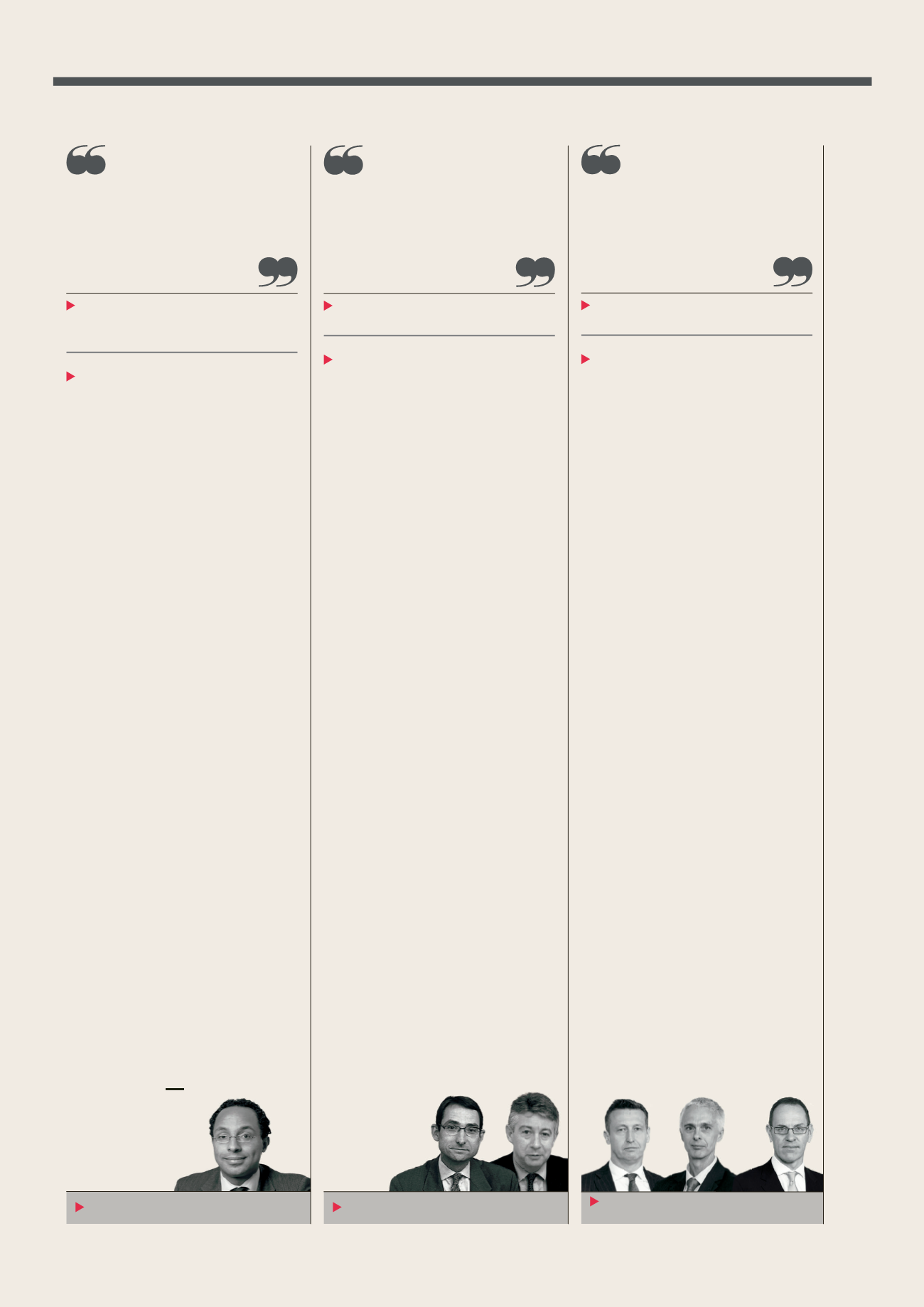
Jonathan Asante
S
tock-market nervousness turned into
outright panic inAugust as China’s
failed attempts to halt the slide in the local
Shanghai stock market culminated with
the central bank devaluing the renminbi on
11August.While it is di cult to quantify
the real impact of slowing growth in China
on the global economy, the market impact
was very real as the sell-o spread from
China, through the emerging markets and
led to a correction in many developed
equity markets.
Volatility has increased across a number
of asset types and emerging markets’
currencies weakened signi cantly.We have
not changed our exposure as a result of the
market sell-o .We take a two- to three-
year view of markets and expect our ideas
to contribute over that timeframe.
At the same time, we are aware that
markets can be volatile over shorter
periods and think carefully about how
we implement our investment ideas to
try to cope if market dynamics change.
For example, our long-equity ideas are
structured in such a way that we are not
exposed to the full extent of market falls.
Furthermore, a number of our ideas take
a relative view of markets that should be
driven by fundamentals between di erent
countries and asset types, rather than
directional market moves.
INVESCO PERPETUAL
Multi Asset
Taking a two- to three-year view
of markets avoids panic selling
Investment plans need
to take into account
market volatility
T
he three-month period has been
challenging for high-yield bond markets.
The apparent resolution of the Greek
crisis in early July helped remove a
signi cant source of uncertainty from
nancial markets which, in turn, helped
high-yield bonds rally and regain some of
the losses of the previous month.
However, more recently the economic
slowdown in China and fall in commodity
markets have caused sentiment to once again
become negative with high-yield bond yields
rising throughAugust and September. Given
the sharp fall in commodity markets, metals
and mining companies have been some of
the biggest underperformers in the asset
class.Volatility in the performance of a few
individual companies throughAugust also
negatively impacted on the performance
of broader high-yield bond indices.
After picking up in July, market
uncertainty – combined with the usual
seasonal lull in capital raising – saw issuance
fall duringAugust. Barclays estimates
approximately €10 billion of European high-
yield debt was issued in the two months.
Looking ahead, we remain defensive and
continue to hold high levels of liquidity in
the fund. Our focus is on well-established
high-yield names that we believe to be
default remote. One part of the market that
we think continues to provide a reasonable
balance of risk and reward is subordinated
nancials.
INVESCO PERPETUAL
Corporate Bond
Remaining defensive as market
volatility affects high-yield bonds
Challengingmarket
leads tonegative
returns inbondmarket
Paul Read and Paul Causer
David Millar, Dave Jubb and
Richard Batty


