38
|
THE INVESTOR
THE INVESTOR CENTRE
All information correct as at 31 December 2015
A
fter a third quarter dominated by
risk aversion, October saw a strong
revival in risk appetite with global equities
rebounding from the dip at the end of
August, and bond yields moving higher in
most developed countries.This move was
extended in November as markets reassessed
the likelihood of a US interest rate hike
before the end of the year, given the strength
of the US economy; as a result, US Treasury
yields rose further. Heightened geopolitical
tensions, however, pushed yields lower mid-
month.The strong divergence in monetary
policy between Europe and the US was
highlighted as the European Central Bank
extended its quantitative easing programme
by six months, and cut deposit rates to -0.3%
from -0.2%.
The portfolio’s allocation to high-yield
bonds was the largest contributor in
October, as the sector bene ted from the
risk-on environment, while higher-quality
sectors and those sensitive to interest rates
underperformed. In November, the relative
performance between asset classes was
reversed, with investment grade credit
adding to returns, while high-yield debt and
bank loans detracted.
Active foreign exchange positioning once
again enhanced returns, as the US dollar
appreciated versus the euro and the Chinese
renminbi. Our strategy continues to favour
dollar-denominated credit assets that o er
attractive yields relative to comparable global
government and emerging market securities.
PAYDEN & RYGEL
Joint manager: Diversified Bond
and Multi Asset
Active focus on foreign exchange
positioning enhanced returns
Returnof risk appetite
inOctober sawglobal
equities rebound
O
ccupier demand for good-quality UK
commercial property remains positive.
The labour market is showing continued signs
of improvement, interest rates and in ation
remain low and the consumer economy is
strong.A lack of speculative development in
the majority of property markets is creating
supply shortages, contributing to widespread
rental value growth.
As expected, over the second half of 2015
there was a reduction in the rate of capital
growth attributable to yield compression,
with rental income and asset management
becoming increasingly central to generating
property returns.The property portfolio has
a diverse range of good-quality institutional
stock, a variety of strong tenant covenants
and low vacancy rates. It is thus well-placed to
continue to generate strong income returns.
The strength of the occupier market and
quality of the portfolio have enabled us to
complete some 45 lettings on 300,000 sq ft
of space, representing £5.6 million in rent for
the year; and a further 16 lease restructures
on 200,000 sq ft representing £5.7 million
in rent.With a further 21 deals in hand on
250,000 sq ft and £3.2 million of rent, this
trend looks set to continue.
Despite the investment market remaining
competitive, total acquisitions for the year
are on track to surpass £400 million. Notable
purchases during 2015 included Snipe Retail
Park in Greater Manchester, St George’s
House,Wimbledon, and theTempleback
o ce building in Bristol.
ORCHARD STREET
Property
Portfolio is well-placed to continue
generating strong returns
Occupier demand
and rental value are
growingwith supply
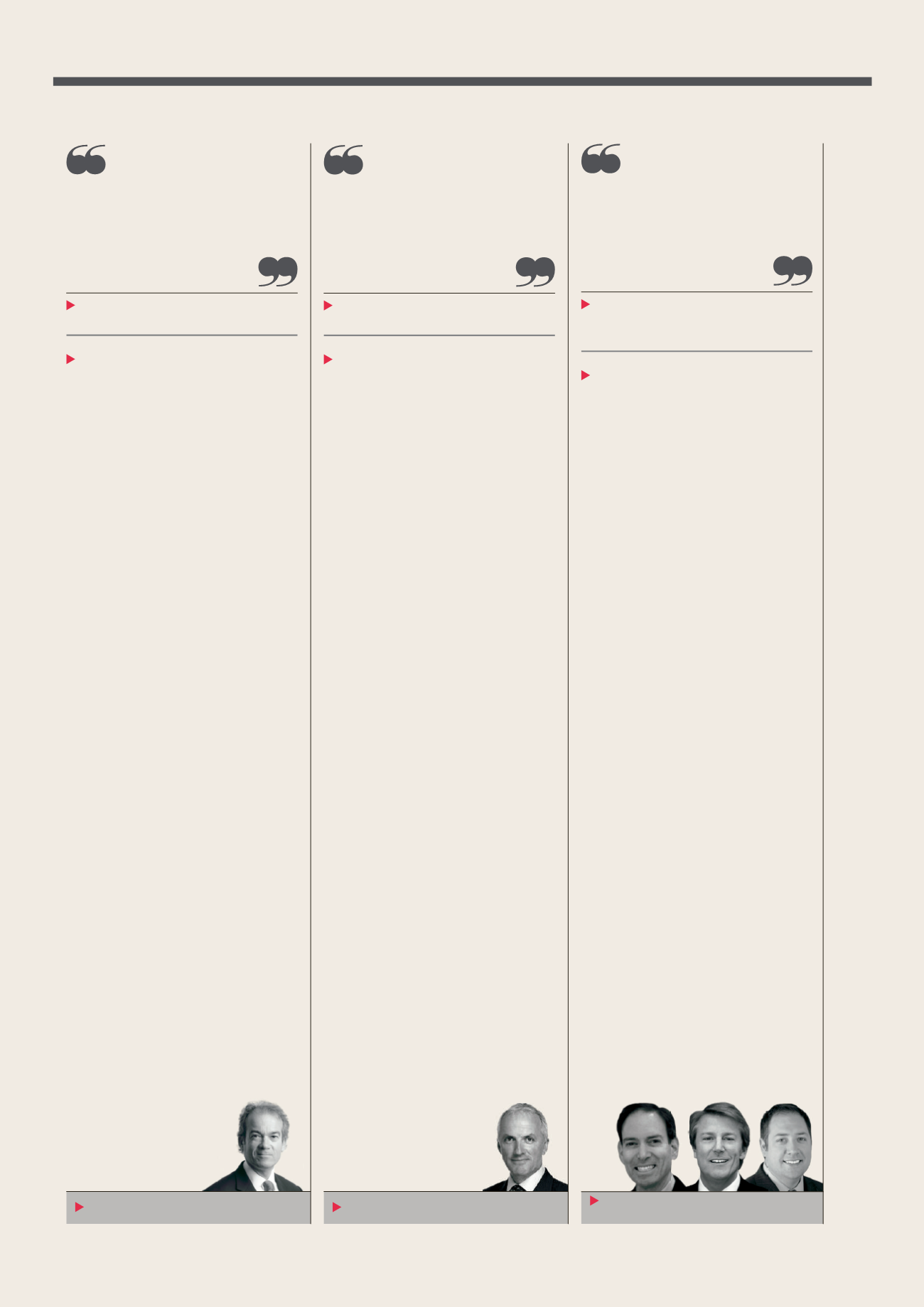
Philip Gadsden
Scott Weiner, Brian Matthews and
Brad Boyd
R
ioTinto’s price/book and price/sales
ratios, both 1.5, are almost the lowest
they have been since 1991. Its dividend yield
is 7% and the company is rmly committed
to maintaining the dividend. In spite of this
commitment, the management has felt
strong enough to plan anAustralian bauxite
project which will cost around $1.9 billion,
estimated to have a return on capital of 20%
(despite the depressed price of bauxite).
We cannot predict commodity prices;
nonetheless, we invest in commodity
companies when they are deeply
unfashionable because, at these times, future
returns tend to be severely underestimated
and hitherto undeveloped projects are often
ignored in the market valuation. RioTinto
spent $42 billion in 2011-13, on which its
required return will have been well over
15%. It would not get 15% now; but even
with, say, 7.5%, these projects could produce
ultimately around $3 billion of incremental
pro t – and this for a company with a market
capitalisation of only $60 billion.
Our last phase of investment in RioTinto
was in 2009-11, at the beginning of which
the world appeared to be crumbling; but it
did not crumble, and the investment gave an
excellent return.The shares again re ect a
crumbling world economic view; and again,
if the world does not crumble, we expect an
excellent return, even if we have to be patient
to get it.
OLDFIELD PARTNERS
High Octane
Low price of Rio Tinto offers chance
of strong returns for patient investors
RioTintomayo er
value despite falling
commodityprices
Richard Oldfield


