analysis
news
THE INVESTOR
|
05
Alamy, Reuters
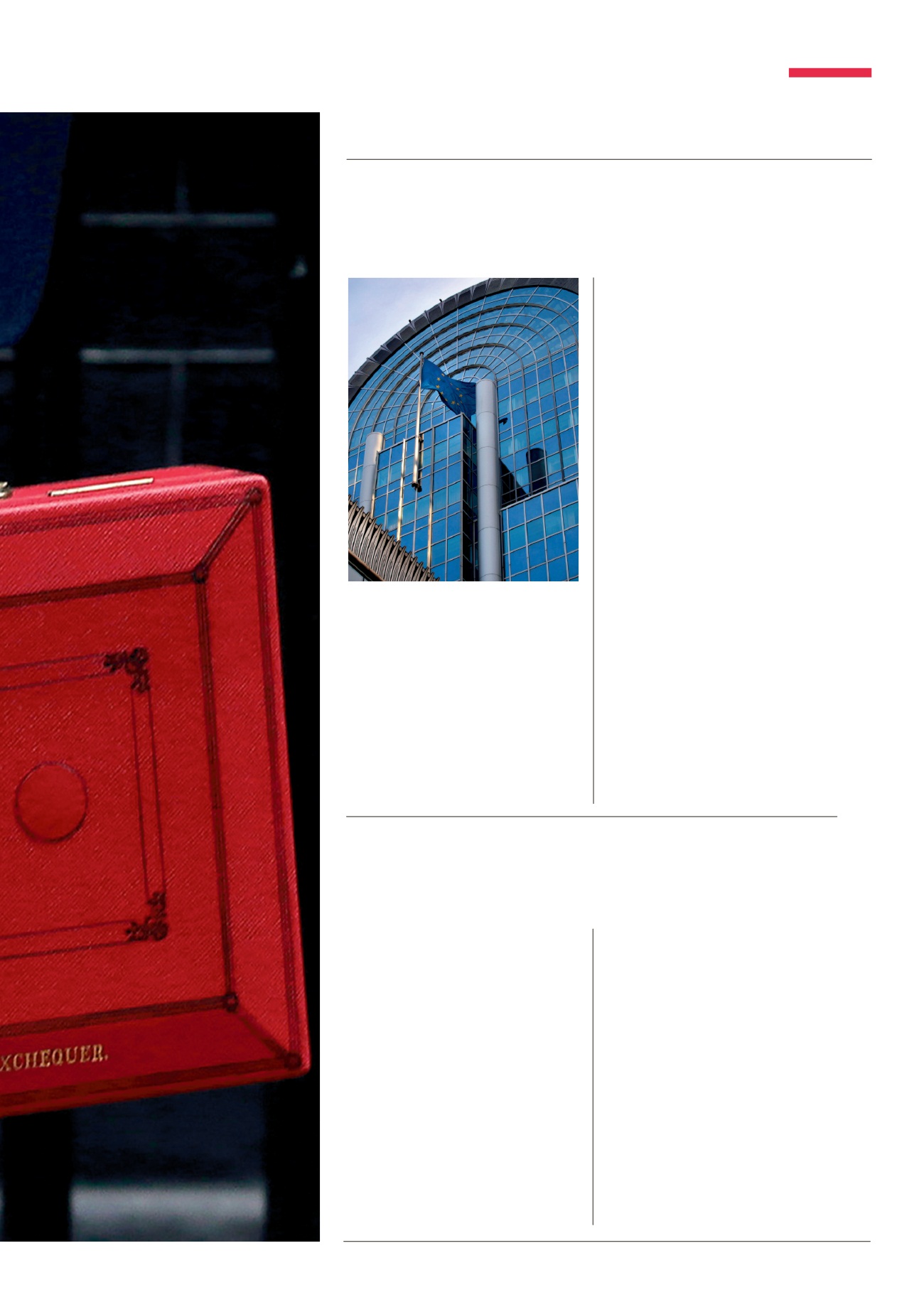
Europe goes to the polls at the end of May
with elections to the European Parliament.
Historically, such elections have been of pressing
interest only to the most ardent of Europhiles
and psephologists; this time round, however,
they are already attracting interest from the
financial community.
That is because these elections are likely to
produce significant advances for anti-European
parties, of both the right and left, as voters across
the European Union seize the chance to register
their protests against austerity, high rates of
unemployment and the perception of growing
More than three million employees have now
signed up for workplace pension schemes
as part of the government’s auto enrolment
scheme
1
, designed to encourage us all to provide
more for our retirement. A further eight million
are expected to sign up
2
before the rollout is
completed in 2018. Their employers need
to make sure that they have established a
scheme to comply with the roles.
Auto enrolment started in 2012 with the
largest employers required to sign up first. Now it
is being extended to smaller employers: those with
61 employees or fewer have to comply between
August 2014 and April 2017, with the exact date
depending on the number of employees and, for
smaller firms, PAYE reference codes.
It is not just companies that are affected:
anyone with employees aged between 22
and the state retirement age who earn more
europe
finance chiefs look to eu elections
Protest votes against austerity measures could lead to pressure
for change to eurozone economic strategy
uk
auto enrolment sees growth of pension uptake
Three million employees sign up for workplace pension schemes
as auto enrolment programme continues rollout
inequality across the region. It is still too early
for opinion polls to start firming up their
predictions on how large these protest votes
will be, but parties such as the Front National
in France, Britain’s UKIP and the Freedom Party
in the Netherlands are expected to increase their
representation in the parliament.
There is concern that a rise in the anti-Europe
vote could lead to pressure for a change in the
economic strategy across the eurozone. That
strategy is not yet showing spectacular results,
but growth is gradually resuming: the latest EU
forecasts are for growth of 1.2% in the eurozone
area this year and 2% in 2015.
Unemployment is still an issue, with the average
across the eurozone expected to be above 10%
next year, and more than twice that in Greece
and Spain. But ever since European Central Bank
president Mario Draghi promised to do whatever
is needed to save the euro, speculation about
a break-up has effectively ended.
While a rise in extremism may make political
debate in the parliament rather stormier, it is
unlikely to lead to sudden or sweeping changes
to the economic policies.
Draghi, for example, is in office until 2019;
while Angela Merkel, the German chancellor
who is the de facto European leader, has just
been re-elected with a greatly increased majority.
The performance of European companies
and stock markets remains relatively healthy.
While the European recovery has some
way to go, the elections are unlikely to do
much to derail it.
than £10,000 a year has to enrol them in
a pension scheme unless they specifically opt
out – and the list of employees could include
a self-employed individual employing their
spouse. Complying with the rules takes time
and administrative effort.
The opt-in process has to be repeated every
three years; salary levels have to be checked
annually; and employees whose salaries are
below the opt-in threshold still have to be given
information about the scheme. Employers with
their own scheme have to ensure it complies
with the requirements; others have to decide
which of the available schemes to join.
In short, every employer who has not yet
reached their staging date should already be
working hard on preparations.
1 & 2 The Pensions Regulator, March 2014


