08
|
THE INVESTOR
ANALYSIS
UK ECONOMY
Gallery Stock, PA Photos
Whereas the US
imposed a lot of fiscal
austerity last year,
in the UKwe
front-loaded it
rise in wages until relative slack in the
labour market is taken up, when temporary
or part-time workers move into full
employment.’
Kern thinks the Bank’s estimate of spare
capacity being between 1% and 1.5% of
GDP
is reasonable.‘It could even be a shade
higher.We don’t know how much there
really is in the system. It’s hard to measure
from business surveys.’
Apart from spare capacity – which the
Bank sees as good reason to keep interest
rates low – other factors may be holding
back business investment. Hawksworth
points to the tendency, going back ten
years now, for businesses to run large
nancial surpluses rather than making
major investments.‘They prefer to retain
a strong cash position or give more back
to shareholders.’
Political uncertainty also plays its part.
Eurosceptics are expected to do well in
this year’s European elections, and the
next general election seems to promise
a government that is either less ‘business-
friendly’ or one committed to a referendum
on Britain remaining within the EU.
Neither prospect is welcomed by
international investors.
Then there is Scotland.The very
possibility of secession from the UK is
already holding up investment projects
there, according to professor Robert
E.Wright of Strathclyde Business School;
and should the ‘Yes’ vote prevail it will
be a drag on economic growth, not just
in Scotland, but across the whole of the UK.
A salient weakness in the recovery is the
continuing trade de cit and slow export
growth.‘Since the dismantling of much of
the UK’s mass-production base in the 1980s,
we’ve never managed to have an export-
led recovery,’ says professor Goodhart.
Certainly, exporters are not helped by
a strong pound, but asWood points out:
‘Sterling is still far more competitive than
before the crisis.’
Professor Goodhart notes that today’s
more specialised, high-quality exporters
are not particularly price-sensitive; and
that since UK exports are very heavily
directed towards Europe, they should
bene t from recent signs of recovery within
the eurozone.
Another perceived weakness is the UK’s
excessive reliance on services – particularly
nancial services – and regional imbalances.
But as professor Goodhart points out:‘The
trend away from manufacturing towards
services is not speci c to the UK. It’s
common among all developed economies –
with the exception of Germany.’
Hawksworth adds:‘While London
and the south-east have bounced back
quickly and are leading the recovery, other
regions have lagged behind – especially
those like Scotland, Northern Ireland and
the north-east which rely on public sector
employment more than the south-east.
However, all UK regions are now showing
some signs of recovery.’
Wood warns that the recovery is not
yet broad-based and that the current
mix of consumer and business growth is
unsustainable. He expects productivity to
pick up next year with a rise in real wages.
He also notes that ‘the structural problems
of continuing trade de cits and the chronic
lack of savings and investment remain’.The
rate of household savings has dropped from
8% to 6%, and over the longer term‘the
economy cannot grow when households are
saving less and less’.
So while he doesn’t see growth rates
returning to pre-2007 levels,Wood is
optimistic about the UK economy.‘If we
manage solid 2.5% growth over 20 years
that will make us much more a uent.’
Balance sheet
With credit flowing, house prices on
the rise and unemployment coming down, the UK
economy is surging ahead. But is the recovery sustainable
and what measures need to be taken to avoid a repeat
of the fiscal troubles of 2008?
FORWARD THINKING
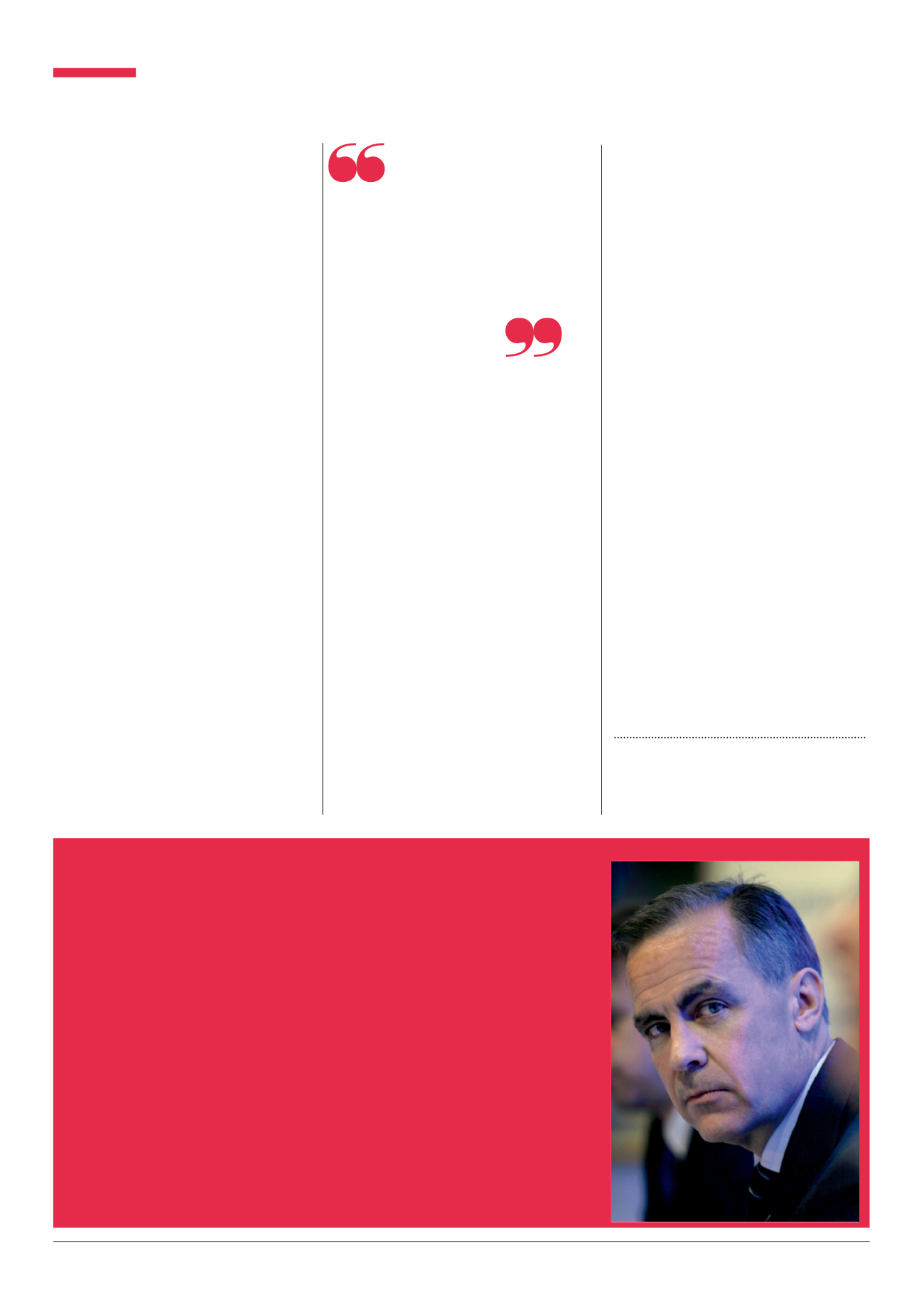
On becoming governor of the Bank of England, Mark
Carney (right) set out a policy of forward guidance on
interest rates intended to give markets and businesses
greater confidence.The key indicator was unemployment:
when this dropped to 7% the Bank would consider
raising the base rate.
Since then, UK unemployment has fallen faster
than expected to near that trigger point. Unwilling to
raise interest rates too soon and choke off the fragile
recovery, Carney has changed the focus of forward
guidance to indicate that rates will change when factors
like spare capacity and estimates of future productivity are
showing signs of improvement. Some critics claim this
change of tack has damaged the Bank’s credibility.
‘I always thought forward guidance was a bigger
success among businesses than it was with City
analysts,’ said Kern. ‘Carney has always said that the
Bank would keep interest rates as low as possible for
as long as possible. Businesses expect him to do that,
though it is worrying that some influential voices are
calling for an earlier rise.’
Professor Goodhart adds: ‘The Bank’s underlying
message is clear: no rise in the immediate future, and
when rates are raised it will be done slowly.’
The other key factor in deciding interest rates is inflation
which, for the first time since the crisis, has fallen below
the Bank’s 2% target. Hawksworth believes that ‘in the
short term, inflation could go even lower’.
So when will rates rise? ‘We think interest rates will start
going up in the first quarter of 2015,’ saidWood, rising
thereafter by a quarter of a percentage point every three
months or so, to between 2% and 2.5% by early 2017.
Kern anticipates no rise until later in 2015. ‘If there’s
strong growth in the economy, that’s not an issue.’ He
then expects rates to be raised gradually, as their profile
over time is equally important.
The basic message is no change until the recovery is
firmly established, though there are dangers in this. ‘The
longer interest rates are held at rock bottom the faster
rises will come,’ saidWood.
At some point, a return to normalcy is necessary.
Hawksworth warned: ‘We need a higher savings rate in
the UK, so the Bank should aim to move interest rates
gradually back to more normal levels by, say, 2020.’


