



 42 / 44

THE INVESTOR CENTRE
All information correct as at 30 June 2016
A
fter a shaky start to the year, the
UK stock market rallied in Q2
and delivered a modestly positive
return amid volatile conditions and
fragile investor con dence.Concerns
about the prospect of a prolonged
period of slower economic growth
linger in many parts of the nancial
market landscape.
Currently, these concerns are most
evident in the bond market.With
more than $10 trillion-worth of bonds
now o ering negative yields, the bond
market is clearly worried that we face
a global de ationary slump. Equity
markets,meanwhile, have rallied, led
higher by cyclical stocks that would be
most vulnerable to the de ationary
scenario that the bond market fears.
It is di cult to understand how the
contrasting views implied by each
market can both be correct.
We aremore sympathetic to the bond
market’s view.Our portfolios are
positionedwith a realistic viewof the
future inmind,with a preference for
businesses that can deliver secular
growth even in a di cult economic
environment.TheUK’s decision to
leave the EUmay be destabilising for
markets in the near term, but our
conviction is undiminished by the
outcome of the referendum.
WOODFORD
Income Distribution, UK Equity and
UK High Income
Portfolio is positioned around
businesses that deliver secular growth
Concerns over long-
termgrowth linger
in nancialmarkets
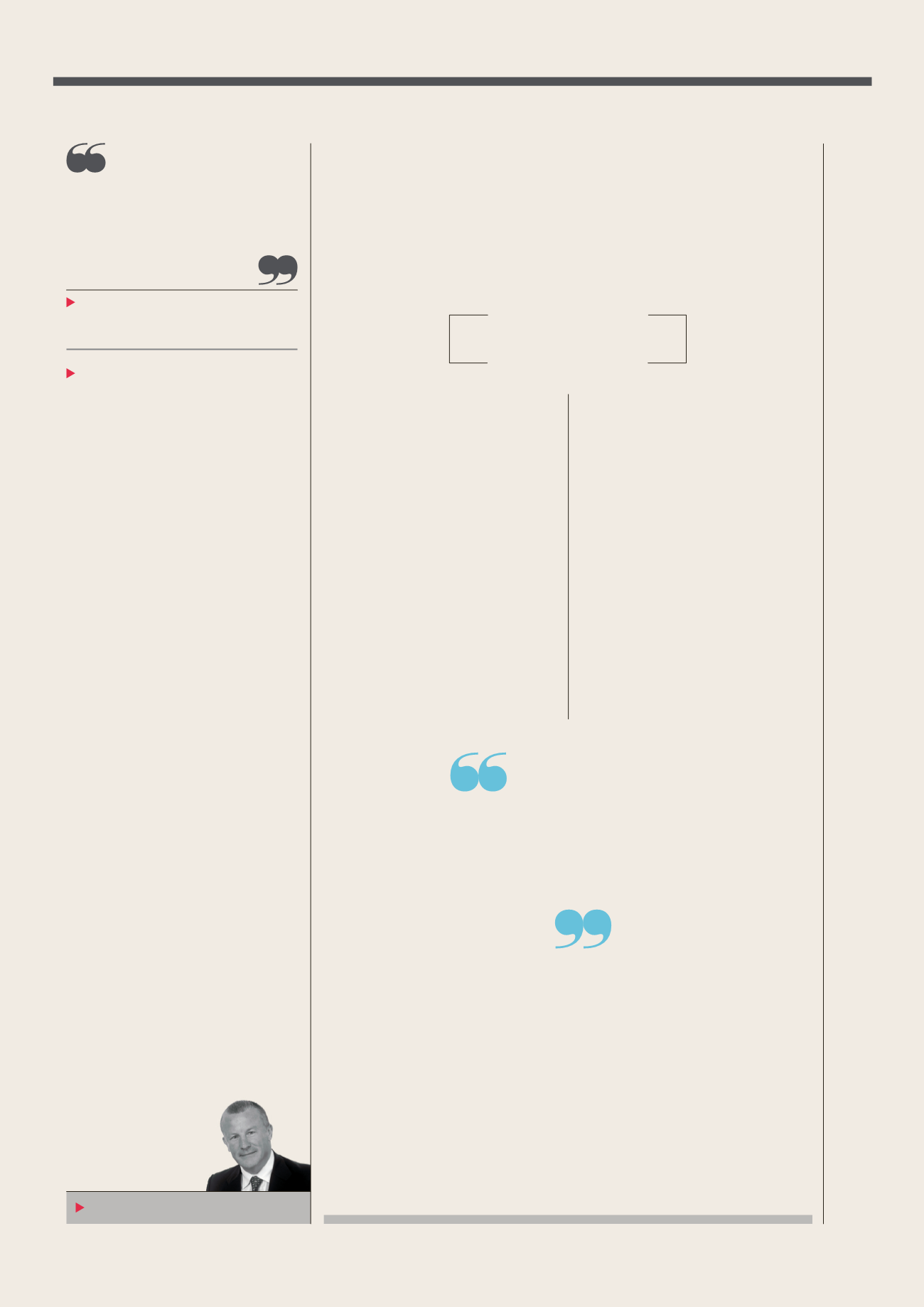
Neil Woodford
By Heather Connon
I
n July 1915,William Boeing
ew in an aircraft for the rst
time. He was so enthusiastic
about this newmode of
transport that, a year later,
he set up Paci cAero Products to
build them. In 1917 he rechristened
it the BoeingAirplane Company,
with a company philosophy of‘Build
Something Better’.
As it celebrates a century in the sky,
Boeing is still synonymous with air
travel; its eet of 737s, Dreamliners
and other commercial aircraft are the
workhorses of the skies. Its defence
division, which was strengthened
by the acquisition
of McDonnell
Douglas in 1997,
sells aircraft and
weapons systems
around the world.
Its engineers and
equipment have
been central to
space exploration
from theApollo launches to the
International Space Station.
In many ways, Boeing’s history
mirrors that of the airline industry
itself.Asthe company says in its
centenary commemoration:‘Born
about one hundred years ago, the
aerospace industry changed the
way we travel,move our goods and
protect our nations during times
of war.The view from above also
changed forever howwe see the
world.Now, after a century of ight,
it has brought us to the moon and
beyond.The sky is no longer the limit.’
Boeing’s aircraft have been at the
forefront of innovation: fromWilliam
Boeing’s original canvas and wood
biplane through to the 247, the rst
modern passenger airline – which
took 20 hours and seven stops to
y fromNewYork to LosAngeles;
to the 707, which was instrumental
in changing the way the public
saw air travel. In defence, its list of
innovations includes the B-52 bomber,
theApache and Chinook helicopters,
and the futuristicValkyrie.
Its nancial record is also strong –
the fact that it has
survived a century
is testament to that.
Over the past ve
years, its revenues
have risen by 40%
and core operating
earnings by 22%
1
,
despite a global
slowdown and austerity packages
across many developed nations.
Next year, its commercial and
space activities will move closer
together with the launch of the
Commercial CrewTransportation
System, a contract between NASA
and Boeing.A small, reusable capsule
will begin space ights in 2017 to
transport crew to and from the
International Space Station – and may
one day be open to paying passengers.
As it celebrates
a century in the sky,
Boeing is still
synonymous with
air travel
A household name in commercial flight, Boeing is
also a major player in defence and space exploration
Boeing – yinghigh
for 100 years
1.
The Boeing Company 2015 Annual Report
, January 2016
42
|
THE INVESTOR