



 23 / 44

THE INVESTOR
|
23
INTERVIEW
F
rances Davies
believes everyone
has their
ownAtlantic
Challenge. Hers
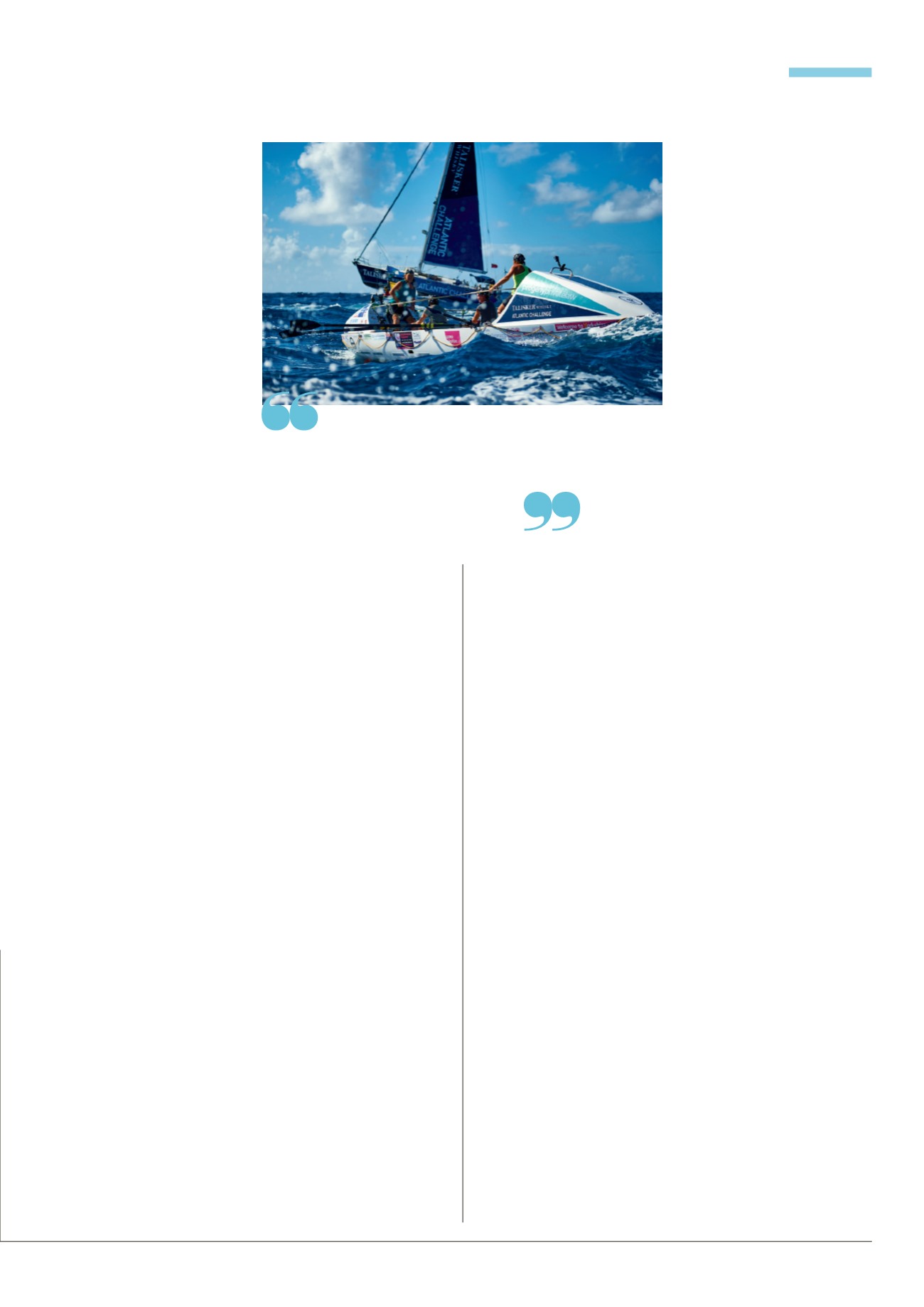
was literal – she spent 67 days
with three friends rowing the
3,000 miles across the Atlantic
from the Canary Islands to
Antigua, becoming the oldest
female crew to row any ocean.
At the presentations and
speaking engagements she has taken part in since completing
the challenge, she has been urging people to write their
ambitions down on a piece of paper – and to work out how
to achieve them.
Frances is someone who relishes a test: she has completed
two London marathons and a Scottish coast-to-coast challenge
that involved cycling, running and kayaking. But the Talisker
Whisky Atlantic Challenge was of a different order; more
people have been into space than have rowed the Atlantic.
None of the four-strong crew were seasoned rowers.
Indeed, they only met four years ago when they joined their
local rowing club. Frances suggested the challenge to the other
three – Janette Benaddi, Helen Butters and Niki
Doeg.Aspart of the training, the crew rowed the North Sea. Frances
thinks they were the first female crew ever to do so, although
she admits that completing the 100-mile journey ‘was a
bit like training for a marathon with a 100-metre sprint’.
Otherwise, their training mainly involved one-hour daily
gym sessions on weights or rowing machines.
Teamwork and co-operation were crucial. Each crew
member had an allocated role – Frances was in charge of
navigation while Janette acted as skipper – and there were
ground rules, including saying ‘just saying’ if any of them
wanted to mention something that was irritating them, to try
to depersonalise
things.Animportant piece of advice came
from Charlie Pitcher, a veteran of rowing challenges who
designed and built their boat,
Rose
.‘He told us that, collectively,
we should not think about ourselves,’ says Frances.‘You should
think your job is to look after the others on the boat. If you all
do that, you will not have to think about yourselves as you will
have three other people doing it for you.’
That philosophy helped them through periods
of homesickness,
claustrophobia, fear of the
dark and giant waves.Two
of them rowed in two-hour
stints while the other two
slept. However, that routine
was abandoned for the
final 1,000 miles when the
automatic rudder broke,
meaning two had to row and
one looked after the steering
while the other one slept.
‘There were tensions but we tended to find that, if one
person was irritated with the others, someone else had
patience and empathy in that moment,’ says Frances.‘We
learned to embrace all difficulties.
‘I actually felt less stressed than normal. It was so peaceful
– most of my responsibilities had gone.All I had to look after
was this group of people.’
The actual row may have taken 67 days, but the journey to
the starting line took two and a half years.The four of them
organised a fundraising drive in order to get the £100,000
needed for the cost of entry, the boat, equipment and expenses.
They also aimed to raise money for two charities –YorkshireAir
Ambulance and Maggie’s Centres, for cancer care – and expect
to be able to divide more than £100,000 between the two.
DianeWatson, the St. James’s Place Partner who has been
advising Frances for 20 years, was one of the first to donate,
an illustration of the close and co-operative relationship
between the two. ‘She knows my work, my family and my
relationships inside out. I see her as a friend,’ says Frances.
‘She makes the effort to go the extra mile to understand what
I want; I am not just a set of numbers on a piece of paper.’
She also had to have absolute support from her family
and employer, Progeny Private Law. The latter had to be
particularly understanding as she established it with three
colleagues in July 2015, just five months before the race
was due to start.
Frances confesses that she and her three rowing mates are
now looking for a new challenge.‘I do not want to take three
months out again until my children, who are aged 13 and 15,
are older,’ she says.
However, she is determined to rise to another challenge
with the three women she now calls her sisters.
Completing the 100-mile journey
‘was a bit like training for amarathon
with a 100-metre sprint’
Ben Duffy, Lorne Campbell/Guzelian