


 25 / 40

THE INVESTOR
|
25
25TH ANNIVERSARY
t has been a good quarter-century for Donald
Trump, by any measure. In 1991, his first
marriage was breaking up, he was nearly
$1 billion in debt and his company owed
$9 billion.Today, he’s the 45th President of the
United States. But if the last 25 years ended
well for him, they haven’t always been easy.
Twenty-five years ago, aged 45, Trump
had not only made his first billion, he was
also in the process of losing it.
He began in his wealthy father’s real estate
business, later becoming a property tycoon
with a talent for buying distressed assets at a
low price. In the 1980s he diversified into
Atlantic City casinos but, as the 1990s began,
the gambling and property markets faltered.
Trump had acquired the unfinishedTaj Mahal casino project in
1988 and added his name to it.The $1 billionTrumpTaj Mahal
finally opened in 1990 but filed for Chapter 11, a form
of bankruptcy, the following year with debts of over $3 billion.
Trump, with personal liabilities of nearly $900 million,
surrendered half his stake to the bondholders. Five years later,
however, hisTrump Hotels & Casino Resorts vehicle bought back
theTaj Mahal, which wasAtlantic City’s highest-grossing casino
until early in the new century.
Trump has never been declared bankrupt himself, but he
has been associated with several corporate bankruptcies.
NewYork’sTrump Plaza Hotel filed for Chapter 11 in 1992.
Trump Hotels & Casino Resorts, which owned three casinos
inAtlantic City, did likewise in 2004.The same company,
renamed Trump
Entertainment Resorts,
defaulted on a bond
payment and entered
bankruptcy proceedings
yet again in 2009.
TrumpVodka didn’t
survive, nor didTrump
Airlines, which never made
a profit. A board game,
a magazine, a university,
a mortgage business and a
luxury travel search engine
were among otherTrump-
branded businesses that, in
the end, didn’t make it.
However, one venture
that did was
The Apprentice
, the successfulTV
show that buoyedTrump’s national profile.Today,
Trump’s successful interests include property
and hotels in Manhattan and Chicago while the
entrepreneur himself says he is worth $10 billion,
although Bloomberg estimates a more modest $3 billion.
Trump first hinted at running for the presidency back in
1988, but then decided to back the ultimately successful George
Bush.As a candidate for the 2016 election, he said he would
runAmerica like his business. Initially written off as a joke, his
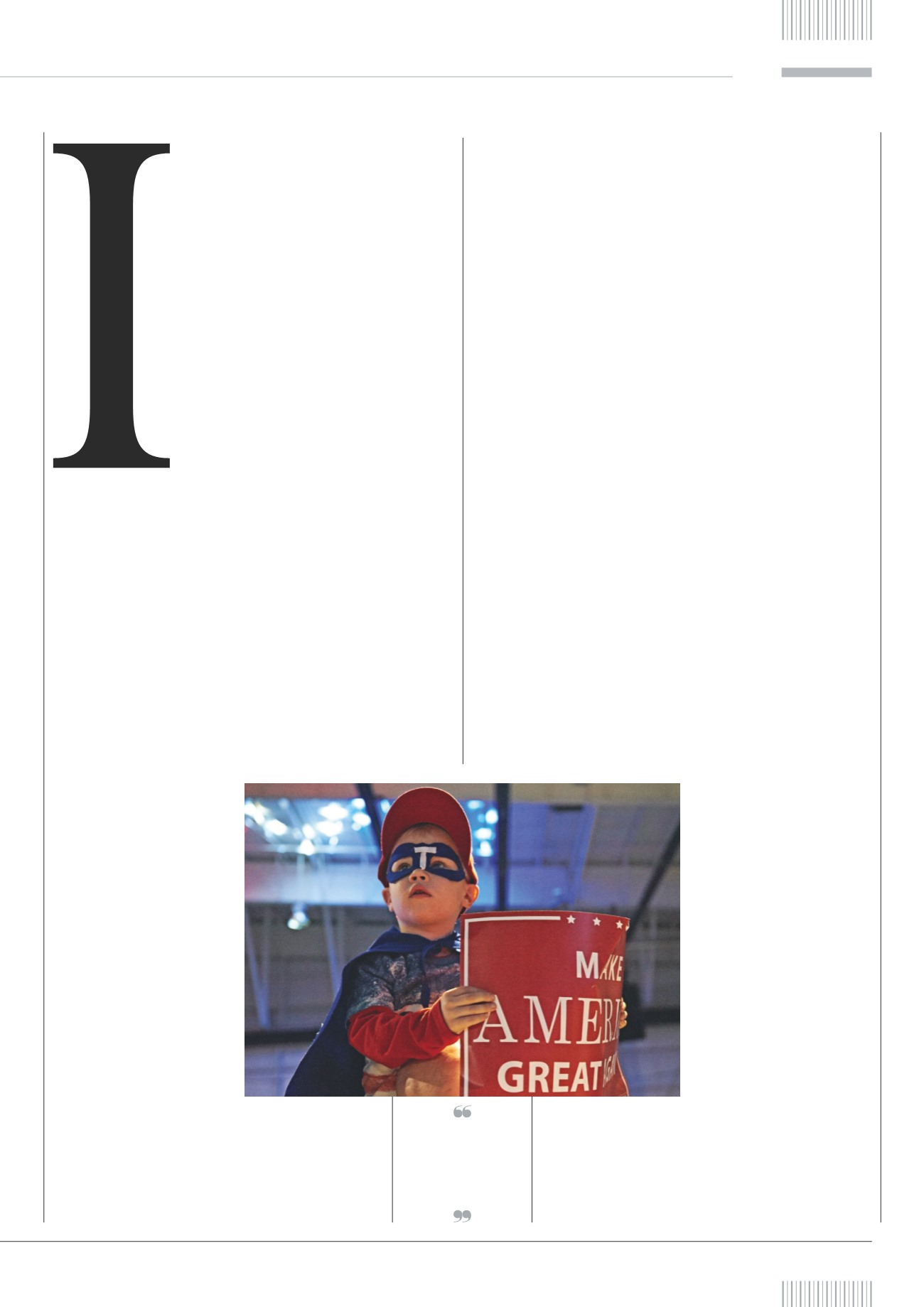
promises to protect US jobs and‘makeAmerica great again’
struck a chord with voters.
On the stump, he promised to impose import tariffs on
China and Mexico, renegotiate or withdraw from trade deals
and pursue China over currency manipulation and unfair trade
practices. He has also confirmed he will scrap President Obama’s
uncompletedTrans-Pacific Partnership (TPP).
The candidate said he would deport illegal immigrants, build
a wall along the Mexican border and make Mexico pay for it.
Already the President is softening his line on deporting the
children of illegals, while his allies have said that the‘wall’ may
not be an actual wall. He has also back-pedalled on his vow to
launch a criminal investigation into Hillary Clinton’s activities.
Trump promised to cut government spending, while spending
more on infrastructure (including that wall) and defence, and
held out the prospect of 4%GDP growth. Some economists
have been sceptical about that.They are more enthusiastic about
his plans to lower corporate tax, including a special 10% rate for
repatriated corporate profits currently held abroad.Any money
attracted home in this way would boost domestic investment.
This is unlikely to be a conventional presidency. But President
Trump also has to work with a Congress that may not fall over
itself to do his bidding. The Republicans have a majority in both
houses, butTrump is inWashington despite many of them,
rather than because of them. He upset or insulted some key
legislators during his
campaign, and not all of his
policies are to their taste.
For many, his spending
plans are too expensive
and his protectionism
runs counter to their
free-trade instincts. So far,
Trump appears not to have
developed the skills and
inclination for the lobbying
and compromise that keeps
the Capitol’s wheels oiled,
though hisVice President,
Mike Pence, may be helpful
in this department.
In the markets,Trump’s
fiscal and tax agenda has so far been good for US
shares, especially bank shares, and bad for bonds, at
least in the short term. But some investors fear his
anti-globalisation policies will damage trade and,
ultimately, corporate profits.
So far,Trump
appears not to
have developed
skills for lobbying
Sources: internationalbusinessguide.org, December 2016; investopedia.com, December 2016
Peter Yang/August Images, Alamy
1992–2017