



 27 / 40

THE INVESTOR
|
27
THE QUARTERLY REPORT
2.3% in March,making an interest rate rise more
likely than a drop in the year ahead, and hitting cash
savers hard. In the eurozone,meanwhile, although
in ation only rose to 2%, it was enough for Mario
Draghi to change his tone – some tapering of the
ECB’s quantitative easing programme looks plausible
in the near term. Eurozone business sentiment
struck a six-year high in February.
The improving outlook, including the tailwinds
for oil majors and nancial companies, helped to
deliver signi cant growth for stocks over the period.
In the US, the S&P 500 rose 6.1%, although it was
the Dow Jones IndustrialAverage that provided the
headline news, rising above 20,000 for the rst time.
MeanwhileApple, the world’s biggest stock listing,
helped deliver stellar quarterly returns for the
tech-heavy NASDAQ index.
The FTSE 100 enjoyed a buoyant rst fewweeks
of the year, rising 3.7% over the quarter despite
mixed corporate results.The UK also saw two highly
signi cant proposed takeovers jettisoned: Deutsche
Börse will not acquire London Stock Exchange; nor
will Kraft Heinz buy Unilever.
The Euro rst 300 rose by 6.1%, re ecting
improved sentiment in the eurozone; but Japan’s
Nikkei fell by 1.1%, bu eted by moves in the
yen and concerns over stalling economic and
corporate reform.
PUSH-PULL
While markets and economies appeared to be on
a growth trajectory, the direction of politics o ered
a number of major uncertainties – and potential
economic headwinds. In the US, DonaldTrump
imposed a short-lived travel ban on visitors from
seven Middle Eastern andAfrican countries,
withdrew the US from theTrans-Paci c Partnership
and failed to steer his healthcare reform package
through Congress.The last of these raised questions
over his ability to deliver on his pledge of tax cuts.
In the UK, the prime minister used a speech in
January to lower hopes for continued single market
membership.TheCityUK, the square mile’s leading
lobby group, gave up its ght for access the same
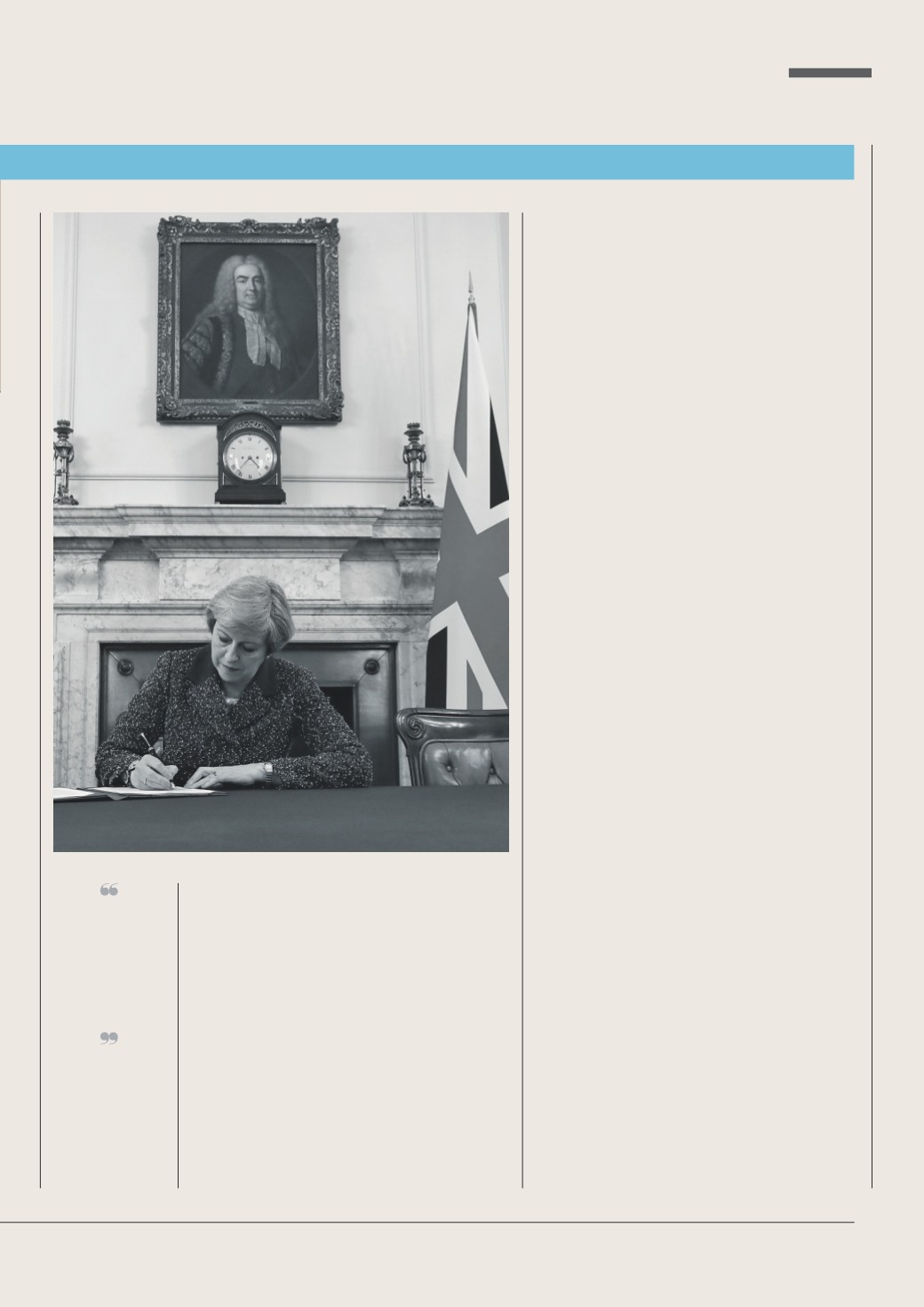
month.Theresa May then triggeredArticle 50 at the
end of March,marking the start of EU exit talks.
Her chancellor may have been glad of the timing, as
the move overshadowed a March Budget whose
weightiest measure was cancelled following
backbench uproar.
Over the quarter, the focus of the globalist-
protectionist dispute shifted from the UK and US
to Continental Europe. Globalists chalked up a
comfortable victory in the Dutch elections, but are
nervous about the forthcoming French presidential
election, although eurosceptic Marine Le Pen lags
the favourite, Emmanuel Macron, by some margin.
Despite solid global growth and stock market
gains, it is likely the quarter will be remembered
for one event: the triggering ofArticle 50. For the
UK, the course of the year ahead may be strongly
directed by that signature moment.
It is likely the
quarter will be
remembered
for one event:
the triggering
ofArticle 50