



 18 / 40

18
|
THE INVESTOR
I
n June 2015, a critically ill
baby girl with a rare leukemia
was treated successfully
at Great Ormond Street
Hospital in London, using
a revolutionary type of
cell therapy.
Doctors at the hospital, in
collaboration withWaseem
Qasim, Professor of Cell and
GeneTherapy at University College
London (UCL), took cells from a healthy
donor and reprogrammed them to seek and
destroy the girl’s cancer cells.The treatment
worked. Since then, another young child
has recovered from cancer following a
similar procedure.
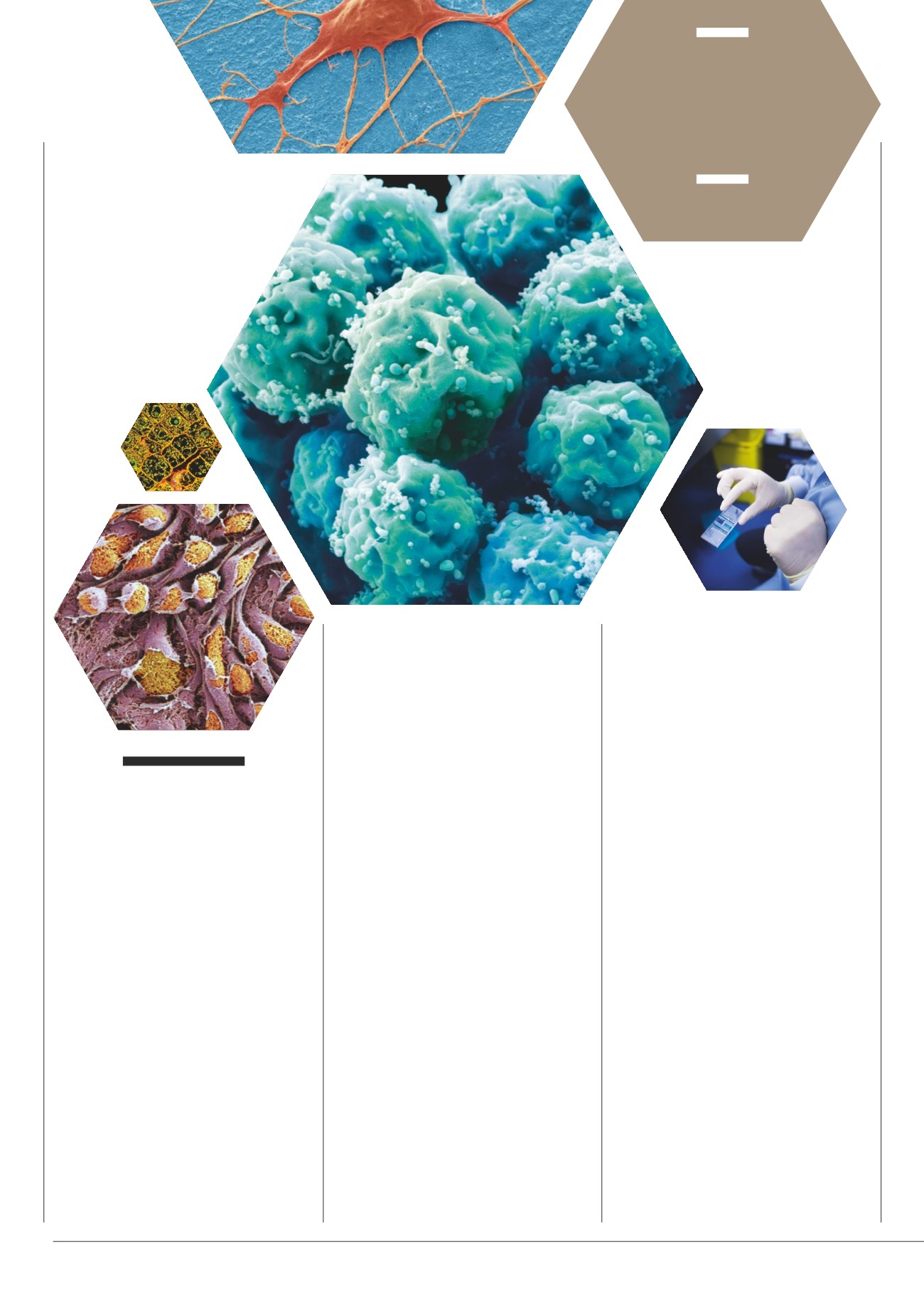
The advancement of cell therapy means
that what were once thought of as miracle
cures for untreatable diseases are, slowly
but surely, entering mainstreammedicine.
Cell therapy is usually an intravenous
treatment – it introduces living cells that
have been re-engineered in the laboratory
into a patient’s body. For example, scientists
can create modifiedT-cells that are capable
of hunting and killing cancer cells through
‘gene editing’ – the molecular snipping of
sections of DNA and the insertion of new
parts.Once prohibitively expensive,
relatively simple and ultra-precise DNA
editing can now be done affordably through
a process called CRISPR (pronounced
‘crisper’) – clustered, regularly interspaced
short palindromic repeats.
The rewards in this field promise to be
huge; a field in which the UK has a leading
role. Behind the breakthrough is a collective
of international scientists, clinicians,
manufacturers, regulators, government
innovation agencies and finance providers,
such as venture capitalists.
London has become a hub for cell
therapy,with many of the experts based in
the so-called Knowledge Quarter near
King’s Cross, home to UCL and the Francis
Crick Institute, the world-leading
biomedical research facility.Meanwhile,
Stevenage in Hertfordshire,which is just a
short journey away by train and within reach
of Cambridge, has become an important
satellite of the biomedical cluster.
Typical of the pioneering developments
under way is work by UCL that uses stem
cells to deliver an anti-cancer gene to NHS
lung-cancer patients; this triggers
destruction in unhealthy cells but leaves the
healthy ones intact.One of the big advances
Scientists hope to
manipulate cells
to treat conditions
such as macular
degeneration and
haemophilia
The UK is leading the way
in cell therapy research.
Private sector investment
is pouring into this
once overlooked sector
SCOPE OF SUCCESS
Work by UCL uses
stem cells to deliver an
anti-cancer gene to NHS
lung-cancer patients