



 27 / 40

THE INVESTOR
|
27
THE QUARTERLY REPORT
monthly falls against a basket of global currencies,
growth has taken wages up with it; unemployment
remained below 4.5% throughout the quarter.
3
Hearteningly, this economic momentum
continued over the quarter despite major troubles in
the south, which was afflicted by two destructive
hurricanes.A calamitous earthquake also struck
neighbouring Mexico, killing 333 people.
4
MOMENTUM, MACRON
Politically, there was plenty to unnerve investors
over the three-month period.As North Korea
launched a series of missile tests, two of which flew
over Japan, political tempers were increasingly
flared.Yet although volatility ticked up to its highest
level of the year, it remained subdued in historical
terms.
5
The Nikkei 225 rose by 1.61% over the
quarter, and was boosted again by economic growth
figures late in the quarter, as the prime minister
called a snap election.
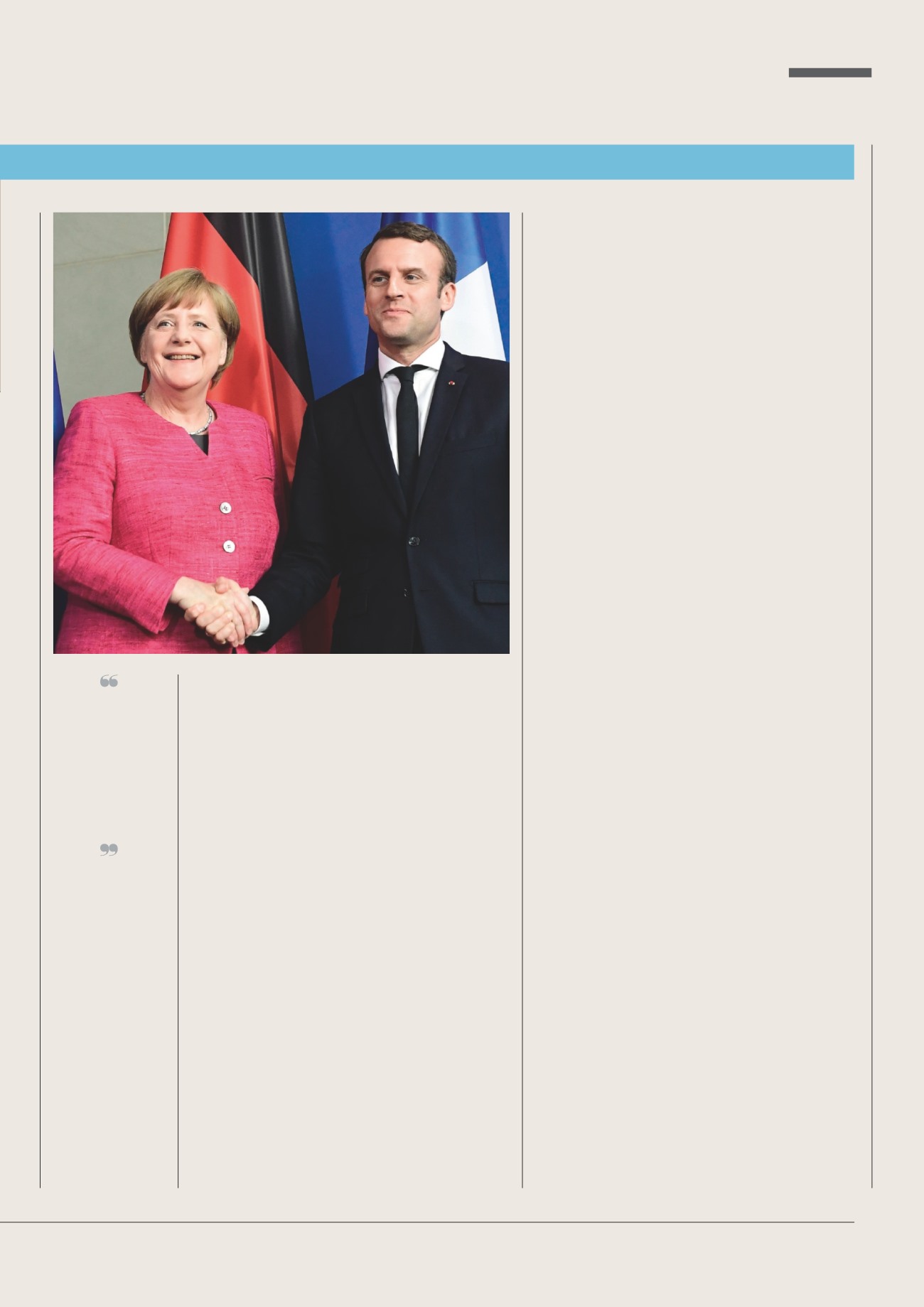
After the unorthodox European elections of the
spring, the third quarter offered the staid spectacle
of German federal elections in September.
ChancellorAngela Merkel was duly returned for her
fourth term, but left considerably weaker.
The Eurofirst 300 rose by 2.24%, reflecting a
buoyant economic picture. Greece returned to debt
markets for the first time since 2014 and Portugal
sold 10-year government bonds at record low yields.
More broadly, anAugust report showed second
quarter eurozone growth striking an impressive
0.6%, EU consumer confidence reached its highest
levels since 2007, and the euro continued its rise.
Momentumwithin the EU shifted somewhat
fromMerkel to Macron, as the new French
President pushed his labour reform package through
the French parliament and spelled out a little more
of his vision for the EU. But, the quarter ended with
violence as Catalans voted on independence.
FLORENTINE FLOURISH
In the UK, the FTSE 100 rose by just 0.82%, and
indicators generally told a nuanced tale. Despite
some positive corporate results, new figures showed
that business investment in the UK has remained flat
since the EU exit referendum, and headline growth
in the second quarter was revised downwards,
making the UK the slowest-growing G7 economy.
An OBR report on bank stress tests said that UK
bank balance sheets were much improved since the
crisis.Yet when the OBR applied the same criteria to
the UK government, the institute said the
government would have failed.The UK received two
downgrades bymajor ratings agencies over the quarter
and the Brexit outlook was cited among the reasons.
But, Prime MinisterTheresa May used a speech in
Florence in September to bridge the growing
rhetorical divide between the UK and EU authorities
– and to begin to set out some details.Meanwhile,
Jeremy Corbyn’s star appeared to be rising.
Apparently taking the 10-year anniversary as its
cue, the Bank of England warned that interest rates
might need to rise in the near future, despite meagre
headline growth (not to mention wage growth), due
to inflationary pressures.Yet it was the US Federal
Reserve and European Central Bank which appeared
to be taking the lead on bringing the world out of
the post-crisis era.The heads of both banks in
September said that they were making plans to
withdrawQE programmes.The Fed will begin to
do so this month.The move will mark the end of era,
but it won’t be a short final chapter.
Getty Images,MasaoYamazaki.1 statisticstimes.com,April 2017;2 en.wikipedia.org,September 2017;3 data.bls.gov,October 2017;4 en.wikipedia.org,September 2017;5 yhoo.it/2x1x13g,September 2017
The UK
received two
downgrades,
with the Brexit
outlook cited
among the
reasons