08
|
THE INVESTOR
ANALYSIS
GENERAL ELECTION
Getty Images, Corbis
The biggest
tax rise was
the increase
in VAT to 20%
in 2011
BANKING REFORM
Britain’s banks have been required to hold more capital and are under a
new regulatory regime, operated by the Bank of England. Mark Carney,
the Bank’s governor, claims that the reform process will solve the ‘too big
to fail’ problem so that taxpayers will not, in future, have to bail out the
banks. Mortgage lending has recovered, assisted by the government’s
Help to Buy schemes, though business lending remains weak.
SCORECARD RESULT
Significant banking reforms have
been introduced, making the system
considerably safer. However, the
LIBOR and currency manipulation
scandals have undermined the
government’s reform efforts and
will be used by opponents to argue
that further reform is needed.
TAXATION
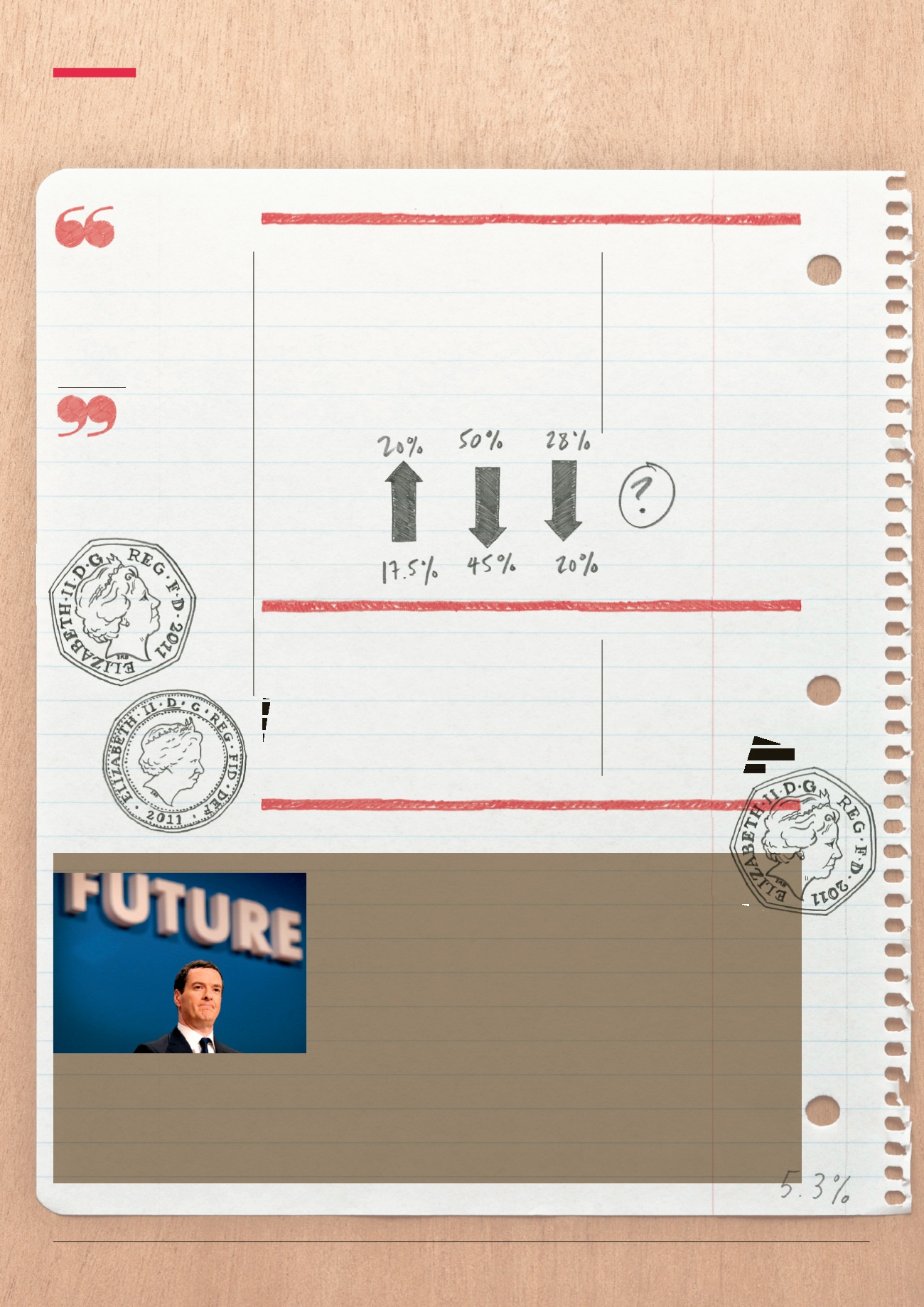
In the period of austerity since May 2010, the biggest tax rise was the
increase in VAT to 20% in 2011. Some other taxes have, in contrast,
come down. The government has devoted considerable resources to
raising the personal Income Tax allowance to £10,600 from April 2015.
George Osborne has also deferred several increases in petrol duty and
cut the top rate of Income Tax from the 50% he inherited to 45%,
claiming that the cost in revenue terms would be negligible. Companies
have benefited from a reduction in the main rate of Corporation Tax from
28% to a planned 20% in April 2015.
HOW HAVE OTHER COUNTRIES FARED?
The UK’s growth rate in 2014 was the fastest in the G7 (the other members of which are the US,
Canada, Germany, France, Italy and Japan) and is predicted to be close to the fastest in 2015. The UK took
longer to get back to pre-crisis levels of GDP, which it did in 2013, than Canada, the US, Germany and
France, and did so at roughly the same time as Japan. Italy has yet to get back to pre-crisis GDP levels.
One reason why the UK took longer than some of these countries was the earlier weakness of growth.
Another was that some of these countries suffered milder recessions and had less ground to make up.
However, while the eurozone had a second recession from 2011 to 2013, a ‘double dip’ after the big
recession of 2008/09, Britain avoided that fate.
Britain’s job market has been healthier than that of most neighbouring countries, with the
unemployment rate standing at 6% by late 2014. The eurozone’s unemployment rate in late 2014
was 11.5%, with France at 10.4% and Italy 12.6%. Although Germany’s rate is lower, at 4.9%, most European
economies have weaker labour markets. The US’s unemployment rate is similar to that of the UK, but large numbers
of ‘discouraged’ workers have dropped out of the labour force.
Some countries have lower budget deficits than Britain. In 2014, according to the International Monetary Fund’s
October 2014 Fiscal Monitor, the UK’s budget deficit of 5.3% of GDP was similar to the US’s 5.5% and lower than
Japan’s 7.1%. But France had a deficit of 4.4% of GDP and even Italy – despite three recessions in six years – had
a deficit of only 3% of GDP. Germany had a budget surplus of 0.3% of GDP.
George Osborne
can be optimistic
for the future of
UK growth
SCORECARD RESULT
The coalition has surprised by
cutting taxes during a period of
austerity, particularly through the
increase in the personal allowance.
In France, President Hollande has
promised
€
40 billion in tax cuts
for business and
€
50 billion in
public spending cuts up to 2017.
In Germany, the big debate for its
‘grand coalition’ is whether and
when to cut taxes.


