



 14 / 44

14
|
THE INVESTOR
ANALYSIS
S
candinavia’s tech start-ups, led
by music-streaming company
Spotify and the clusters of
life-sciences companies on
either end of the Øresund
bridge between Sweden and Denmark,
are the latest in a long tradition of
innovative Scandinavian companies.
Sweden is the second most proli c
tech hub after SiliconValley, while
TeliaSonera, the Finnish-Swedish telecoms
operator, and Ericsson, the Swedish
telecoms giant, have announced that
Stockholm andTallinn in Estonia will be
the rst two cities in the world to get 5G
telephone networks in 2018.Technology
is inescapable in the Swedish capital: it
has a digitally connected public transport
system and high take-up rates for tablet
and app usage. None of this is accidental;
it re ects the subsidies paid by the
government for personal computers in
the 1990s, the state’s commitment to
broadband and bre optic, and a belief that
the next wave of Swedish prosperity would
be based on digital connectivity.The
investment is paying o .
To be an engineer in Scandinavia in the
early 20th century was one of the most
prestigious occupations someone could
have. Engineers built many of the region’s
of capitalism, it seems unlikely that many
of the great Nordic companies would
have got o the ground – they certainly
would not still dominate the local stock
exchanges with a consistency
unparalleled elsewhere.
In 1916, new legislation required banks
to separate their banking, shareholding and
investing businesses. Enskilda’s portfolio
became InvestorAB, whose portfolio,
now in a separate unit, still includes
Atlas Copco, as well as SEB (the former
Enskilda Banken), Electrolux, Saab,ABB,
Ericsson and Husqvarna.
As the investor company, InvestorAB
actively owns a number of companies,
placing corporate power in the hands of
shareholders rather than management.The
shareholders elect board directors and are
involved in major strategic decisions.This
model is found in many other businesses in
the Nordic region, such as the investment
company Kinnevik.
Christian Stadler, Professor of Strategic
Management atWarwick Business School,
says that, while large controlling stakes can
make things hard for outside shareholders,
family businesses have some clear
advantages.‘Industrial dynasties, such as
theWallenbergs, tend to have very strong
personal networks, for instance,’ he
A long-term, collaborative
view has seen Scandinavian
industries prosper, from
banking to tech start-ups
By Heather Farmbrough
most successful international export
businesses, such as manufacturers SKF
andAtlas Copco, while scientists helped
create Denmark’s Novo Nordisk
pharmaceutical company. Backed by banks
prepared to take a long-term view,
Scandinavia has produced a number of
major international companies that are
still at the top of the Nordic stock
exchanges almost a century later.
Some of this goes back to the roots of
Swedish capitalism. In the middle of the
19th century,AndréWallenberg founded
Enskilda Banken in Sweden.The bank
performed a similar role to that of today’s
private equity companies, which have
helped to nance tech start-ups (though
their time horizons tend to be shorter).
When things became di cult for the
bank’s customers, Enskilda stepped in
and invested, rather than see the
companies go under.Without this kind
Industrial dynasties,
suchas theWallenbergs,
tend tohave very strong
personal networks
€
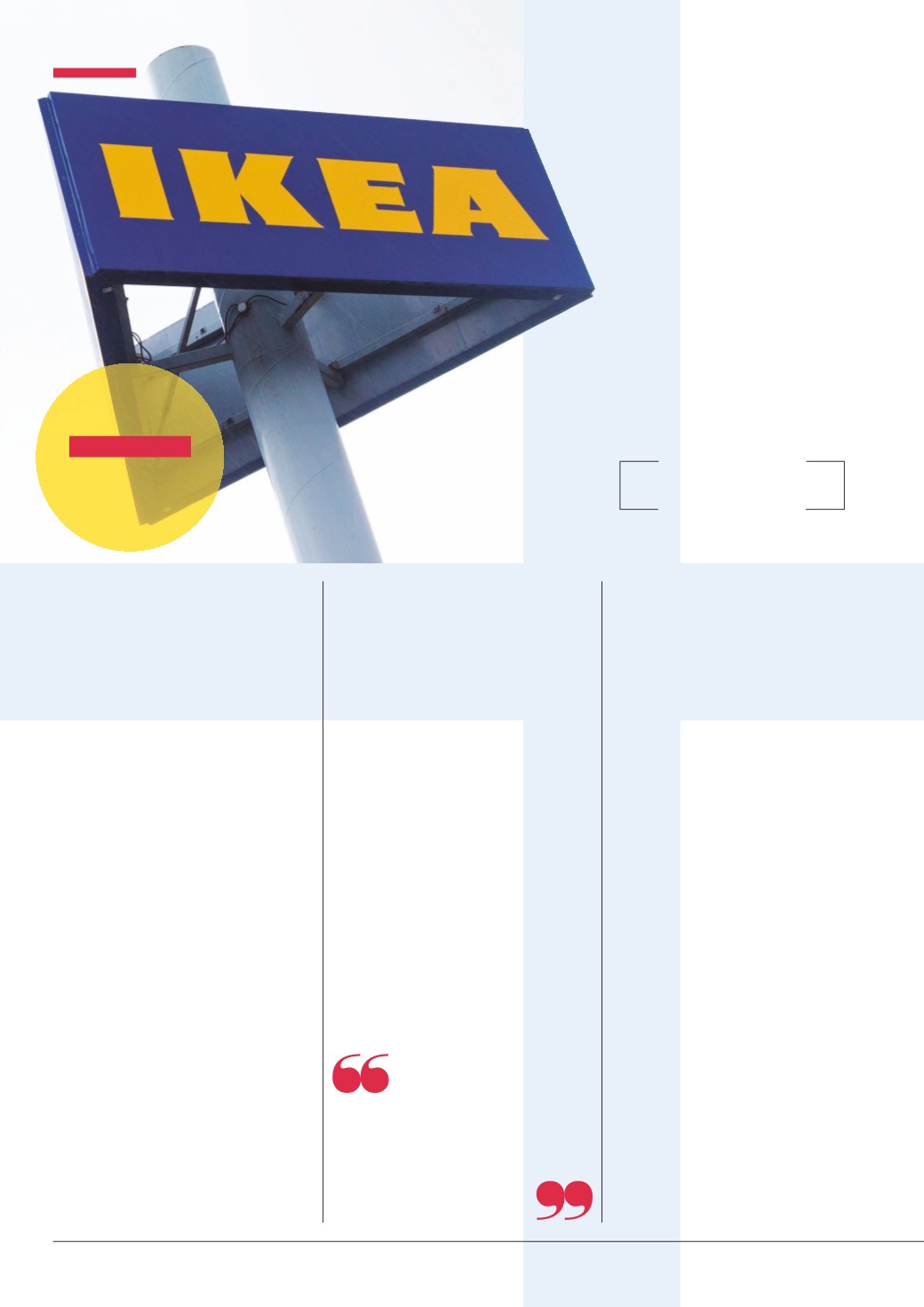
31.9 BILLION TOTAL SALES
WORLDWIDE 2015*
IKEA