



 15 / 44

THE INVESTOR
|
15
ANALYSIS
REGIONAL FOCUS
Other empirical studies – using
measures such as accounting profitability,
growth, stock market value or stock
returns – suggest performance is, on
average, no worse, or even slightly better
than that of companies with more
conventional ownership structures.
Investment companies that are prepared
to take an exceptionally long-term
strategic view have been integral to the
success of many Scandinavian companies.
In turn, the successful financial
performance of these has been closely
linked to society’s interests.There is,
however, a cultural aspect to Scandinavian
capitalism, whose success has also owed
much to engineering, science, design and,
more recently, technology skills, and a
society which both respects and rewards
these. It is perhaps no coincidence that
these, and a long-term business outlook,
have evolved from an environment in
which long-term planning is required in
almost every aspect of life.
It can’t simply be exported in the way
that IKEA flat-pack furniture has spread
throughout Europe.
Balance sheet
Scandanavian companies have grown
and flourished over the years, thanks to the region’s
adherence to long-term investment strategies.
You can’t create
successful product
portfolioswith a
short-termview
observes, something borne out by Cristina
Stenbeck, who recently stepped down as
Executive Chairman to concentrate on her
role as the main owner of Kinnevik,
looking for companies in new areas in
which to invest. She has publicly admitted
that her position as the owner has enabled
her to open the doors to certain heads of
state and other powerful figures.
‘The CEOs of non-family businesses are
under pressure to hit the numbers every
quarter,’ observes Stadler.‘Unfortunately,
this also increases the pressure to discard
strategies that don’t work immediately;
but a glance at some of the most successful
family businesses helps to illustrate why
they should resist. Patience is a virtue when
it comes to strategy.’
Stadler cites InvestorAB’s role in
saving Ericsson in the 1930s as a positive
example of the investor company’s wider
social and economic role.
MarcusWallenberg, the founder’s
great-great-grandson, said in a recent
interview in the
FinancialTimes
:‘We have
stuck with many businesses where we were
confident that doing so would create value
in the long run.The capital markets need
investors who recognise that the innovation
cycle is often measured in years and that
you can’t create successful product
portfolios with a short-term view. In our
part of the world, the presence of
dominant long-term owners on the share
registers – investors who feel a
responsibility towards companies in
difficulty – is an advantage.’
The Nordic model is attracting interest
from regulators and governments –
including the European Commission –
looking to head off financial crises. Some
believe that, applied more widely, it could
reduce short-term thinking.
For investors, there is some empirical
evidence that the structure of family and
foundation companies typically found in
the Nordic region can be beneficial. In
2013, SteenThomsen fromCopenhagen
Business School and Henry Hansmann
fromYale Law School suggested that
companies owned by industrial foundations
seem to perform as well as conventional
investor-owned companies.
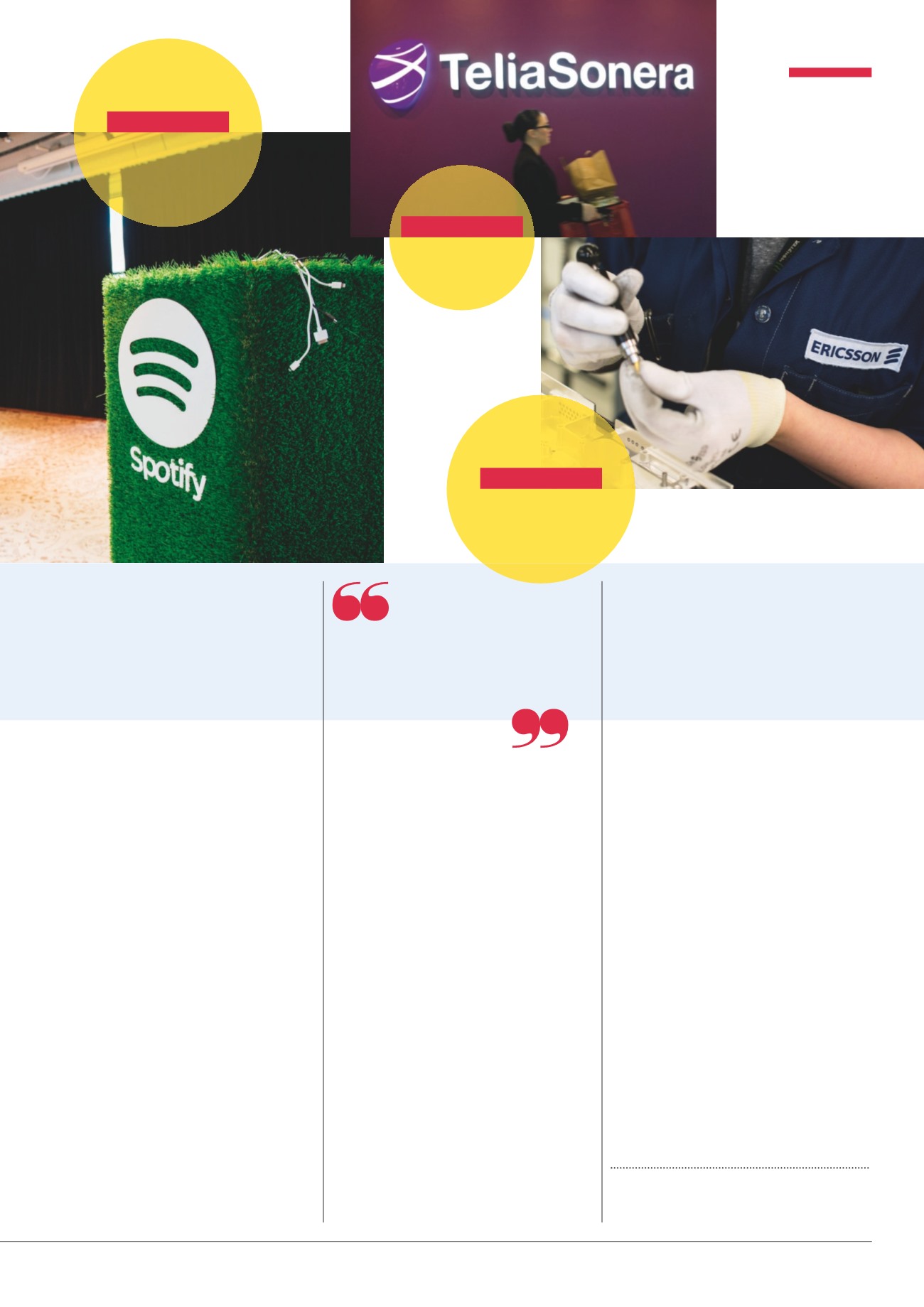
Getty Images. *Sources (left to right): www.ikea.com, 2016, www.statista.com, 2016; www.teliasonera.com, 2016; www.ericsson.com, 2016
30 MILLION PAYING
SUBSCRIBERS WORLDWIDE*
27,000
EMPLOYEES*
39,000 PATENTS
REGISTERED*
SPOTIFY
TELIASONERA
ERICSS0N