



 11 / 44

THE INVESTOR
|
11
IN YOUR INTEREST
One of the biggest challenges facing the
millennial generation is how to save enough
for a deposit on a first property.More than
half of UK first-time buyers in 2014 were
given a helping hand by‘the bank of mum
and dad’, according to the Council of
Mortgage Lenders
2
. Parents can (and do)
help their children to save for a deposit, but
they can also help with funding the
mortgage. It has always been possible to help
a child onto the property ladder by acting as
a guarantor for their mortgage, but not
everyone was happy to take on that risk.
Now, however, some mortgage providers
will allowparents to be part of themortgage
process without having to put their names
on the title deeds, removing the potential
liability for any default.
Some lenders will take a combination
of the parents’ and their child’s income
into account before calculating the
maximum loan available.The higher the
combined income, the higher the
potential loan. Others will ring-fence
some of the parents’ assets to increase the
size of the deposit which, because it
lowers the loan-to-value ratio, thereby
reduces the mortgage payments.
Wealth management is as much about
protection and preservation as it is about
growth and distribution. Many people in
the UK are thought to be underinsured,
particularly the young – who will often
turn to their parents for support when they
suffer a loss. Insurers are now designing
intergenerational insurance policies that
can meet the needs of an entire family,
while they benefit from preferential rates.
If the young are more likely to
underinsure their property and effects,
they are also less likely to have life
insurance. On the same principle as these
new general insurance plans for families,
group life policies are becoming available.
Historically, the older
generation might have
understood the virtues
of life cover, but the
fact that they had no
insurable interest meant
that they were unable
to buy a life policy on
a child’s behalf. The
new group policies
address this problem.
The older generation
may also need support,
as they increasingly
need to be cared for. If
a parent or grandparent
moves into a care or
nursing home – unless
they enjoy a very high
net income to pay the fees – this will have
an effect on the next generation,who will
inherit less.How should residential care be
funded, and can they avoid selling their
home?With careful planning, these issues
can be managed.
Whatever the context, all financial
planning should include making aWill
and a lasting power of attorney. Not only
does this avoid unnecessary delay and
family members – intergenerational
planning is not, ultimately, a one-way
street. Even as you support your children,
the understanding is that the transfer may
be returned in some form in the future,
should you require it – perhaps for your
own long-term care costs.
1 National population projections for the UK, 2014-based,
Office for National Statistics, 2015
2
www.cml.org.uk, 2015
Trusts,Wills and powers of attorney are not regulated by the
Financial Conduct Authority.Wills and powers of attorney
involve the referral to a service which are separate and
distinct to those offered by St. James’s Place.
Regular gifting can
help a child to build
a solid pension pot
of their own
complication on death – or in the event of
a family member becoming incapacitated
and unable to take decisions for
themselves – it’s also a useful way of
starting a conversation about wealth,
particularly in families where talking
about money does not come easily.
When planning how to dispose of
wealth it is good practice to include all
family members in the discussion,
wherever possible, as this will ensure
clarity and mutual understanding, and
help to prevent family disputes. But there
is another good reason for involving all
Balance sheet
Now that we’re all living for much
longer, financial planning often has to take into
consideration the needs of four generations.
1
UK births (2014):
776,352
2
UK deaths (2014):
570,341
3
It is expected that a third of children born
in 2013 will live to
100
4
Median age of population (mid-2014):
40
5
Life expectancy at birth:
1980–82
Men
70.8 years
/ Women
76.8 years
2011–13
Men
78.9 years
/ Women
82.7 years
6
Number of people aged 90+:
384,980
(2002) /
513,450
(2012)
7
Number of 26–30-year-olds (2014):
4.5 million
8
Average age people give birth:
27.9 years
(1992) /
29.8 years
(2012)
9
Average age of first-time buyers:
29 years
(2011) /
30 years
(2015)
THE UK BY NUMBERS*
INTERGENERATIONAL FINANCE
Alamy, Camera Press/Jason Bell, Getty Images. *Sources:
1
http://webarchive.nationalarchives.gov.uk, 2015;
2,3
http://webarchive.nationalarchives.gov.uk, 2013;
4,5
http://webarchive.nationalarchives.gov.uk, 2014;
6
http://webarchive.nationalarchives.gov.uk, 2010;
7
http://webarchive.nationalarchives.gov.uk, 2011;
8
www.mothers35plus.co.uk/intro.htm, 2015;
9
www.lloydsbankinggroup.com/Media/Press-Releases/2015/halifax/139500-new-first-time-buyers-so-far-in-2015, 2015
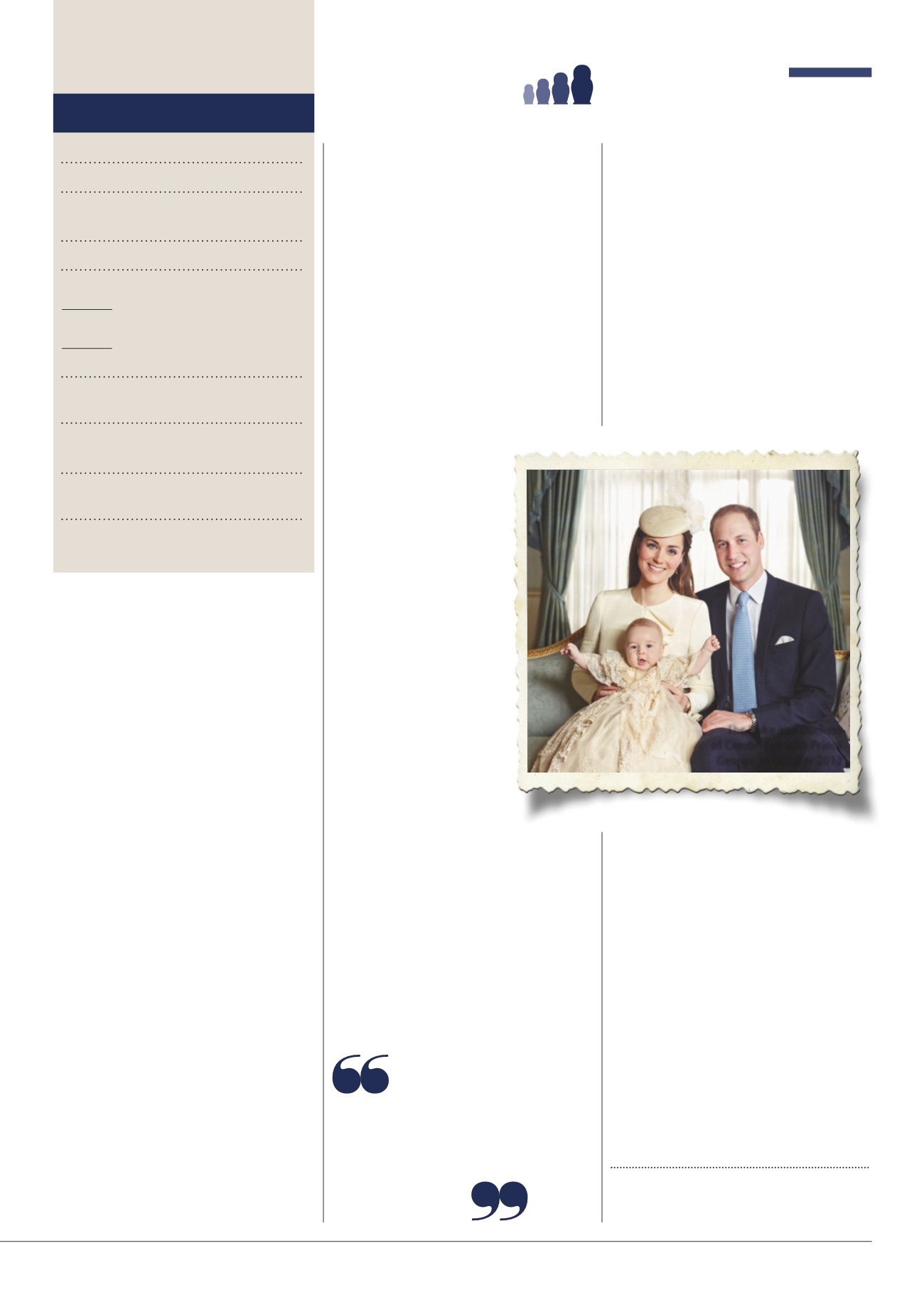
The Duke and Duchess
of Cambridge with Prince
George, in October 2013