



 8 / 44

08
|
THE INVESTOR
ANALYSIS
rising – and in some cases securing a
competitive devaluation – has been part of
the motivation for the negative rates
set by the ECB and the central banks of
Switzerland and Japan. Clearly, not
everyone could achieve a lower value
for their currency if all were to adopt
negative rates, but those who act quickly
can steal a march on others.
Are negative rates here to stay? If so,
howmuch further can they fall?While the
experiment has yet to play out, there is
a limit to howmuch longer rates can drop
or remain in negative territory. Before his
move in March, the ECB’s Draghi was
warned by the banks that his policy was
hurting them, and that any further
reduction in the rate would do damage.
After announcing another small cut he
offered broad hints that the process would
not go much further.
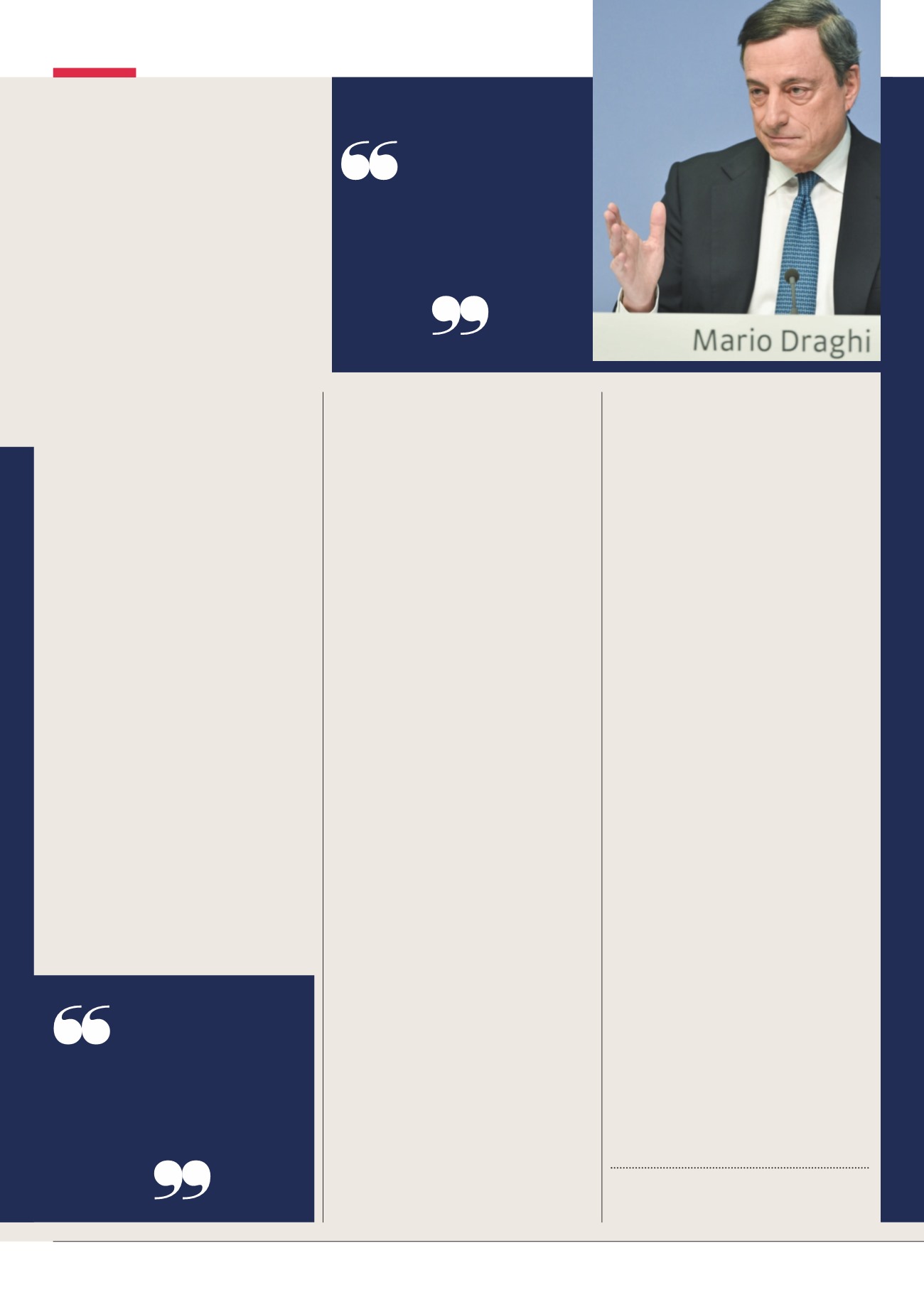
At the ECB’s conference following the
rate cut in March, Draghi said:‘How low
can we go? Rates will stay low, very low, for
a long period of time. Let me also add that
the experience we’ve had with negative
rates, in our case at least, has been very
positive in easing financing conditions, and
in the transmission of these better
financing conditions to the real economy.’
There is, in addition, serious resistance
to setting negative interest rates at other
central banks.The Federal Reserve in
America embarked on a process of raising
rates late in 2015, while Bank of England
Governor Mark Carney warned in a
speech in February that using negative
interest rates to achieve a lower currency
was‘a zero sum game’.The risk, he said,
Balance sheet
Central banks are using negative
interest rates to encourage the banks to lend, but the
downside could see customers close their accounts.
was of creating what he described as‘a
global liquidity trap’, in which the actions
of central banks lose any force.There was,
he said,‘no free lunch’ for central banks
in negative rates.Only time will tell
whether circumstances will force him
to change his view.
Up to now, negative interest rates have
operated in the rarefied zone of central
banks, and in their dealings with
commercial banks and the money markets.
But howwould ordinary savers respond to
negative rates; to their money being worth
less in a year’s time than it is now? It is not
as far-fetched as it sounds. In recent years,
savers have been happy to keep their
money in the bank – earning a return
barely above zero – even when inflation has
been much higher. Negative real interest
rates have been the post-crisis norm.
People are also happy to pay a monthly fee
– ostensibly for bundled products – on
current accounts, which in many cases
equates to a negative interest rate.
Both are, however, different
psychologically to an explicit negative
rate; a savings regime that would see the
value of your money, in purely cash terms,
decline year after year. Howwould people
react?We can guess, or we can draw on
research carried out recently by ING, the
Dutch-based international bank. ING
surveyed 13,000 people,mainly in Europe
but also in the US andAustralia.
The results suggest that if policymakers
think that individuals would respond to
negative interest rates by spending more
and thereby boosting the economy, they
are probably wrong. Further, negative
rates would be very bad for the banks.
As Mark Cliffe, ING’s Chief Economist,
puts it:‘A remarkable 77% said that they
would take money out of their savings
accounts.While a fewwould spend more,
this would be offset by almost as many
saving more.Most said that they would
either switch into riskier investments or
hoard cash “in a safe place”.This is better
news for safe-makers than it is for banks
and central banks.’
The most surprising aspect of ING’s
findings was not that negative interest rates
would be of limited value in boosting
spending.After all, savers still need to
put money away for a rainy day, a house
deposit or some other future need. It was
that so many would regard it as a reason
to desert their banks. So for the banks,
an experiment with negative rates for
ordinary customers could prove to be very
difficult, if not disastrous.
‘The banks would be faced with an
uncomfortable choice between not
cutting retail rates below zero, and so
seeing their profit margins squeezed, or
doing so and risking a substantial deposit
outflow,’ says Cliffe.
Negative interest rates are in fashion
among central banks. However, even
among them, there is some disquiet.There
would be even more disquiet if ordinary
savers were expected to pay banks for the
privilege of keeping their money safe.
Fortunately, that is unlikely to happen.
1
www.ecb.europa.eu, 2016
The experiencewe’ve
hadwith negative
rates, in our case at
least, has been very
positive
There is a limit to
howmuch longer
rates can drop or
remain in negative
territory