



 11 / 44

fund management groups, such as Legal &
General
3
, and companies such as Unilever
4
have turned against quarterly reporting,
saying every six months is quite enough.
Several years ago a team of behavioural
economists at Barclays wrote a paper
called
Overcoming the Cost of Being Human
5
.
Among the things it discussed was how
investors frequently get shaken out of
a stock if it falls in value shortly after
they have bought it.They panic and sell to
avoid further loss.
In their analysis this was quite the wrong
thing to do.They showed via the MSCI
World Index that, over the past 40 years,
no matter when you bought, whether
markets were high or low, you would have
made money if you took (and held) a
long-term view. In that 40-year span, the
longest you had to hold on to show a pro t
was 11 years; but apart from a few freak
periods where people were sucked in at
market peaks, between ve and eight years
was enough.
By the same token it showed that the
vast majority of investor losses were
incurred on investments held for two years
or less.The trouble is that we are
programmed to react immediately to
danger, and while we claim to be rational,
emotion and experience play a huge
part in our
decision-making.Welook for
facts that con rm our prejudices rather
than challenge our
thinking.Wehate
to acknowledge
mistakes.Weare
frequently torn and switch between
security and performance.
But at least if we recognise these
weaknesses, we are halfway towards
managing them and more than halfway to
having a less angst-ridden investment life.
THE INVESTOR
|
11
Shutterstock/Rex
1
www.hungrydummy.com,March 2016
2
www.bbc.co.uk/news,April 2016
3
www.legalandgeneralgroup.com, June 2015
4
www.unilever.com, May 2011
5
www.wealth.barclays.com, January 2006
Balance sheet
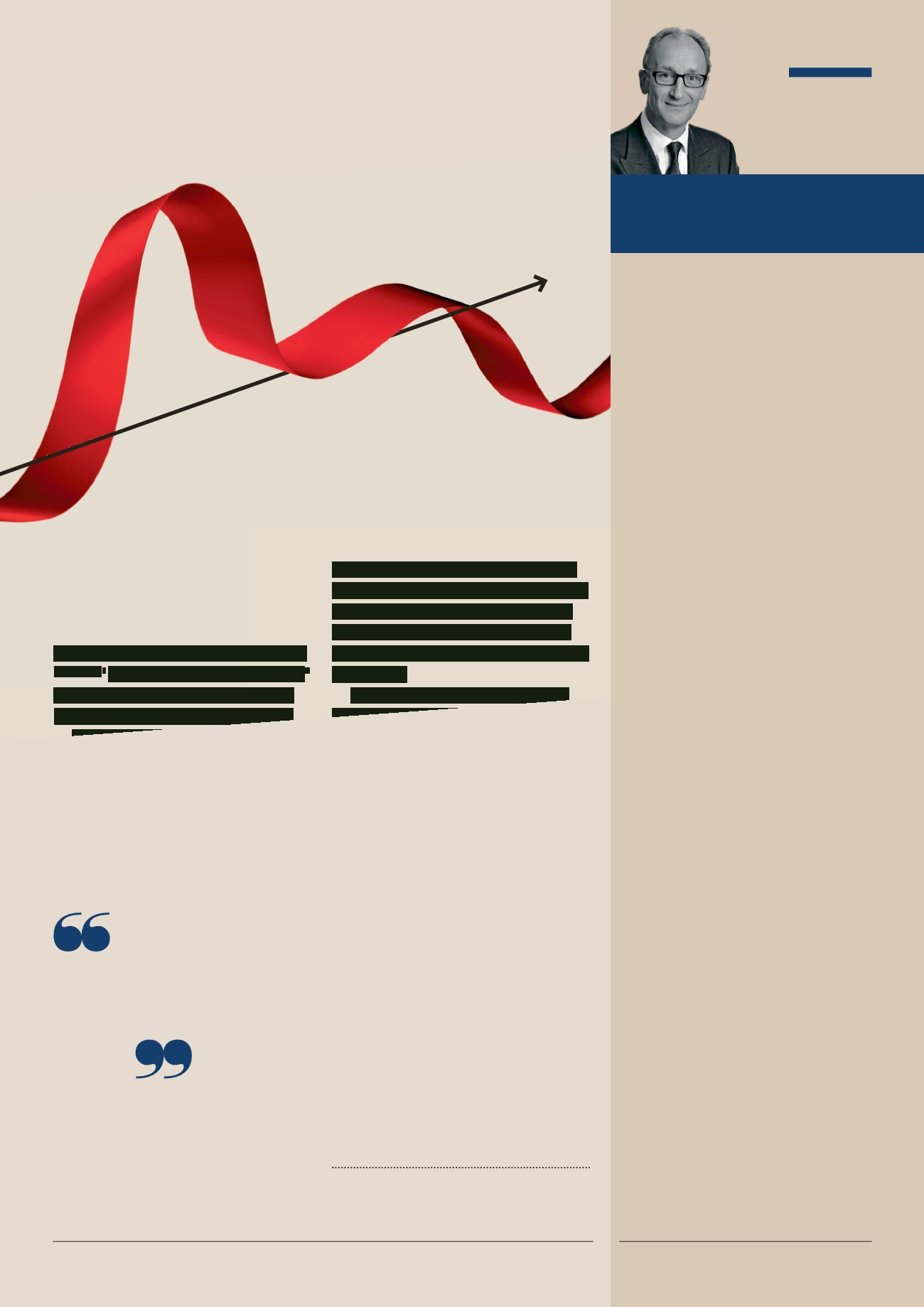
Investors who look at the long term
rather than reacting to short-term fluctuations are more
likely to see a healthy return on their investment.
Technologymeans
people can invest
their moneymore
quickly
INTERVIEW
IN YOUR INTEREST
How should investors react to market
turbulence following the Brexit vote?
As with any unexpected change, investors
should review their portfolios to ensure that
they are still appropriate for their long-term
goals. One of the results of leaving the EU
may be that interest rates will remain lower
for longer than expected. Coupled with the
prospect of a rise in inflation, the real returns
from holding cash may be eroded even further.
An initial reaction might be to sell. Is
that a sensible decision?
We strongly advise clients not to be swayed by
short-term considerations and volatility – the
FTSE 100 quickly regained the ground it lost in
the immediate aftermath of the vote. It
remains true that time in the market is more
important than market timing. As Anthony
Hilton’s article [alongside] notes, taking a
long-term approach is likely to produce better
returns than dipping in and out of the market.
What is the long-term impact likely to be?
There is still uncertainty over the terms of the
UK’s exit so we cannot reliably predict the
effect on the economy and UK companies.
The US presidential election and elections in
Europe increase that uncertainty. Initial
observations suggest that UK companies
which trade internationally could benefit from
a weaker pound. However, domestically-
focused businesses may be impacted if there is
a slowdown in the UK economy.
What are the benefits of St. James’s
Place’s approach in the current market?
We focus on the long term and our portfolios
are appropriately diversified and
constructed to suit the goals and risk appetite
of most investors. Over the past 12 months
we have added to the strategies across
various asset classes to provide investors
with more diversification opportunities.
These additions include UK and global
equities offerings as well as in fixed income.
CHRIS RALPH
CHIEF INVESTMENT OFFICER,
ST. JAMES’S PLACE