



 7 / 44

ANALYSIS
couple of UK housebuilders and Lloyds
Bank. It would be foolish to think that these
can be wholly una ected by recent – and
future – events. But with the economy
staying out of recession, as we think it
will, the impact will be limited. Lloyds, in
particular, is an interesting case – slower
credit demand and a rise in non-performing
loans will, naturally, not be helpful, but it
remains one of the world’s best capitalised
banks.Wehave regarded it as being
incorrectly valued for some time now,
and we still do. It deserves to be more
highly rated.
We have been spending time talking
with politicians and negotiators from the
European Commission and sources close
to the German government.While the
outlines of an exit agreement are as yet
very unclear (and will remain so for a good
while) it is well recognised that it would
serve no one on either side to put up trade
barriers.The UK is an important market
for larger multinationals such as Essilor and
Volkswagen, and they want to be able to
sell into the UK. Such a benign outcome
cannot, of course, be taken for granted, but
we doubt that we are wrong on this, even
if – once more – it takes time for us to be
proven right.
We will carry on doing what we have
been doing for the past 30 years – going
on the road to visit companies, carrying
out diligent research and trying to nd
new and interesting investment ideas.Our
experience of these past three decades –
which has included the invasion of Kuwait,
the second Gulf War, the dotcom crash
and the great nancial crisis of 2007 – is
that there is opportunity to be found amid
chaos.The opportunity to make money for
our investors has not gone away.
THE INVESTOR
|
07
I
t was not the result we wanted.
Nor was it the one we expected.
Nonetheless,we feel it would be
quite wrong to respond to the
Brexit vote by trying to recast our
investment stance.This is because we see its
implications as less than might be expected,
and the changes that come about will take
far longer to work through than many
commentators think. If ever there was a
time to keep calm and carry on, this is it.
Of course, it is more than likely that the
UK economy will, in the short term, grow
at a slower rate than had been expected. But
not necessarily by very much.The bu ering
impact on activity supplied by the quick
post-referendum downward adjustment
in the level of sterling should not be
underestimated.Atworst,we think growth
could be at by the start of next year;more
likely, it will still be mildly positive.
Another reason to be wary of making
big and quick changes is that the majority of
the portfolio is made up of great, super-
quality growth companies based in Europe.
Just 7% of Europe’s exports go to the
UK, and these companies will be even less
a ected by any softening in the UK than this
already low gure implies.Thinking longer
term, it remains an observable fact that
Europe has more than its fair share of great
companies.These are often companies with
great technologies and a vibrant culture
of innovation,well capable of addressing
global markets which continue to grow,
markets which are wholly una ected
by Brexit and its fallout.They include
companies such as SAP, Essilor,Amadeus
andAssaAbloy, all present in the portfolio.
We do hold, in the Greater European
Progressive portfolio, a small number of
UK-orientated companies, including a
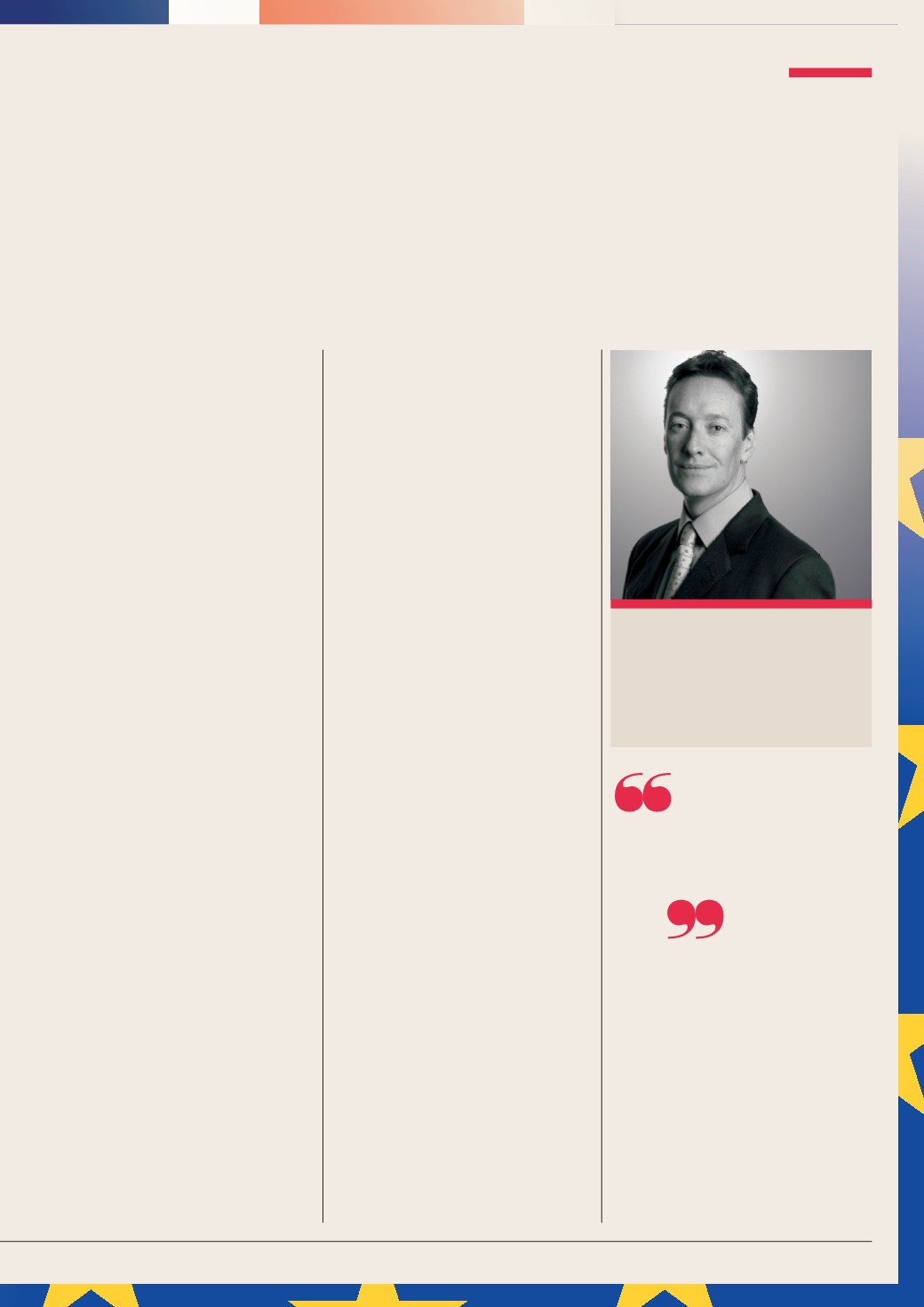
Stuart Mitchell
Continental European
and Joint Manager,
Greater European and Greater
European Progressive
At worst, we think
growthwill be flat
by the start of next
year
BREXIT
Matthew Stylianou