



 5 / 44

ANALYSIS
That compares with a previous forecast
of around 1.7%.
However,we think the Bank of
England (BoE) is likely to consider the
rise in in ation temporary but will be
considering both this and the weakening
of the economy when setting its monetary
policy.Asin ation is likely to rise above
the government’s target of 2%,which
in normal circumstances could trigger
a reaction from the BoE’s Monetary
Policy Committee, the extraordinary
circumstances of Brexit mean that policy
will surely be looser than it would have
been had we voted to remain in the
European Union.The BoE has made
clear its willingness to o er emergency
liquidity to the market, but it is also likely
to gauge its response to the slowdown in
economic
activity.Wealso expect it will
think hard before intervening to defend
the pound.The initial fall was dramatic, by
any standard,with the pound at one point
falling to its lowest level against the dollar
in 30 years. But the scale of the fall had
been exaggerated by the rally preceding the
vote.Arguably, a double-digit decline in the
currency is not an overreaction to a policy
change of this magnitude.
The interplay between domestic
and global factors was highlighted by
the reaction of the UK gilt market.
Immediately after
the vote, long-term
government bond
yields barely moved
but they then moved
sharply lower after
Prime Minister
David Cameron
announced his
resignation.Wewould expect gilt yields to
be lower, over time, than if voters had opted
to remain in the EU, given our expectation,
outlined above, that short-term rates will
THE INVESTOR
|
05
BREXIT
I
nvestors were seriously wrong-
footed by the result of the UK
referendum. But the shock of City
traders was nothing compared with
the stunned response of the people
who thought they ran the country.The
economic and political questions raised by
this vote will not be answered for years. But
the immediate questions for investors are
how long the markets will continue to seek
the safety of low risk assets and howmuch
damage it will do in the process.
Our initial assessment is that this is a
large shock but, ultimately, a local one.The
UK economy will slow sharply.Our best
estimate is that growth will slow from an
annualised pace of 1.6% to around 0.6%
in the second half of 2016,with a similar
growth rate achieved in 2017. But the
decline in the value of sterling relative to
the dollar in particular, as well as the euro
and other currencies,will put pressure
on prices as our imports become more
expensive.Wecan expect in ation to jump
to 3% or 4% by the second half of 2017, as
a direct result of the decline in sterling.
be‘lower for longer’. To put this another
way,we do not think question marks about
sterling will turn into questions about the
creditworthiness of the UK government.
Further a eld, growth in the eurozone
will be dented, possibly strengthening the
case for the European Central Bank to
expand its quantitative easing programme
of bond purchases in the autumn. If there
is a prolonged decline in global market
con dence, the US central bank could nd
it more di cult to move forward with
higher interest rates in the second half of
2017.Central banks in countries with‘safe
haven’ currencies, notably the Japanese yen
and the Swiss franc,may also come under
pressure to ease policy to prevent these
currencies rising further.
As things stand,we do not think the
Brexit shock poses an immediate threat to
the global recovery.Over time,we would
expect this reality to be re ected in asset
markets outside the UK, particularly in
the US,where the stock market initially
reacted sharply to a result which would
be expected to have only modest direct
consequences for the US economy.
However, it could take some time before
the dust settles and investors should expect
plenty of volatility, as UK policymakers
and the wider world come to grips with
the consequences of this historic vote.
This immense
shock for the UKwill
have an economic
and nancial impact
on the rest of the
world, but we believe
that the fallout should
be manageable,
if policymakers
respond appropriately and investors
keep their heads.Whether the political
implications will also be containable,
particularly in Europe, is another matter.
We do not think the
Brexit shock poses an
immediate threat to the
global recovery
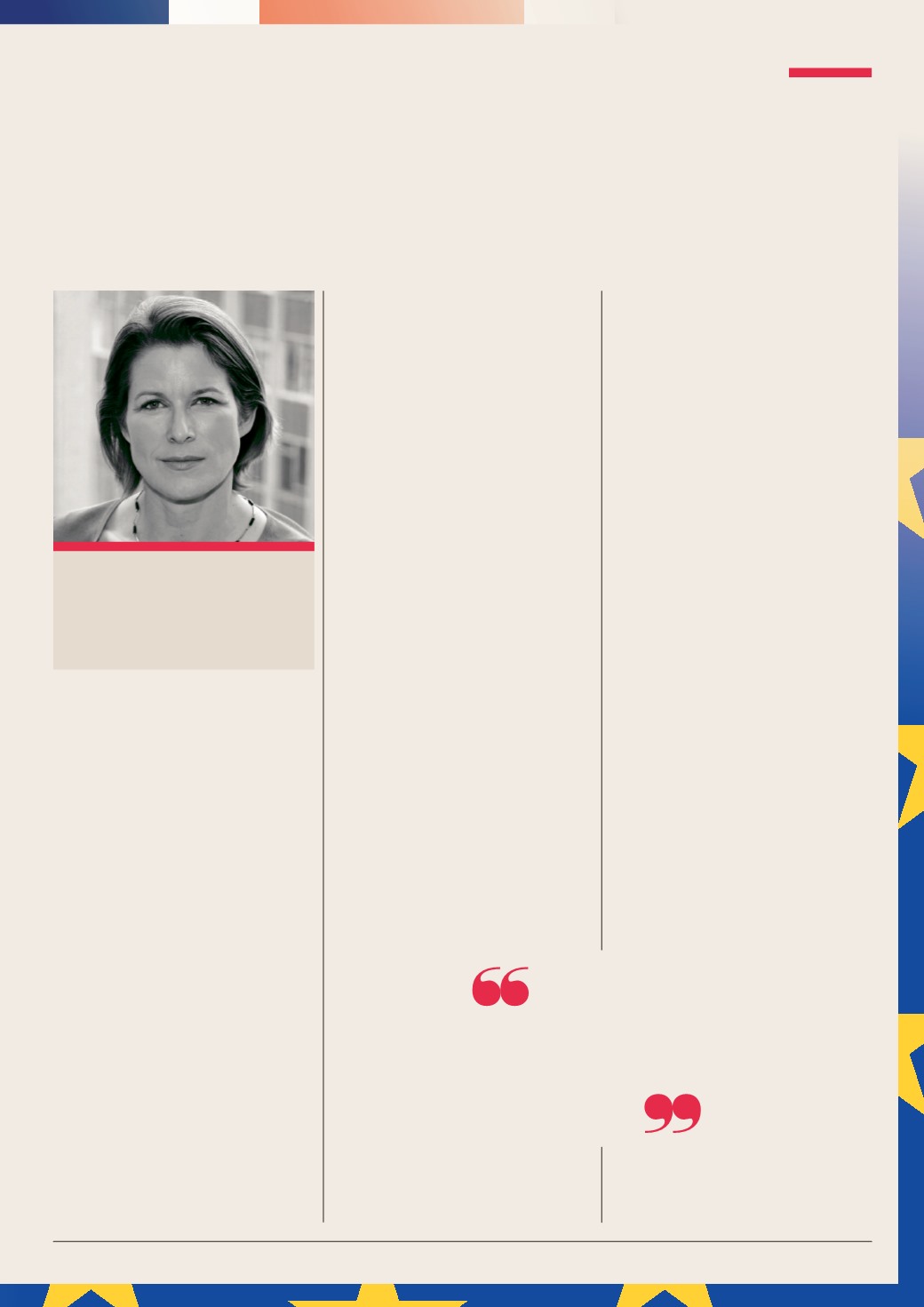
Stephanie Flanders
Chief Market Strategist
for Europe, JP Morgan
Asset Management
Getty Images