



 8 / 40

08
|
THE INVESTOR
Even the European
Commission has come
upwithwide-ranging
proposals for the
future of the EU
established mainstream politician, is
running as an outsider with an untried
political party called
En Marche!
.
And we shan’t fully know the fate of the
mainstream political establishment in
Europe until 24 September,when
Germany goes to the polls.
At the start of the year it was assumed
that Germany would, not without
reluctance, returnMerkel to a fourth term
in o ce.After 12 years many voters have
tired of
Mutti
.Her decision in 2015 to open
the country’s borders to what became more
than a million
1
refugees cost her support and
red up more extreme voices,most notably
the right-wing
Alternative für Deutschland
.
And yet there was still no real alternative;
until, that is, the Social Democrats – junior
partners inMerkel’s Christian Democrat-
led‘grand coalition’ government – made
the surprise decision to opt for Martin
Schulz as their candidate.Though a former
president of the European Parliament and
rmly pro-EU, Schulz has been able to cast
himself as a newcomer.His attacks on
austerity and calls for more workers’ rights
have gone down well.His personal story –
footballer, former alcoholic, apprenticeship
as a bookseller – is seen as a refreshing dose
of authenticity.All in all, there has been
a whi of populist tactics, albeit delivered
from the centre and with familiar policy
positions.Voters seemed to approve: the
SPD’s poll ratings have reclaimed levels
not seen for years.‘He will make her ght,’
says Constanze Stelzenmüller of the
Brookings Institution.
This is certainly a welcome development.
Eight of Merkel’s 12 years in o ce have
been in a grand coalition of Germany’s two
biggest parties.This has underpinned
Merkel’s dogged policy of colonising the
political centre-ground at home and come
at a time when, almost imperceptibly,
Germany has been establishing itself as a
‘normal’,more active international power.
At the same time German political
culture has been harmed.The closer the
two main parties embrace, the more their
support falls as voter apathy and cynicism
sets in.The bene ciaries are the smaller,
more extreme parties.A revived SPD
under Schulz, bringing with it a variety of
alternative,multi-coloured coalition
options, could change that.
The arrival of Schulz has also stimulated
much speculation about how he could
change the European political landscape.
Ahead of the rst round of the French
presidential elections there was much talk
of a revival of the fabled Franco-German
motor behind the EU.This would reform
the EU’s structures, opening the way for a
‘multi-speed’ Europe, overcome the bitter
impasse over eurozone policy, put an end to
austerity, re up investment and restore
growth – or so went the thinking.
The reality may prove di erent. In
Germany there are months of campaigning
left to go. Regional elections in the state of
Saarland at the endofMarch sawan increased
vote for Merkel’s Christian Democrats and
only marginal gains for the SPD, suggesting
that the
Schulz-E ekt
may not be as
powerful as pundits initially claimed.
Nevertheless, across Europe as a whole,
observers say that, even if unsuccessful, the
emergence of new candidates has opened
up the potential for a di erent,more
constructive politics.Debate has been
stimulated. Even the European
Commission has come up with wide-
ranging proposals for the future of the EU.
Europeans would certainly appreciate
that.As well as improving the lives of the
millions who su ered the hardships
wrought by the nancial crash of 2008 and
the eurozone debt crisis, it would inject
new life into the continent’s politics.
Yet it would not be a heal-all.The
problems that confronted Europe at the
start of the year still exist.And analysts
worry that the underlying model is broken.
‘The risks are still there,’ says Stelzenmüller,
citing the vulnerabilities of representative
democracy, the apparent failure of markets,
and fraying of social contracts.
Even if the European centre holds in
2017, it feels as though we are at an
in ection point. Politics and the
mainstream parties won’t ever be the same.
Frederick Studemann is the
FinancialTimes
Comment and Analysis Editor
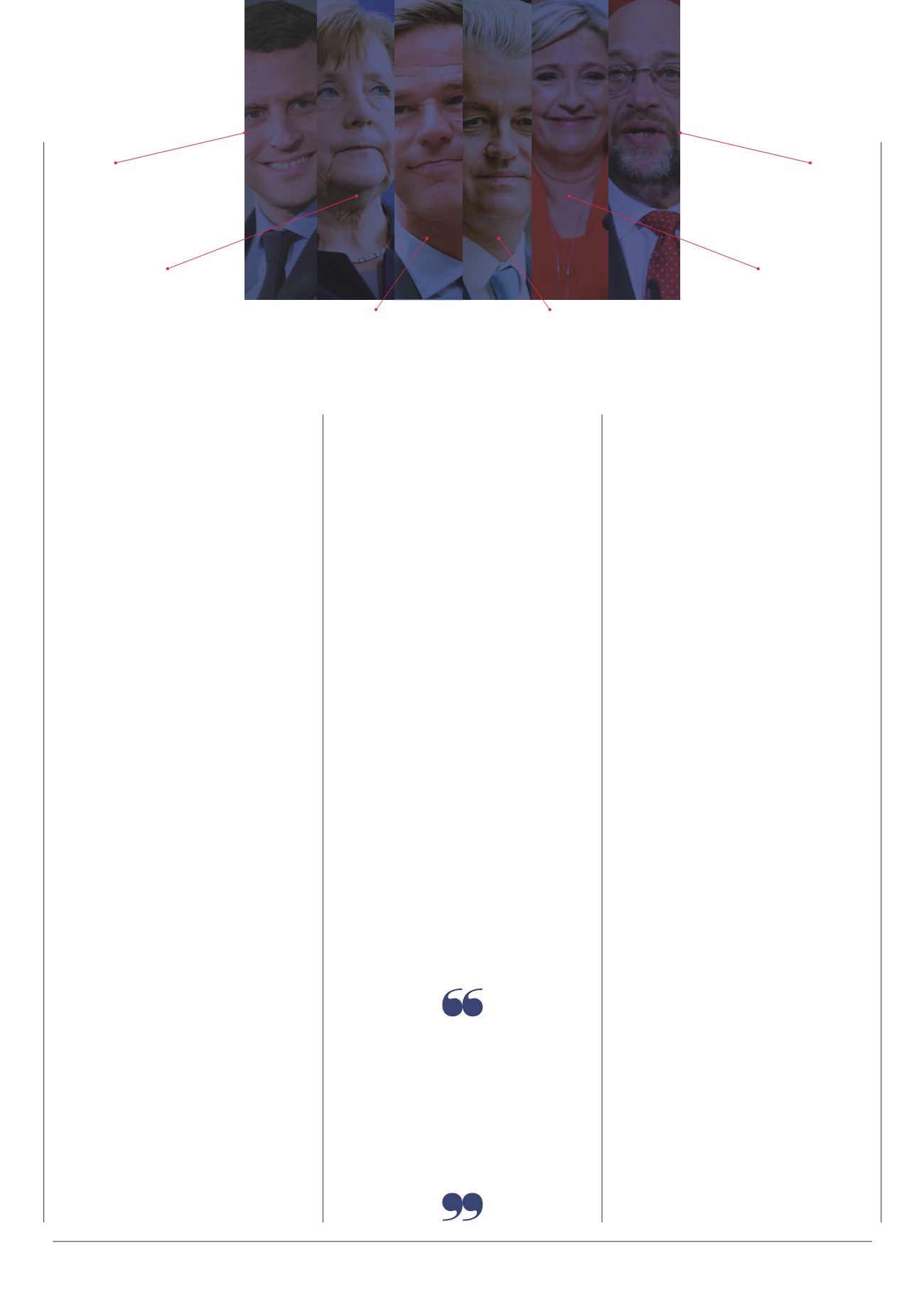
EMMANUEL
MACRON
Socialist Party
France
MARTIN
SCHULZ
Social Democratic
Party
Germany
ANGELA
MERKEL
Christian
Democratic Union
Germany
MARINE
LE PEN
National Front
France
MARK RUTTE
People’s Party
for Freedom and
Democracy
Netherlands
GEERT
WILDERS
Party for Freedom
Netherlands
Getty Images. Source: 1 bloomberg.com, January 2016