



 13 / 40

military conflict on the Korean
Peninsula, or in the South China Sea,
or the possibility of major terrorist or
cyber attacks – especially if sponsored
by a sovereign state; these can cause
substantial harm and economic loss. If
the US and China did get into
a trade war after all, then it would
cause significant damage to the global
economy and emerging countries.And
Brexit would become a big deal for the
world if it proves to be a catalyst for the
to the 9/11 attacks, have not generally
led to major or lasting discontinuities in
the flow of trade, investment and
spending. Often policymakers have
calmed economic and commercial
nerves by easing policy or maintaining
easy policies. Most geopolitical
developments, including those going on
today, have had small-scale effects.The
major exception was in the 1970s, when
OPEC’s oil embargo, the quintupling of
energy prices, and the Iranian
Revolution generated profound
economic shocks. Nowadays, shale oil,
gas and renewables have made people
more relaxed about threats to energy
supplies and prices.
In macroeconomics, we tend to think
about geopolitical shock effects as ‘tail
risks’; that is, they lie at the extremes of
probability distribution.The trouble
with tail risks is that, if they do come to
pass, these ‘black swans’ have
catastrophic consequences.Think about
disintegration of the EU or eurozone
and, therefore, for the whole of the
post-1945 European order.These
outcomes would lead to a major
disruption in the functioning of the
world economy, in much the same way
that the financial crisis did a decade ago.
Even within our own country,
populism could have more deleterious
economic consequences than it has up
to now. For example, it could lead to
policies that produce higher inflation,
protectionism, larger fiscal deficits and
more public debt. Short-term, artificial
or poorly-crafted boosts to economic
growth that are unsustainable would
cause economic damage. Central banks
that lose their independence to populist
politicians may quickly become agents
of inflation and instability.
The global economy is not in bad shape
at the moment; though we should
remember that the world is still coming
to terms with the aftermath of the
financial crisis, and we still have to lighten
the economic burden of high levels of
national indebtedness. China, which
accounts for half of the increase in
world debt since 2005
3
, will have to
address the growing risk of financial
instability in the next two to three years,
if not sooner.The result will be a
significant, perhaps protracted, economic
slowdown.That would herald new risks
for the world economy.Meanwhile,
the stalling or partial reversal of
globalisation is a growth depressant that
remains with us, while the demographics
of ageing will compromise growth for
the foreseeable future.
All of these drags require coping
mechanisms and mitigation strategies.
The failure to find them is precisely the
kind of thing that could lead politicians
to distraction, and take geopolitical
instability to a more dangerous level.
George Magnus is an economic consultant
and associate at the
University of Oxford
China Centre
GEOPOLITICS
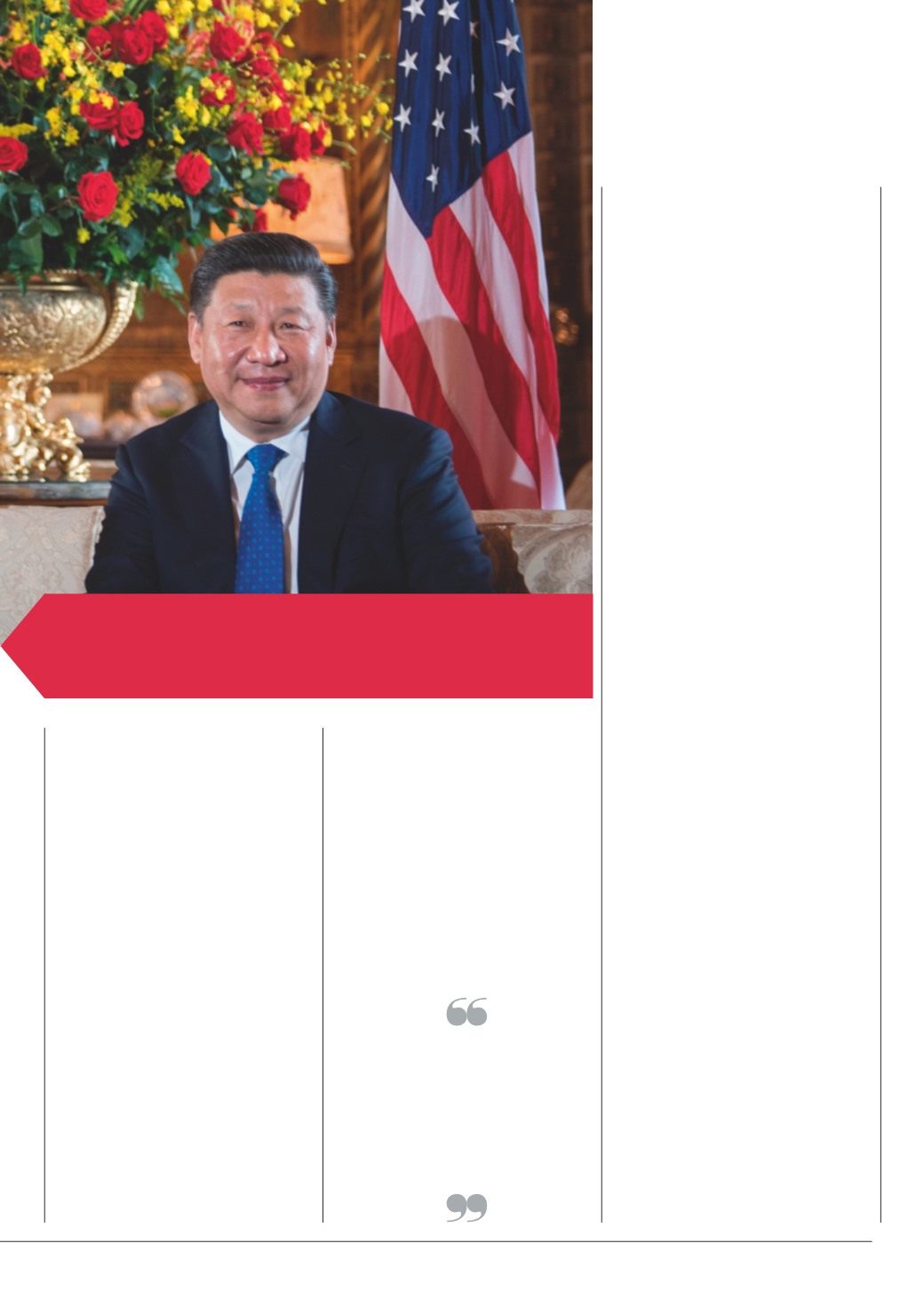
If the US and China
get into a tradewar,
significant damage
to the global economy
would ensue
TENSIONS
THE INVESTOR
|
13
IN YOUR INTEREST