



 19 / 40

India has taken a bold technological leap that now allows virtually all of its
citizens to identify themselves digitally. The Aadhaar system is ushering in
a revolution, circumventing government bureaucracy and promising to give
hundreds of millions of Indians access to loans from mainstream banks, thereby
unleashing a new entrepreneurial wave.
The country has long been viewed overseas as suffering from backward
infrastructure, stifling form-filling and corrupt officialdom. But India has
confounded expectations by signing up more than 1.1 billion citizens to what
the World Bank chief economist has described as the world’s most sophisticated
biometric personal identification system.
Matt Dreith, Portfolio Manager at Wasatch Advisors in Salt Lake City, is
convinced this will supercharge the country’s already impressive economic
growth. ‘This is transformational for India,’ he says. ‘Before, four-fifths of the
population could not get access to affordable credit from the formal finance
sector. Aadhaar will allow small entrepreneurs to launch start-ups, as well as
curb corruption in the payment of state subsidies to individuals.’
Dreith also believes that India could emerge as the global leader in fintech,
the burgeoning finance sector driven by technological innovation.
INDIA: LEADING THE WAY IN BIOMETRICS
stealth”, which has been the Indian way of doing
things, will be unlikely to suffice.’
India’s labour laws remain painfully restrictive,
which deters employers from hiring: about nine
in 10 workers toil in informal jobs without terms
and conditions.
9
Small businesses stay small in
order to avoid red tape and having to deal with
corrupt officials. It remains hard, without
political help, to buy land to build a factory.
Inefficient state-owned companies crowd out
private ones in sectors from the steel industry to
defence firms building fighter jets. Modi’s
response to many of these problems has been to
pass them down to the state level.
Publicly owned banks account for more than
two-thirds of all loans,
10
but are hamstrung by bad
debts after lending to infrastructure companies
and others to finance projects that failed to pay
off.The government shies away from tackling the
issue, for example by recapitalising the banks and
selling majority stakes to the private sector, for
fear of a public backlash against writing off bad
loans at taxpayers’ expense.
Critics say Modi indulges in glitzy gestures,
such as his ‘Make in India’ campaign, to lure
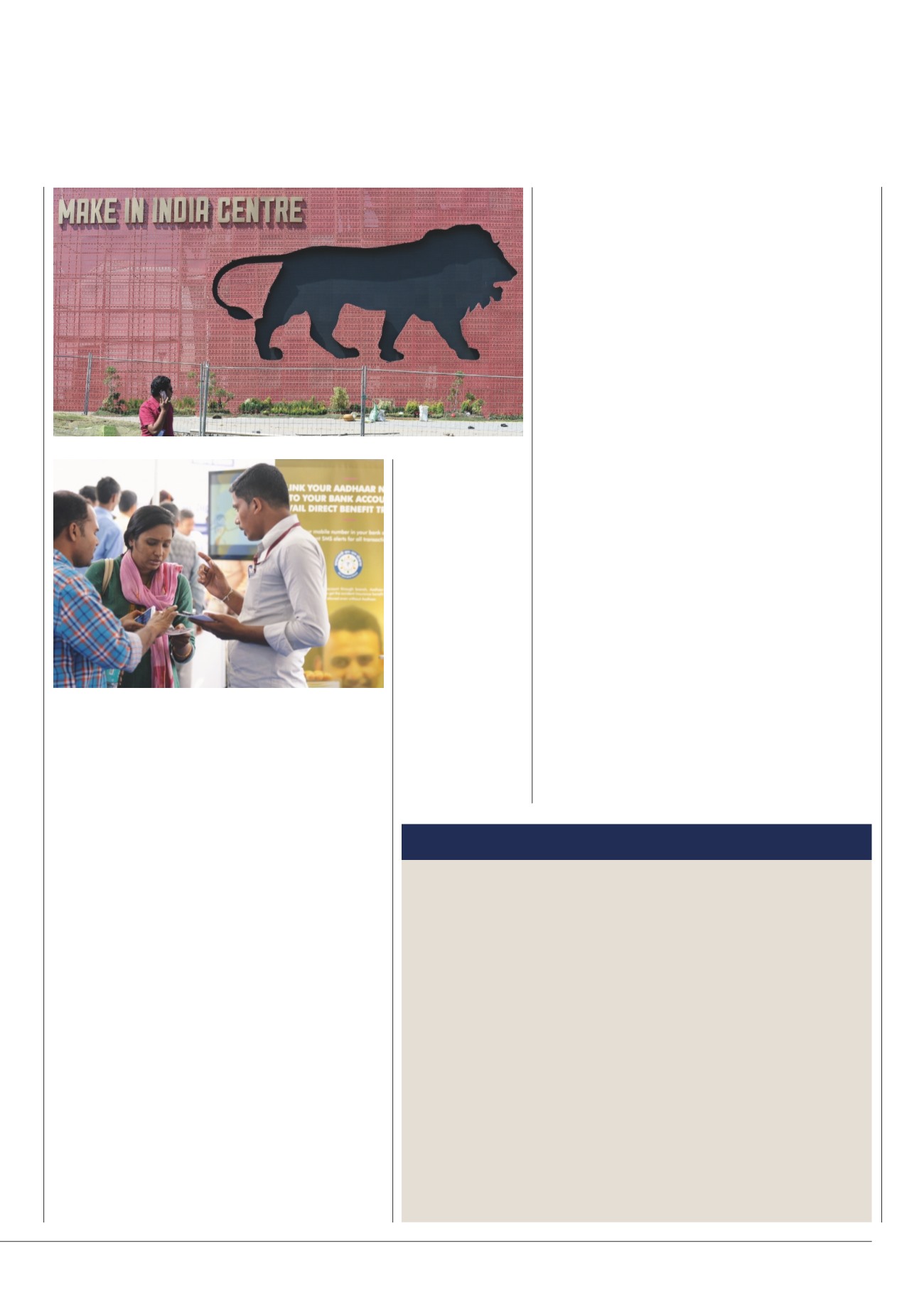
REFORMS IN ACTION
Attracting foreign
manufacturers to
India (above); using
biometrics to give
entrepreneurs better
access to loans (left)
foreign manufacturers but without tackling the
underlying problems that discourage investors.
These include poor infrastructure, lack of a
reliable power supply, a dysfunctional land
market, and weak education and training.
A worry that runs still deeper is Modi’s brand
of Hindu nationalism. Modi has a difficult
relationship with India’s Muslim community of
200 million – a 15% minority in the country
11
– and tensions are simmering. In 2002, more
than 1,000 people
12
– mostly Muslims – were
killed in ‘communal’ (or ethnic) riots in Gujarat
state while he was Chief Minister. A court
cleared him of wrongdoing, but critics say he did
not do enough to stop it happening.
Some analysts believe Modi is biding his time
on economic reform, hoping for an even
stronger mandate at the next elections for the
lower house of parliament in 2019. But he
doesn’t have a majority in the upper house,
meaning that he would have to cut deals to pass
tax, labour and land reforms.
So could India do better than it is currently
doing? The answer is almost certainly, yes. Still,
for the moment it is sustaining economic growth
rates that the rich European and North American
countries can scarcely even dream of.
Brian Groom was until recently a Senior Editor at
the
FinancialTimes
THE INVESTOR
|
19
INDIA
Alamy, Getty Images, Magnum Photos