



 9 / 40

THE INVESTOR
|
09
app cars could mean that thousands of
acres of public and private car parks,
some in prime locations, could be put
to different and better uses.
The government’s stated approach to
driverless vehicles is to leave current
laws in place but to introduce reforms
‘as we gather real-life experience’.
10
But
lawyer Alex Glassbrook, author of
The
Law of Driverless Cars
, explains that we
will be entering uncharted territory,
especially in terms of data.‘The app car
is set to be the most significant object
an individual has for giving and receiving
data about themselves, with the volume
rising massively,’ says Glassbrook.
Moreover, he cautions that new-
generation cars are likely to spawn novel
crimes; and, of course, that the car will
see the passenger as someone to whom
it can market a range of products.
Even if we can surmise the probable
direction of the transition to driverless
cars, it does not imply that it will be
easy to invest in it profitably.There is
the same difficulty reading the situation
as there was in the time of the dotcom
bubble, nearly 20 years ago. Forecasts
that the internet would be the next big
thing were of course correct; but more
start-ups fail than become anAmazon
and even the successful ones don’t
always generate a profit in the first few
years. Hence some fund managers
suggest it may be wiser to pick winners
from among the less glamorous
incumbents if these companies have solid
cash flow and can afford to reinvent their
business model.Toyota, for example, has
been helped by its early lead in hybrid
car technology andVolvo has set the pace
by claiming it will be the first premium
manufacturer to go electric across its
range.
11
Even the German giants are
belatedly joining the revolution.
On the face of it, one of the asset
classes with the bleakest prospects is
that of classic cars. Until recently, steep
rises in values made it the perfect
‘passion investment’.
12
Yet in a brave
new world where ‘human driving’
becomes a costly and highly regulated
activity, that may cease to be the case.
Then again, nostalgia could make the
car you can own and drive yourself
even more an object of desire.
New-generation cars
will see the passenger
as someone towhom
it canmarket products
One of the most marked impacts of
the car’s transformation will be on
property.Town and country
development has always been framed by
the forms of transport that are current.
Wider car ownership, for example, gave
rise to urban sprawl in the 1930s.
8
Experience suggests that once driverless
cars come along, people will see this as
a chance to commute from faraway
places where they sleep – or even sleep
in the car en route. In this scenario, a
larger and cheaper house outside the city
could reduce the price differential
between urban and rural areas.
9
Property developers might no longer
be required to provide parking spaces for
each dwelling.And the advent of fleets of
Future-proof
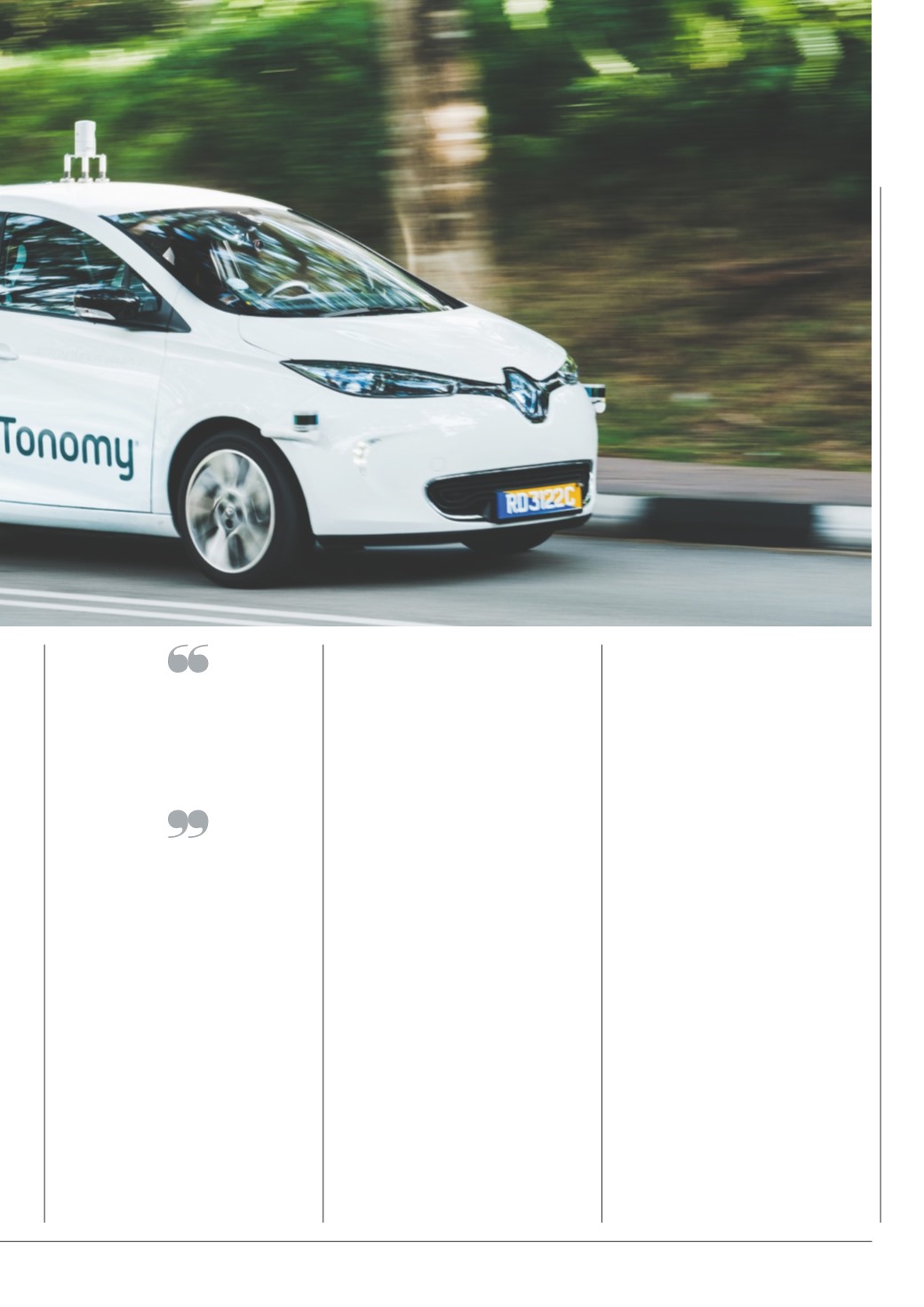
MIT spin-off
nuTonomy is pushing the development
of software for self-driving cars;
(below) there’s no need to go
to a car hire outlet when your
smartphone can find a self-drive
vehicle near your current location