



 16 / 40

xxxxxxxxxxx
16
|
THE INVESTOR
Meanwhile, Sir Richard Branson has
unveiled the prototype of a 40-seater
built by Denver-based start-up Boom
Technology, nicknamed Baby Boom.
This would make its first commercial
flight around 2023 with the price of a
ticket between London and NewYork
set at $5,000 return.With a cruising
speed of Mach 2.2 or 1,687mph, this
would be faster than Concorde and
nearly three times quicker than
lumbering subsonic airliners.
At the moment there are
prohibitions on civil aircraft sonic
booms over land. Some developers are
seeking to minimise the noise through
the aircraft’s shape, others via
advanced new technology (including
using electromagnetic elds to generate
a plasma eld around key parts of the
craft and improve laminar ow), while
a third category is simply planning to
fly supersonic only above oceans.
So will these fly? Grabar says: ‘I
imagine only one or two will make
it. But I don’t doubt that there is a
market.The super-rich, the top 1%,
represent a signi cant market travelling
between the world’s major cities.
They are prepared to pay two to three
times the price to save a few hours.’
Oddly, the other big thrust is
towards smaller, slower aircraft. Uber,
for example, has published a concept
paper giving a glimpse of a future
where flying cars take us one step
closer to a
Blade Runner
-type future.
Fleets of autonomous, helicopter-like
vehicles would fly around megacities,
cutting our daily commuting time
by nearly 90% for a price that
could ultimately be the same as a
taxi ride.
This would once have been scoffed
at. But Antoine Gélain, Managing
Director at Paragon European
Partners, comments: ‘As people
start rethinking transport in three
dimensions and flying becomes an
integral part of individual mobility
scenarios, traditional air travel – on
large airplanes, to and from distant
airports, on fixed schedules and
limited routes – will increasingly
look old-fashioned. Airlines may
rebrand themselves as luxury cruise
operators. Boeing and Airbus may keep
battling it out, but they will lose their
status of industry trailblazers.’
Although we would need both,
enthusiasts claim that with advanced
precision positioning technologies,
it may turn out to be easier and safer
to operate and monitor fleets of
small, self-driving air vehicles over
land than it is to track large
transcontinental airliners flying over
oceans, given the vast mid-ocean
spaces with no radar. And the prospect
of flying cars envisaged by Uber
dovetails neatly with the supersonic
jet projects in their appeal to that key
market: the super-rich – striving to
move seamlessly around and between
major cities like Shanghai, London
and NewYork.
There is one fly in the ointment –
regulators such as the Federal Aviation
Administration in the US.Their
plodding approach, so different from
SiliconValley’s culture, is a prime
reason why air travel worldwide is
so dull but safe.They don’t relish
working with start-ups. So will they
yield to this intrepid new culture,
where speed to market is at a
premium, embracing artificial
intelligence? On the one hand, the
pace at whichTesla is winning
acceptance of its self-driving car
systems is an encouraging sign. But
many regulators – and not a few
nervous flyers – may still feel air travel
needs to take things slowly.
The super-rich
are prepared to pay
two to three times the
price to fly to save
a fewhours
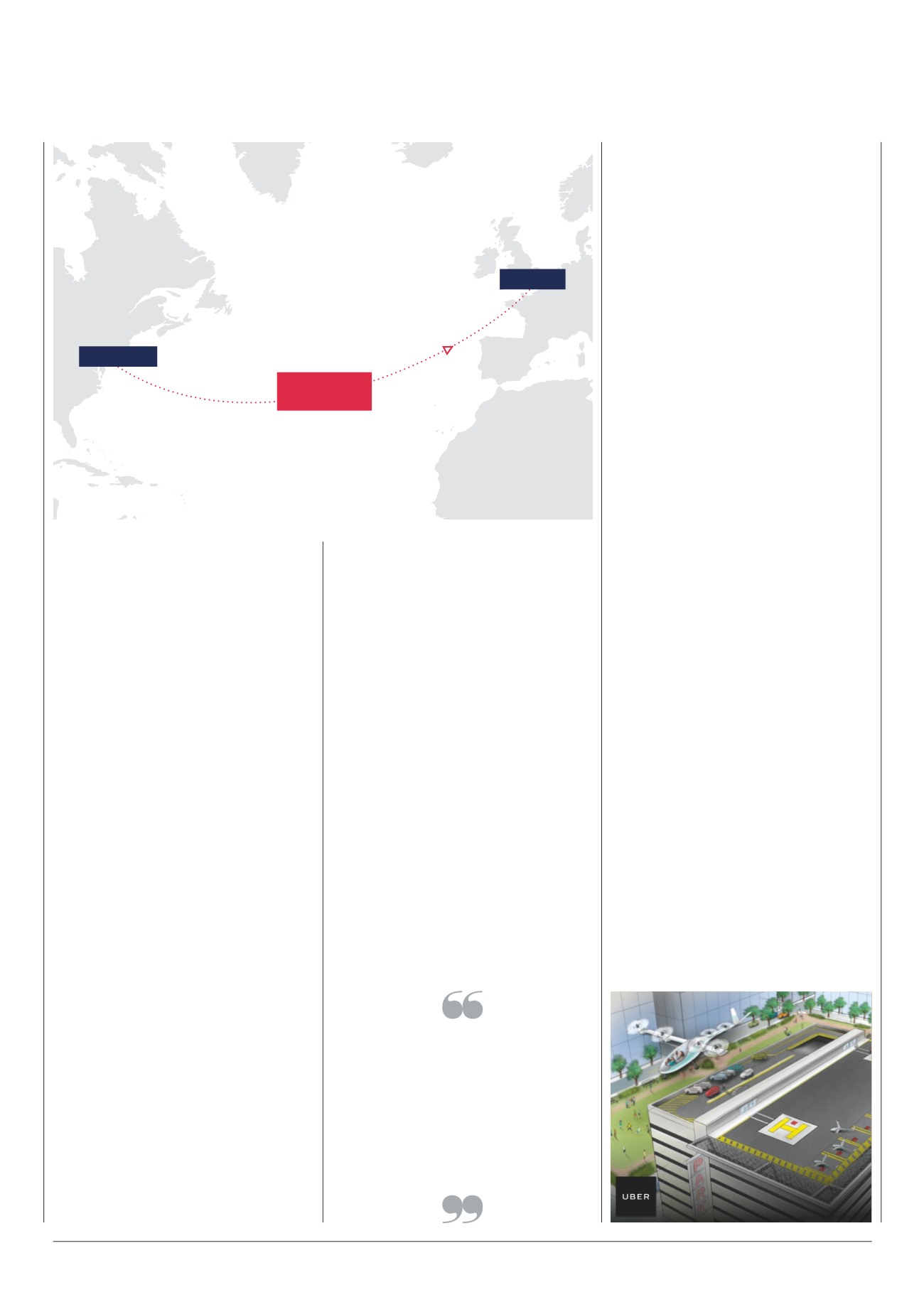
LONDON
NEW YORK
3 HOURS
15 MINUTES
4
BOOM
TECHNOLOGY’S
PLANE COULD FLY
FROM NEW YORK
TO LONDON IN
UBER FAST
Driverless, flying cars could be
a reality sooner than we think
Source: 4 boomsupersonic.com, March 2016