



 7 / 44

THE INVESTOR
|
7
I
t’s been 25 years since the
dramatic break-up of the once-
mighty USSR.Two key events
have shaped the direction of what
was the Soviet Union since then,
according to John MacLeod, Senior
Analyst for Russia and Commonwealth
of Independent States at Oxford
Analytica:‘First, the creation of modern
Russia and the other successor states;
and second, the arrival of Putin.’
Yet as DavidWoodruff,Associate
Professor of Comparative Politics at the
LSE, points out, the underlying processes
leading to the break-up began in the
1980s.Then-premier Mikhail Gorbachev
adopted freedom of expression and
openness (glasnost) and restructured
the command economy (Perestroika),
where the government decided what,
and howmuch, should be produced, and
the price of those goods.
The BerlinWall had fallen and former
Warsaw Pact countries in Central
Europe left the Soviet fold. By 1991,
the Union itself was threatened.
‘Gorbachev’s reforms released dynamics
that the Conservatives felt they couldn’t
control,’ observesWoodruff.‘They
wanted to put the brakes on.’
So inAugust 1991, when the
Gorbachevs were holidaying in Crimea,
Conservatives in the military and security
forces placed the president under house
arrest. Popular protests erupted across
Russia and non-Communist politicians
in the Duma (parliament) seized the
initiative. Boris Yeltsin famously climbed
on a tank outside theWhite House in
Moscow, and the military withdrew.
‘It was a failed coup,’ saysWoodruff.
‘The Communist Party was discredited
and the only leaders left were those
recently voted into the legislatures,
many of whom were more radical and in
favour of secession from a Soviet Union,
which no longer had working structures.’
On Christmas Day 1991, Gorbachev
resigned and within days the Soviet
Union ceased to exist.Yeltsin and his
allies only accelerated the dismantling
of the old command economy.
Woodruff sees the enforced and
comprehensive privatisation of state assets
by free-market liberals as politically
driven.‘It made economic reform
irreversible,’ he says.‘But it was rushed
and the new “owners” – workers,
managers and outside investors – had
little reason to work together.There
were long battles over property rights
and a lot of lawlessness.’The end result
was capitalism and the rise of cronyism.
‘The end of price regulation in early
1992 led to hyperinflation,’ he adds.
‘Former Soviet states were locked into
a single currency, but each had its own
central bank issuing notes. Inflation rose
above 1,000%. People’s savings became
worthless. But whereas in late 1991 there
was nothing to buy, a year later goods
were for sale, although very expensive.’
Another economic crisis in 1998 –
Russia’s sovereign default and the
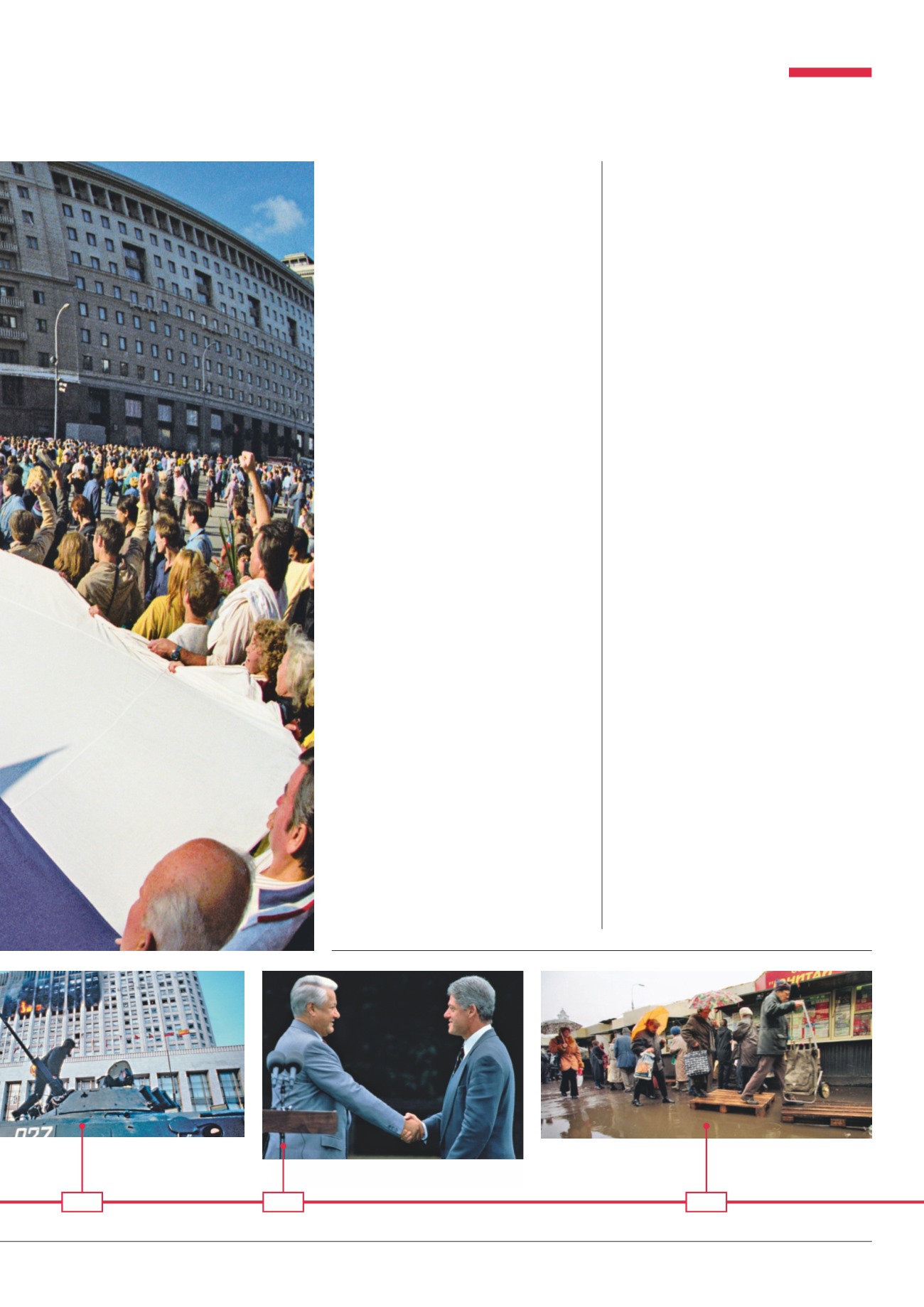
The Russian parliament – the
White House – in flames
during the failed 1993
coup against Yeltsin
The economic crisis of
1998 precipitated the
rise of Vladimir Putin
Muscovites celebrate a victory for democracy in
Manege Square with a massive Russian flag in August 1991
1993
1998
1995
Presidents Boris Yeltsin and Bill Clinton shake
hands at a New York press conference
ECONOMY
ANALYSIS