



 8 / 44

8
|
THE INVESTOR
ANALYSIS
collapse of the ruble – led to the rise
of Vladimir Putin.‘Most people thought
he was a puppet,’ says MacLeod.‘A
former KGB officer, he built a consensus
with most of the business oligarchs and
the mafia to create a new model.
‘What he offered the Russian people
was prosperity and stability at the cost
of liberties – including freedom of the
press and other media. Most people
were grateful for the rising oil prices and
the return of Soviet-style stability.’
Berenberg Bank’s Equity Strategist for
Emerging Europe, Carsten Hesse, notes
that during his first two presidential
terms Putin was more ‘market-friendly’.
Western investment was encouraged.
Among the grand projects of those years
were building Moscow into a global
financial centre and interim President
Medvedev’s plan to create a Russian
version of SiliconValley outside the
capital – neither have come to pass.
‘They received a subdued amount of
foreign investment,’ says Hesse,‘because
of the relatively high level of corruption,
economic sanctions, falling commodity
prices and weak rule of law.’
Ajay Krishnan of Wasatch, Lead
Portfolio Manager of the Emerging
Markets Equity fund for St. James’s Place,
says:‘Until four years ago, we had a
reasonable exposure to Russia, but we
changed our stance in 2014.The invasion
of the Crimea was a serious event and
there was no way of calling an end game,
no logic to Putin’s interests.
‘Where many Russians used to travel
abroad, the weak ruble encourages them
to stay at home.The wealthy are buying
property in Russia.There has been a lot
of import substitution, with people
encouraged to buy local products.
‘While retailers selling imported
goods are hurt, the government has
moved to kick-start the local economy.
As such we recently added back into the
portfolio a discount supermarket called
Lenta, which has been growing its
business as recession pushes more people
into that customer segment.’
But,‘Overall the economy is stagnating
and stands in need of structural reforms,’
says Hesse, who sees GDP flatlining in
2017. Moreover,‘any oil price-related
recovery will be held back by the ruble’s
weakness because as the oil price rises,
the currency will likely strengthen, which
limits government spending power and
dilutes the benefits to the economy.’
MacLeod notes that ‘the last two years
have seen an erosion of real incomes, so
the Kremlin has shifted from delivering
prosperity to a more political appeal
through showing its military might.’
‘It’s hard to tell where Putin will lead
the country,’ says Krishnan.‘Will he be
satisfied with “successes” in Crimea,
Ukraine and Syria? As NATO looks
increasingly weak, Putin may become
more aggressive.A lot depends on
his bid to remain president in 2018.
‘Only then will there be a clearer
picture of how Russia, its economy and
finances might fare in the future.’
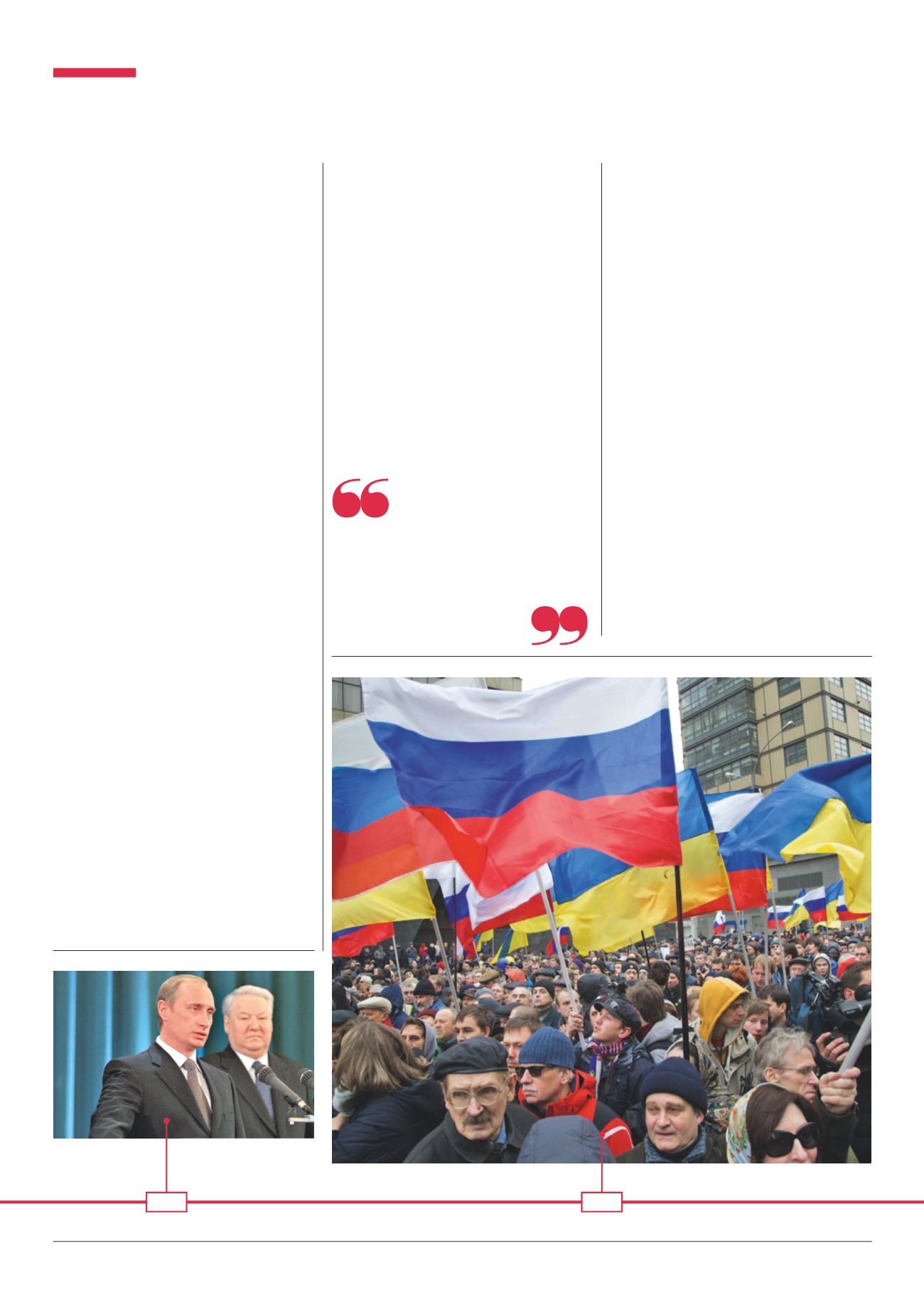
Demonstrators hold Russian and Ukrainian flags in
Moscow while opposing Putin’s intervention in Crimea
ECONOMY
Overall, the economy
is stagnating and
stands in need of
structural reforms
2000
2014
Putin takes over office as
leader from Boris Yeltsin
Getty Images, Press Association