



 7 / 40

THE INVESTOR
|
07
25TH ANNIVERSARY
01011100100101
10011000101010
01101010001000
1001001001001
001011100011100
10101010100101
11001001011011
01011100100
1011001100
01010100110
1010001000
10010010010
01001011100
01100101010
T
he internet
has been
one of the
great trans-
forming
factors of
the past 25 years.A survey by
the Boston Consulting Group
found that 77% of respondents
in the US
1
would rather give up
chocolate for a year than lose
access to the internet.
There are estimated to be 3.4 billion users of the internet as of
December 2016, which represents 46% of the world’s population.
Yet it was only in the late 1980s that computer scientistsVint
Cerf and Bot Kahn developed the protocol to allow computers
on the world’s mini-networks to communicate with each other.
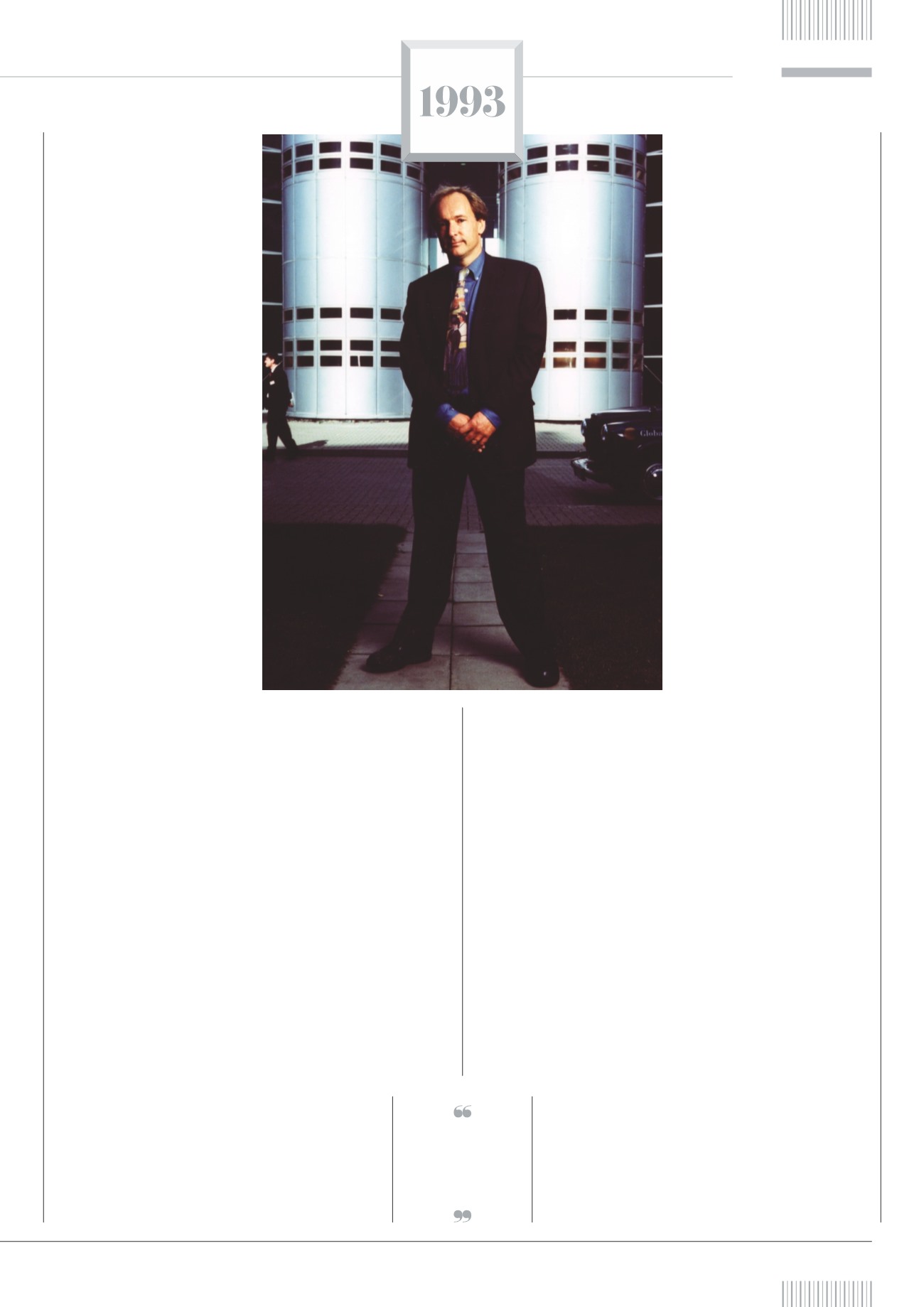
In 1991Tim Berners-Lee created a web of information
that anyone could access; and shortly afterwards the rst web
browser,Mosaic, was invented.
Google’s search engine was launched in 1997 whileThe Sims,
the world’s best-selling computer game, went live in 2000. In
2004 Mark Zuckerberg launched what was then known asThe
Facebook.As ofApril last year Facebook had 1.79 billion monthly
active users. Google Maps began life in 2005 while Twitter
emerged in 2006, and has around 320 million active users
2
.
The internet has had a huge economic impact.Across the world’s
13 biggest economies,which create 70% of global gross domestic
product (GDP), it is estimated to account for some 3.4%. In the
UK alone the internet accounts for 6% of GDP
3
.
Its e ects have been dramatic in the developing
world, where internet-enabled technology is bringing
about economic change on an unprecedented scale.
Internet revenues are growing at 40% a year in India,
while in China and Brazil they are growing at an
annual rate of 25%, similar to the US
4
.
Perhaps surprisingly, the
internet’s greatest impact has
been outside the IT sector.
McKinsey & Company
estimates that as much as
75% of the bene ts from the
internet go to companies in
traditional businesses such as
automobile manufacturers
and retailing
5
. In China, where
there are relatively few large
retail malls outside the three largest cities, online sales have
already outstripped those in the US.
The internet is also a great social and economic leveller.Any
entrepreneur can set up a business with immediate access to a
global marketplace. Data can be stored in the cloud rather than
in physical servers, while middlemen are becoming a thing of the
past in many industries. For consumers, the bene ts of the internet
have been considerable, not least in helping to drive down prices.
The next big step is the‘internet of things’, where devices of
all kinds will connect.This will bring dramatic advances in many
areas – its potential is enormous.
New technologies will go on shaping what we can do as more
and more people use the internet.The need to access big data –
large data sets generated from every internet interaction – is just
one example. Using this data creatively could help to transform
operations from insurance to recruitment, and have profound
e ects in healthcare and education over the next decade.
However, the use of big data and machine learning could
also work against us.TheWorld Economic Forum
predicts that ve million people will be displaced
from their jobs because of new technology by 2020
6
.
So we have to be smart and exible.The internet
has accelerated the drive towards the survival of
the ttest economically, and it has also brought
opportunities across the world and hope to many.
In 1993,Tim Berners-Lee advocated the release,
royalty-free,of the world wide web standard he
had created,unleashing a wave of innovation
TECH GAINS
BY HEATHER FARMBROUGH
There are
estimated to be
3.4 billion users of
the internet today
1 bcg.com, March 2012; 2 adweek.com, April 2016; 3, 4 bcg.com, March 2012; 5 mckinsey.com, April 2016; 6 weforum.org, January 2016
1992–2017